Skip to content

Cart

Your cart is empty

Sodium Benzoate Powder

INCI: Sodium Benzoate · CAS: 532-32-1

≥99.0%Assay specification
High-purity, USP-conforming preservative powder with defined analytical and microbiological specifications.
USP conforming
Defined microbial limits
Flexible preservation design
Sale price$32.95
Available in:

Available to order

Sold by weight (g or Kg) for formulation accuracy.

Calculate quantity needed +
Recommended use levels

0.1–1.0%

Excludes processing loss and retained samples. The calculation does not establish a suitable or effective use level.

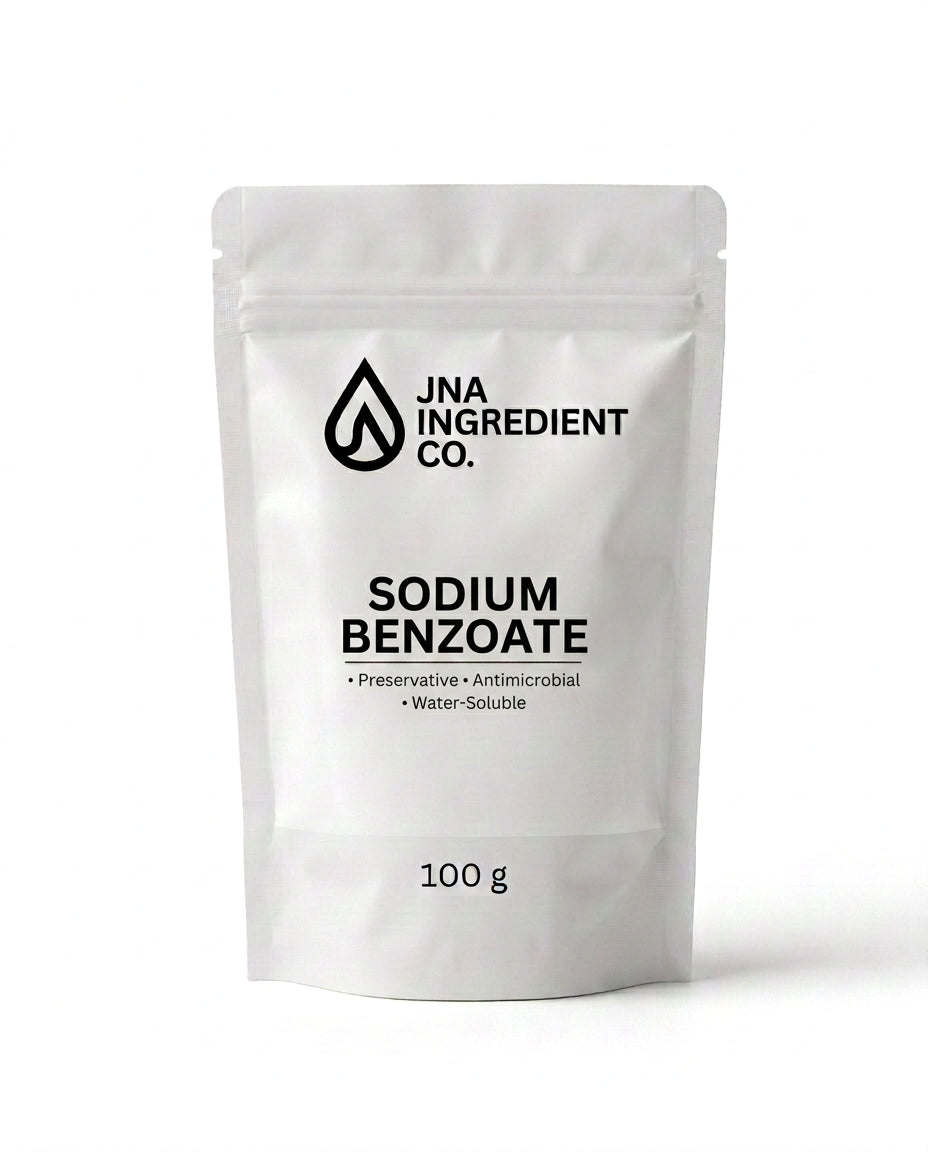
JNA Ingredient Co. Sodium Benzoate cosmetic‑grade preservative in minimalist packaging for microbial protection and formulation stability in skincare products
Sodium Benzoate Powder1 Kg Sale price$32.95
Australianowned & operated
Trusted byformulators
Quality ingredientsfor real results
Wholesale & bulk supply enquiriesTell us your ingredient, quantity and timeframe

Our Sodium Benzoate

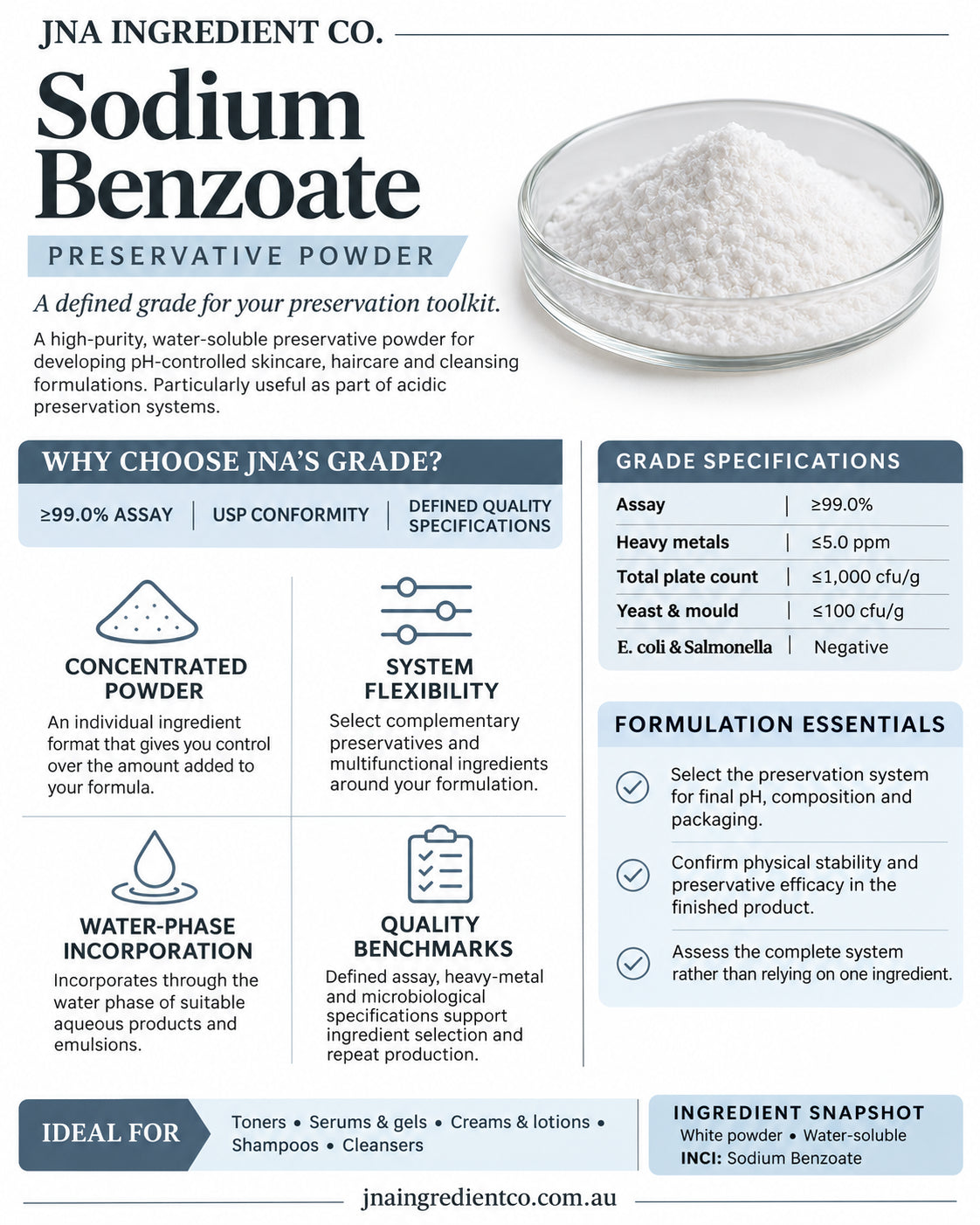
Build your preservation system around a clearly defined grade. JNA’s Sodium Benzoate is a high-purity preservative powder with a minimum 99.0% assay specification and documented USP conformity, suited to developing pH-controlled skincare, haircare and cleansing formulations.

Our grade is supported by analytical specifications covering loss on drying, total ash, heavy metals and microbiological quality. These give you measurable raw-material quality benchmarks for development and repeat production, alongside the concentrated assay.

The individual powder format gives you flexibility to select complementary preservatives and multifunctional ingredients around your own formula. Incorporate it through the water phase of suitable toners, serums, gels, lotions, creams, shampoos and cleansers, with the preservation system selected for the product’s final pH, composition and packaging.

Sodium Benzoate is particularly useful in acidic preservation systems. Confirm the complete formulation’s physical stability and preservative efficacy rather than relying on the presence of any one ingredient.

Why choose JNA’s Sodium Benzoate?

  • High Purity - ≥99.0% AssayA defined minimum assay gives you a concentrated preservative powder and a clear quality benchmark for formulation development and repeat purchasing.
  • Documented USP ConformityOur grade is supplied with stated conformity to the USP standard, adding a recognised quality reference to the material’s assay and analytical specification.
  • Defined Quality ControlsSpecifications cover loss on drying, total ash, heavy metals and microbiological quality. These measurable criteria help you assess the raw material beyond appearance or purity alone.
  • Flexible Preservation DesignThe individual powder format lets you select complementary preservatives and tailor the system to your product’s pH, ingredients and packaging, rather than working around a fixed liquid blend.

KEY SPECIFICATIONS

Know what you’re formulating with.

≥99.0%

Assay specification

INCI
Sodium Benzoate
Otherwise known as
Sodium Salt of Benzoic Acid; Benzoate of Soda
CAS number
532-32-1
Grade
Cosmetic grade - documented USP conformity
Appearance
White powder
Assay specification
≥99.0%
Solubility
Water soluble
  • USP Conforming

    Conforms with USP standards

  • ≥99% Assay

    Specified assay of at least 99%.

  • Water Soluble

    Dissolves in water for incorporation into aqueous formulations.

  • Microbial Quality Controls

    Microbiological acceptance limits form part of the ingredient specification.

QUALITY · SOURCING · SAFE HANDLING

Selected for specification.

Ingredient name is the beginning. Specification is the difference.

We select our ingredients for the quality behind the name: the right grade, defined purity or composition, clear origin and consistent specifications.

Our focus is dependable ingredients, supported by clear technical information, that you can formulate with confidence and rely on for repeat production.

Need more information about this ingredient
Formulation & Processing

Processing

Weigh accurately and dissolve in a suitable portion of formulation water with mixing. Confirm complete dissolution before introducing the premix into the batch. Dissolution and incorporation should be checked within the processing conditions used for the complete formulation.

Check the final pH after adding the remaining ingredients and again after the product has cooled and equilibrated. Record the addition order and processing conditions so the method can be reproduced.

Compatibility

Develop Sodium Benzoate as part of a preservation system matched to the complete product. Complementary preservatives or multifunctional ingredients may be needed to achieve the required microbial coverage.

Potassium Sorbate is one possible partner in suitable acidic formulations. The combination does not automatically establish broad-spectrum protection. Select concentrations and final pH around the complete system and confirm performance through preservative efficacy testing.

Assess the effect of salts on electrolyte-sensitive thickeners and surfactant systems. Recheck viscosity and physical stability after the final pH adjustment.

pH guidance

Preservative activity is pH dependent and is generally favoured by acidic conditions. As pH rises, the proportion of active undissociated benzoic acid decreases. Select the finished pH around the complete formula and preservation system, then verify efficacy and pH stability.

Troubleshooting

Crystals or haze after pH adjustment: review dissolution, premix concentration and final pH. Converting more benzoate to benzoic acid can reduce the amount that remains dissolved; simply reheating a sample may not resolve storage stability.

Viscosity changes: review the combined electrolyte level, thickener choice and final pH. Compare small controlled trials before changing the full formula.

Unsatisfactory preservation testing: review microbial coverage, dose, final pH, incorporation, manufacturing hygiene and packaging. An unchanged appearance or a satisfactory initial microbial count does not establish ongoing protection.

Grade & analytical controls

Loss on drying: ≤5.0%. Total ash: ≤5.0%. Heavy metals meet specification.

Microbiological limits: total plate count ≤1,000 CFU/g; yeast and mould ≤100 CFU/g; E. coli and Salmonella negative under the specified tests.

INCI: Sodium Benzoate. CAS: 532-32-1. Water-soluble preservative powder.

USP conformity is stated in the technical documentation for the supplied grade. Raw-material assay and microbiological specifications describe the ingredient’s quality; preservation efficacy is assessed in the finished formulation.

Heavy metals meet specification. Total plate count ≤1,000 CFU/g; yeast and mould ≤100 CFU/g; E. coli and Salmonella negative under the specified tests.

Storage & shelf life

Store tightly closed in a cool, dry place away from direct sunlight, heat and moisture. Keep separate from strong oxidising agents.

Documented shelf life: 24 months under the recommended storage conditions. Follow the applicable product-label expiry or retest date. The raw powder’s shelf life does not establish the shelf life of a premix or finished formulation.

Handling & product safety

Use clean, dry dispensing equipment and reseal promptly. Avoid generating dust and prevent water or other formulation ingredients from entering the original container. Label any prepared solutions separately and establish their own storage conditions.

Supplied as a concentrated raw material for incorporation into formulations. Avoid generating or breathing powder dust and avoid contact with eyes. Wear appropriate protective clothing, gloves and eye protection. Refer to the SDS for safe handling, storage and first-aid guidance.

Raw-material information does not establish the safety of the finished product. Assess the complete formulation for safety, stability, preservation and suitability for its intended use.

Documentation
Shipping & supply

Shipping charges and delivery options are confirmed at checkout. For supply quantities beyond the listed packs, contact JNA with your requirements.

View shipping information ↗
Need more information about this ingredient

Practical Questions About Sodium Benzoate

What distinguishes JNA’s Sodium Benzoate grade?

Our grade is supplied to a minimum 99.0% assay specification with documented USP conformity. Specifications also cover loss on drying, total ash, heavy metals and microbiological quality, giving you defined material-selection criteria beyond the ingredient name alone.

Why does the finished product’s pH matter?

Sodium Benzoate belongs to an organic-acid preservative system. Its antimicrobial activity depends on the amount present as undissociated benzoic acid, which is favoured by acidic conditions. Increasing pH reduces that proportion. Select the final pH around the complete preservation system and confirm that it remains suitable during storage.

Is Sodium Benzoate enough to preserve a product on its own?

Do not assume that a single ingredient will provide the required protection. Performance depends on concentration, pH, other ingredients, manufacturing conditions and packaging. Complementary preservatives may be needed; preservative efficacy testing establishes whether the complete system provides adequate protection.

Can I use it with Potassium Sorbate?

Yes, the two can be considered together in suitable acidic formulations. Both depend on the finished conditions, and their combination is not automatically a validated broad-spectrum system. Evaluate the selected levels, physical compatibility and final pH, then test preservation in the actual product.

Why might crystals appear after acidifying the formula?

Lowering pH shifts more benzoate towards benzoic acid, which is less water soluble. Concentration, temperature and other ingredients can then affect whether everything remains dissolved. Check the final formula after cooling and during storage; temporary clarity after warming does not demonstrate long-term stability.

How does a raw-material microbial specification differ from challenge testing?

The raw-material specification limits contamination in the ingredient before use. A preservative efficacy or challenge test assesses how the finished formula controls deliberately introduced microorganisms over time. A compliant raw material or a low initial microbial count cannot replace that finished-product assessment.

Ingredient shortlist

Your shortlist is empty. Bookmark ingredients to keep them here while you shop.