Skip to content

Cart

Your cart is empty

Bisabolol (Alpha Bisabolol)

INCI: Bisabolol · CAS: 515-69-5 (alpha-bisabolol); 23089-26-1 ((−)-alpha-bisabolol / levomenol)

≥99.0%Purity
High-purity Alpha-Bisabolol naturally derived from chamomile for soothing, skin-comfort and sensitive-skin formulations.
Chamomile-derived
No added additives
Soothing skin-conditioning active
Sale price$35.95
Available in:

Available to order

Sold by volume (mL). Alpha-Bisabolol has a density of 0.922–0.928 g/mL. Volume and weight are not interchangeable.

Calculate quantity needed +
Recommended use levels

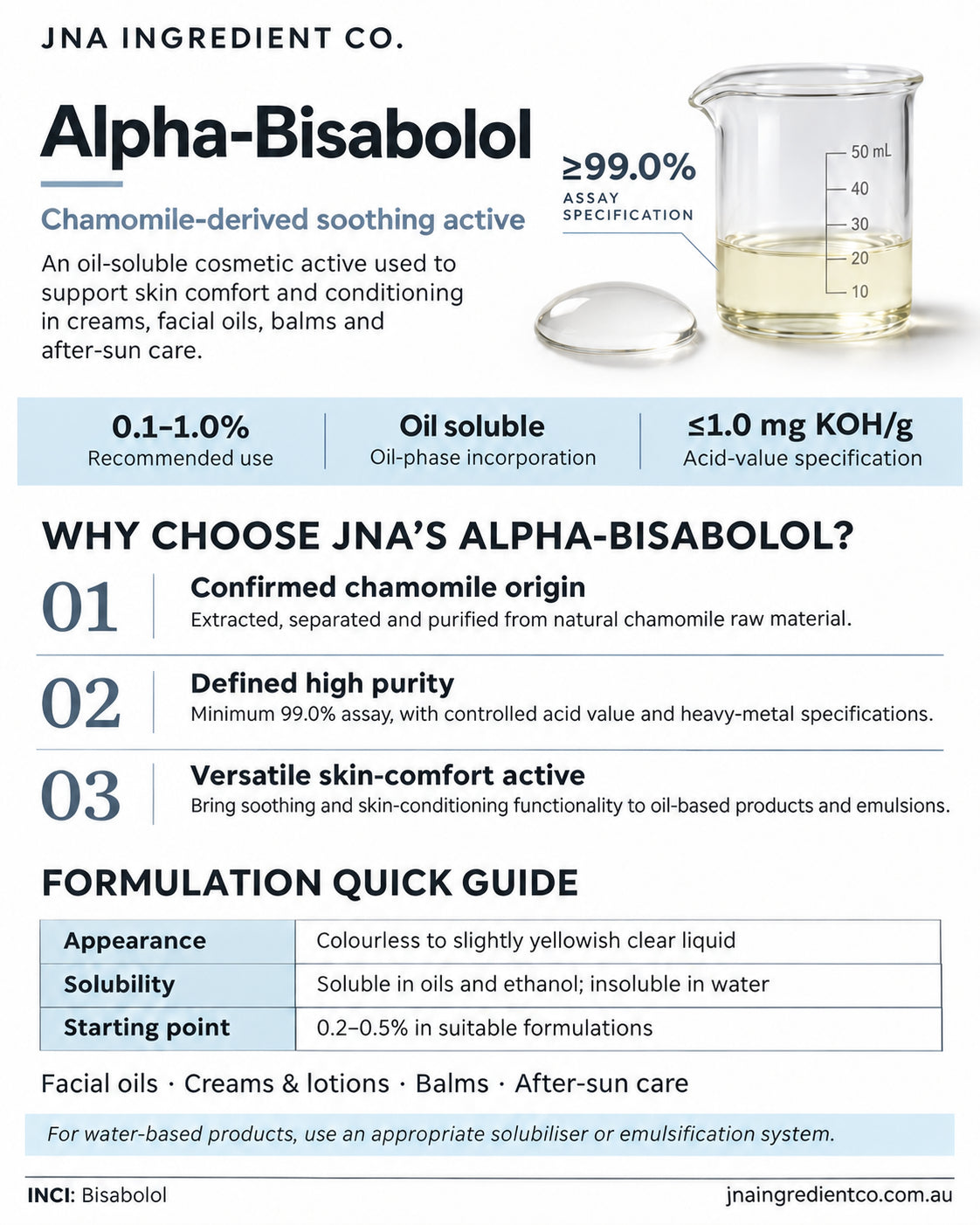
0.1-1.0%

Excludes processing loss and retained samples. The calculation does not establish a suitable or effective use level.

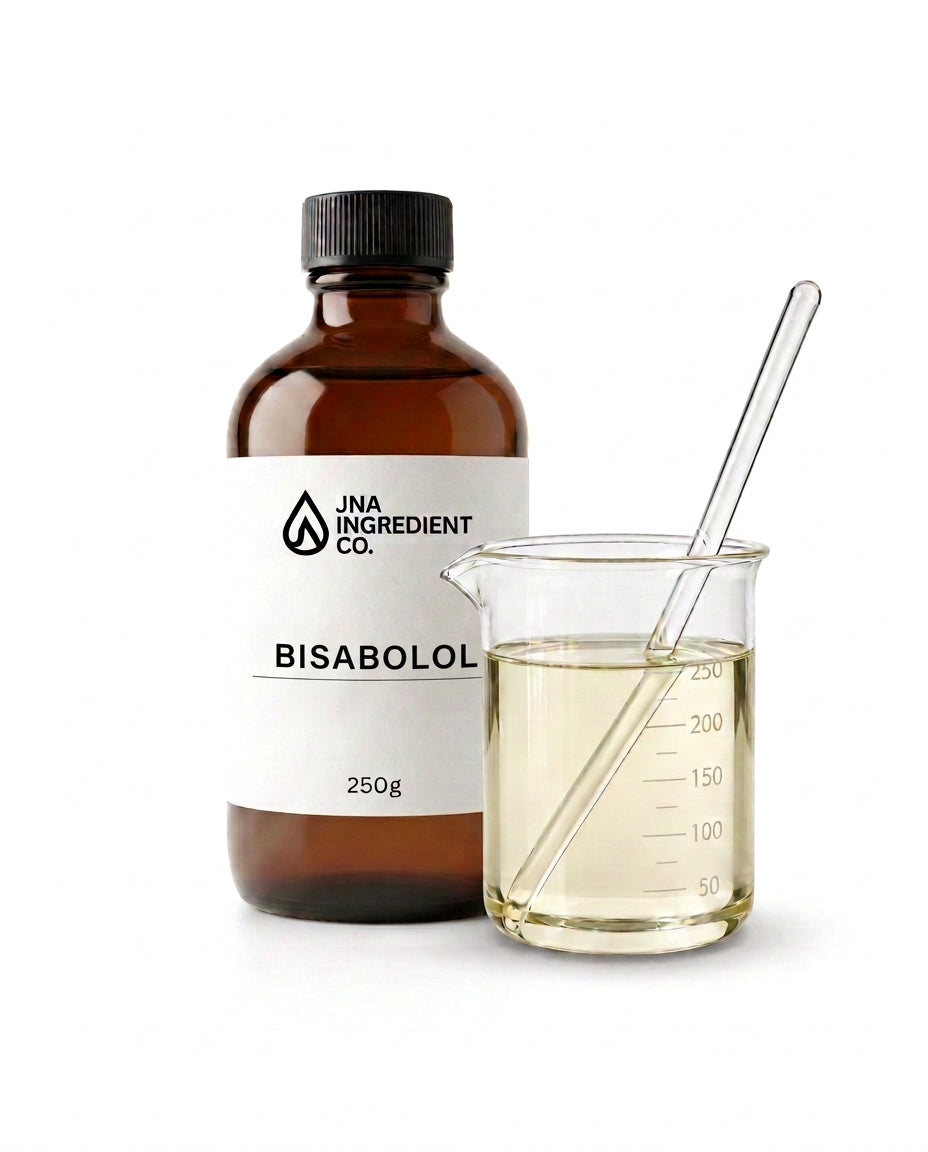
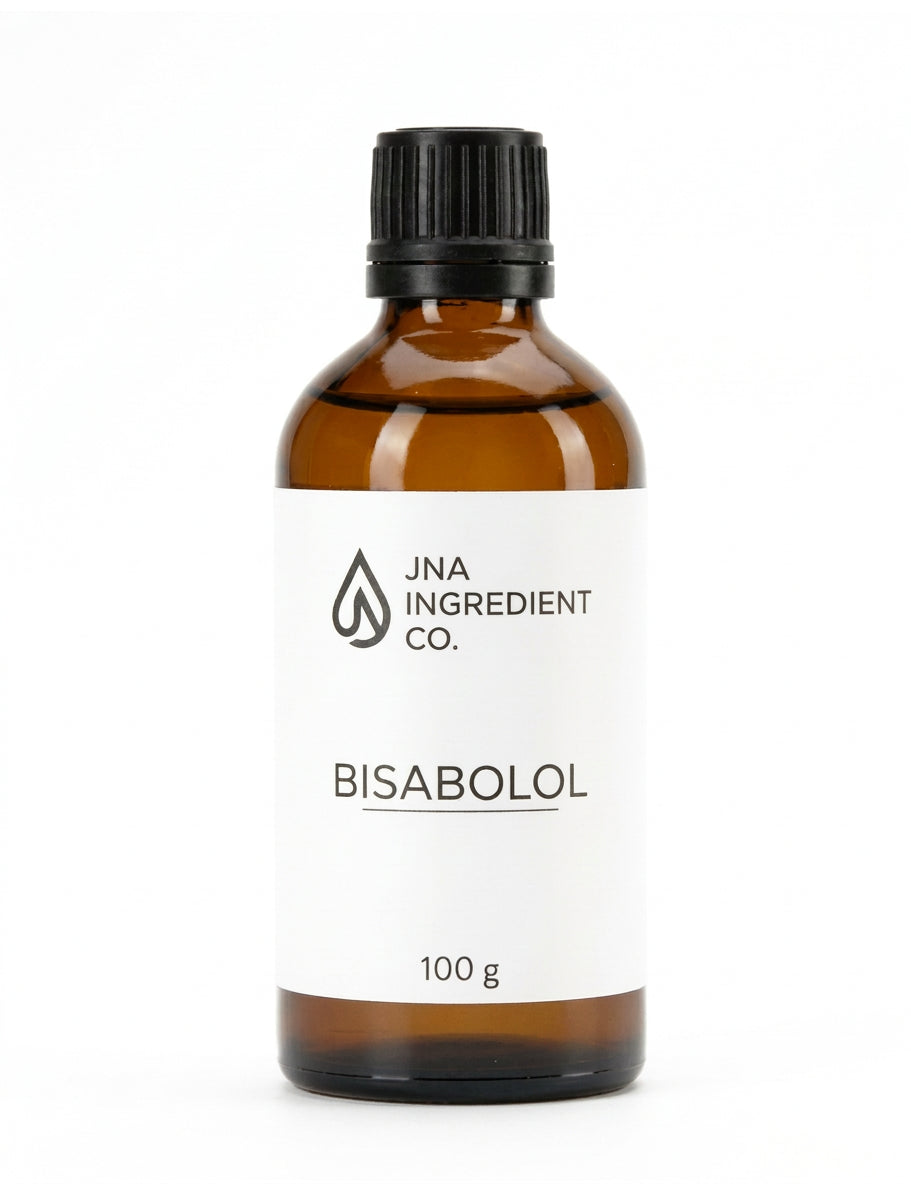
An amber glass bottle labeled 'JNA INGREDIENT CO. BISABOLOL 250g' stands next to a clear glass beaker containing High-quality Alpha Bisabolol ingredient for serums, creams, and facial treatments.
Bisabolol (Alpha Bisabolol)15 mL Sale price$35.95
Australianowned & operated
Trusted byformulators
Quality ingredientsfor real results
Wholesale & bulk supply enquiriesTell us your ingredient, quantity and timeframe

Our Alpha-Bisabolol

JNA’s Alpha-Bisabolol combines confirmed chamomile origin with a minimum 99.0% purity specification. It brings soothing and skin-conditioning functionality to facial skincare, moisturisers, balms and other products developed around sensitive-feeling skin and skin comfort.

Our grade is obtained from natural chamomile raw material through extraction, separation and purification, giving you a documented botanical source alongside a defined assay requirement.

Supplied as a colourless to slightly yellowish clear liquid, it is soluble in cosmetic oils and ethanol and insoluble in water. This makes it useful in compatible facial oils, balms and the oil phase of emulsions.

Defined purity and acid-value specifications, together with heavy-metal and microbiological controls, provide quality benchmarks for ingredient selection and repeat purchasing. Use it alongside complementary emollients and conditioning ingredients to build a skin-comfort formula with the texture and finish you want.

Why choose JNA’s Bisabolol (Alpha-Bisabolol)?

  • Soothing Skin ComfortSupports formulations designed to calm sensitive-feeling skin and improve skin comfort, making it useful when developing facial skincare, body care and other leave-on products around a soothing brief.
  • Naturally Chamomile DerivedOur plant-derived Alpha-Bisabolol is produced from natural chamomile raw material, giving you a defined botanical source when selecting a skin-comfort ingredient for your formulation.
  • High-Purity ActiveSupplied as highly purified Alpha-Bisabolol for targeted cosmetic formulation, allowing you to incorporate this ingredient directly rather than introducing the broader composition of a whole botanical extract.
  • Oil-Phase VersatilityIts oil-soluble format suits compatible facial oils, balms, creams and emulsified serums. Incorporate it within an appropriate oil phase to bring skin-conditioning functionality to a range of product textures.

KEY SPECIFICATIONS

Know what you’re formulating with.

≥99.0%

High-purity Alpha-Bisabolol

Naturally derived from chamomile for soothing and skin-conditioning formulations.

INCI
Bisabolol
Otherwise known as
Alpha-Bisabolol
CAS number
515-69-5 (alpha-bisabolol); 23089-26-1 ((−)-alpha-bisabolol / levomenol)
Grade
Cosmetic grade
Appearance
Colourless to slightly yellowish clear liquid
Source
Naturally derived from chamomile
Recommended use range
0.1-1.0%
Assay specification
≥99.0%
Solubility
Oil soluble
  • No Animal Testing

    Declared Not tested on Animals

  • Non-GMO

    Declared free from genetically modified organisms

  • No Added Additives

    No added preservatives, stabilisers or other additives.

  • Plant Origin

    Naturally extracted from chamomile

QUALITY · SOURCING · SAFE HANDLING

Selected for specification.

Ingredient name is the beginning. Specification is the difference.

We select our ingredients for the quality behind the name: the right grade, defined purity or composition, clear origin and consistent specifications.

Our focus is dependable ingredients, supported by clear technical information, that you can formulate with confidence and rely on for repeat production.

Need more information about this ingredient
Formulation & Processing

Processing

Incorporate Alpha-Bisabolol into the oil phase or an appropriate oil-soluble premix. In emulsions, ensure it is fully incorporated into the oil phase or complete emulsification system.

For predominantly aqueous formulations, an appropriate solubiliser or emulsification system is required because Alpha-Bisabolol is insoluble in water.

Compatibility

Compatible with cosmetic oils and other oil-soluble formulation components. Alpha-Bisabolol may also be incorporated into emulsions and appropriately solubilised systems.

When combining with multiple actives, surfactants or complex emulsification systems, assess compatibility, stability and sensory performance in the complete finished formulation.

pH guidance

Not inherently ph dependent in anhydrous systems; in emulsions, follow the pH requirements of the overall formulation.

Formulation applications

Soothing Facial Cream · 0.2 - 0.5%
Lightweight facial serum designed to support sensitive, stressed or easily irritated skin.

Calming Moisturiser · 0.2 - 0.5%
Ideal for moisturisers, lotions and barrier-support formulations where a soothing active is required.

After Sun & Recovery Balm · 0.3 - 1%
Well suited to after-sun, post-shave and intensive soothing formulations targeting skin comfort.

Development concept only. Validate the complete formulation; this is not a complete or tested formula.

Troubleshooting

Ingredient separates from an aqueous formulation: Bisabolol is not water soluble. Incorporate through an appropriate oil phase or solubilisation system.

Cloudiness developed in a clear water-based product: Review the solubilised system and Bisabolol concentration.

Formulation becomes unstable after addition: Review the total oil-phase load, emulsifier or solubiliser system and incorporation method rather than increasing mixing alone.

Grade & analytical controls

Acid value: ≤1.0 mg KOH/g
Soluble in cosmetic oils and ethanol; insoluble in water

Natural chamomile origin, produced through extraction, separation and purification. Non-GMO, no animal testing and BSE/TSE-free status are supported by product declarations.

Non-GMO. No animal testing conducted or commissioned for the material and its starting materials. No intentionally added allergens specified in the declaration. BSE/TSE statement confirms no ruminant-origin raw materials or high-risk animal-source components.

Controlled to defined heavy-metal specifications; microbiological quality tested to specification.

Extracted from chamomile, a renewable botanical feedstock, through extraction, separation and purification.

Storage & shelf life

Store in a cool, dry place away from strong light and heat. Keep the container tightly sealed after use to minimise unnecessary exposure and oxidation.

2 years when properly stored

Handling & product safety

Use clean, dry dispensing equipment and keep the container closed when not in use. Wear suitable eye protection when handling the concentrated ingredient. Refer to the Safety Data Sheet for detailed handling and safety guidance.

Refer to the current Safety Data Sheet for complete safety and handling information.

Avoid direct contact with eyes. Use appropriate handling practices and refer to Safety Data Sheet for detailed safety information.

The formulator is responsible for assessing the safety, stability and suitability of the finished formulation for its intended application.

Documentation
Shipping & supply

Shipping charges and delivery options are confirmed at checkout. For supply quantities beyond the listed packs, contact JNA with your requirements.

View shipping information ↗
Need more information about this ingredient

FORMULATOR FAQ

Practical Questions About Formulating with Alpha-Bisabolol

Bisabolol FAQ

Can Alpha-Bisabolol be used alongside water-soluble soothing actives?

Yes. Alpha-Bisabolol can be paired with water-soluble ingredients such as Panthenol, Allantoin, Beta-Glucan or Ectoin to build a broader skin-comfort system. They do not need to share the same phase: incorporate Bisabolol through the oil phase or suitable solubilisation system and add the water-soluble active according to its own processing requirements.

Should Bisabolol replace the main emollient in a facial oil or balm?

No. Bisabolol is used primarily as a functional soothing and skin-conditioning active rather than as the main carrier or emollient. In an anhydrous formulation, it can be incorporated alongside ingredients such as squalane, Caprylic/Capric Triglycerides or suitable plant oils that provide the bulk of the oil phase and determine much of the finished skin feel.

Why can a clear formulation become cloudy after adding Bisabolol?

Because Bisabolol is insoluble in water. A formulation may appear clear initially but develop haze, droplets or separation if the solubilisation system cannot accommodate the complete oil-soluble load. When troubleshooting, assess the total fragrance, essential oil and other oil-soluble materials together rather than considering the Bisabolol level in isolation.

Does adding Bisabolol make a formulation suitable for sensitive skin?

Not by itself. Bisabolol is commonly selected for soothing and skin-comfort focused formulations, but the suitability of a finished product for sensitive skin depends on the complete formula. Surfactants, fragrance, preservation, pH, other actives and their use levels can all influence finished-product tolerability.

What is the difference between natural and synthetic Alpha-Bisabolol when selecting a raw material?

Alpha-Bisabolol may be available from different sources, so formulators should assess the specification and supporting documentation for the particular grade rather than relying on the ingredient name alone. JNA's grade is supplier-documented as naturally derived from chamomile through extraction, separation and purification, with no synthetic Bisabolol substitute.

Should Bisabolol be counted as part of the oil phase when developing an emulsion?

Yes. Because Bisabolol is oil soluble, its contribution should be considered as part of the formulation's total oil-soluble load when developing and testing an emulsion. The emulsifier system should be assessed against the complete oil phase rather than treating Bisabolol as though it were a water-phase active.

Ingredient shortlist

Your shortlist is empty. Bookmark ingredients to keep them here while you shop.