Skip to content

Cart

Your cart is empty

Hydroxyethyl Cellulose (HEC) Powder

INCI: Hydroxyethyl Cellulose · CAS: 9004-62-0

4,000-6,000 mPa·sDefined Viscosity Grade
Nonionic Cellulose Thickener & Rheology Modifier
USP grade
Cotton-derived cellulose
Defined viscosity grade
Sale price$11.95
Available in:

Available to order

Sold by weight (g or Kg) for formulation accuracy.

Calculate quantity needed +
Recommended use levels

0.2–1.5%

Excludes processing loss and retained samples. The calculation does not establish a suitable or effective use level.

JNA Ingredient Co. HEC cosmetic thickener presented in clean, editorial packaging for clear gel systems, surfactant compatibility, and stable pH‑flexible formulations
Hydroxyethyl Cellulose (HEC) Powder100 g Sale price$11.95
Australianowned & operated
Trusted byformulators
Quality ingredientsfor real results
Wholesale & bulk supply enquiriesTell us your ingredient, quantity and timeframe

Our HEC

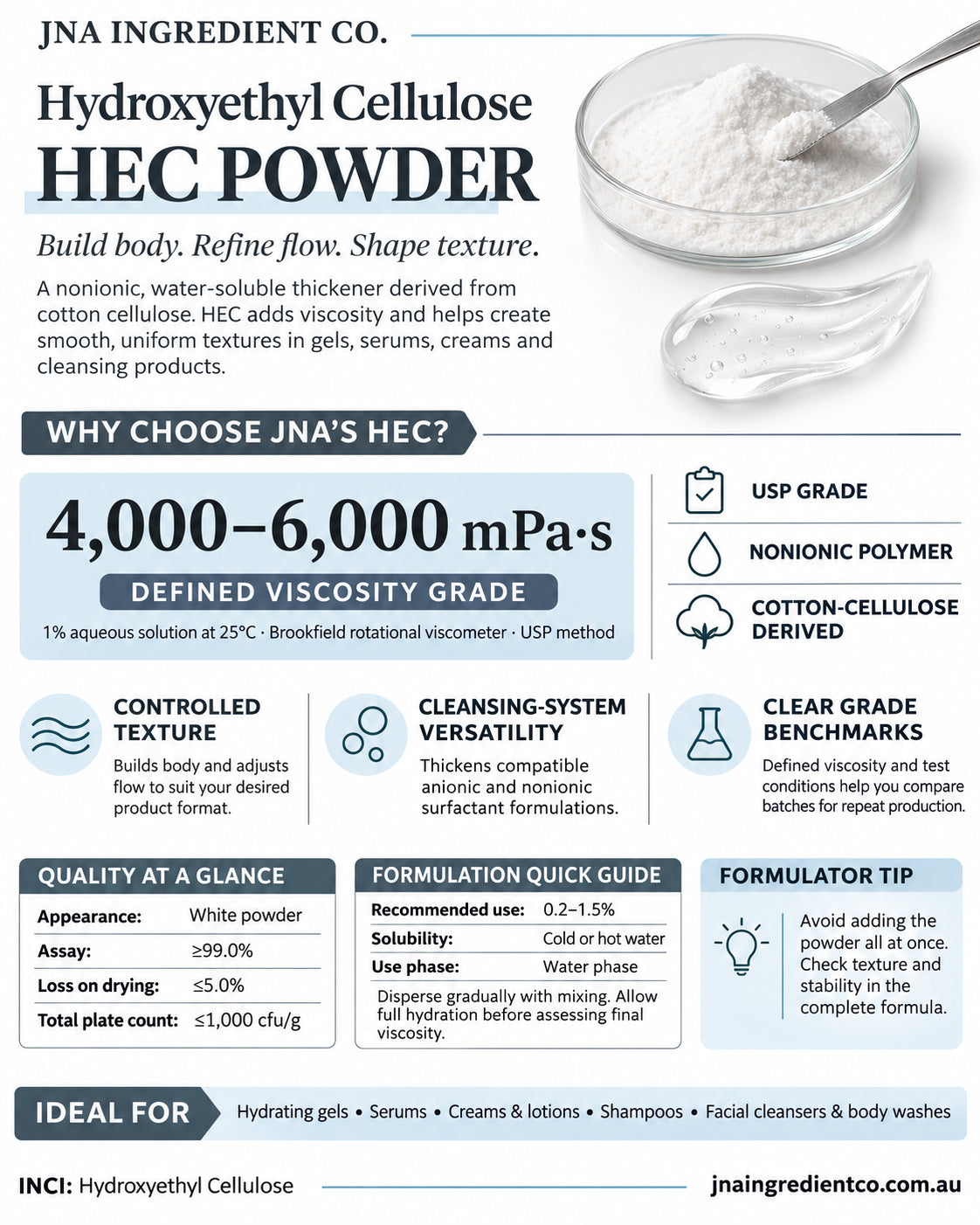
JNA’s Hydroxyethyl Cellulose (HEC) is a USP-grade thickener with a defined viscosity range of 4,000-6,000 mPa·s, giving you a clear specification for formulation development and repeat production. Each batch is tested before shipment and supported by a Certificate of Analysis, with the same viscosity grade available for future orders.

Derived from cotton cellulose, this nonionic, water-soluble polymer builds body and controls flow in serums, gels, creams and cleansing products. It supports smooth, uniform textures and provides thickening in compatible anionic and nonionic surfactant systems, including shampoos, facial cleansers and body washes.

Viscosity is measured using a 1% aqueous solution at 25°C with a Brookfield rotational viscometer, to meet the USP standard. These defined test conditions help you compare incoming batches and maintain a consistent raw-material specification as you move from development to production.

The recommended use range is 0.2-1.5%, depending on the desired texture and complete formulation. Disperse gradually and allow full hydration before assessing final viscosity.

Why choose JNA’s Hydroxyethyl Cellulose (HEC)?

  • USP-Grade QualityOur HEC meets the USP standard, giving you a defined quality benchmark when selecting a thickener for development and repeat production.
  • Defined Viscosity GradeSpecified at 4,000-6,000 mPa·s, measured using a 1% aqueous solution at 25°C with a Brookfield rotational viscometer according to the USP method.
  • Flexible Texture DevelopmentBuild and adjust water-phase viscosity in compatible gels, creams and cleansing products, with control over body, flow and dispensing characteristics.
  • Consistency for Repeat OrdersThe same viscosity grade is available for future orders, helping you reorder against an established specification and reduce variation caused by changing thickener grades.

KEY SPECIFICATIONS

Know what you’re formulating with.

4,000-6,000 mPa·s

Defined Viscosity Grade

Measured using a 1% aqueous solution at 25°C with a Brookfield rotational viscometer, to meet the USP standard.

INCI
Hydroxyethyl Cellulose
Otherwise known as
HEC · Hydroxyethylcellulose · Cellulose Ether
CAS number
9004-62-0
Grade
USP Grade
Appearance
White Powder
Source
Plant-derived cellulose · Cotton fibre
Recommended use range
0.2–1.5%
Assay specification
≥99.0%
Solubility
Water soluble
  • No Animal Testing

    Declared Not tested on Animals

  • Non-GMO

    Declared free from genetically modified organisms

  • Cotton-Derived Cellulose

    Made using cellulose obtained from cotton.

  • USP Conforming

    Conforms with USP standards

QUALITY · SOURCING · SAFE HANDLING

Selected for specification.

Ingredient name is the beginning. Specification is the difference.

We select our ingredients for the quality behind the name: the right grade, defined purity or composition, clear origin and consistent specifications.

Our focus is dependable ingredients, supported by clear technical information, that you can formulate with confidence and rely on for repeat production.

Need more information about this ingredient
Formulation & Processing

Processing

Gradually sprinkle HEC into cold or hot deionised water with effective mixing to disperse the powder evenly and minimise lumps. Allow approximately 30-60 minutes for hydration and viscosity development, depending on temperature and mixing conditions.

Confirm full hydration before assessing viscosity or adding more thickener. Check the final texture again after incorporating the remaining ingredients.

Compatibility

HEC’s nonionic character makes it useful across aqueous skincare, haircare and cleansing formulations, including compatible anionic and nonionic surfactant systems.

It can be used alongside humectants, water-soluble ingredients and other rheology modifiers. In creams and lotions, it builds water-phase viscosity and supports physical stability alongside the emulsifier system.

Assess viscosity and texture in the complete formulation, particularly where electrolytes, concentrated surfactants or multiple polymers are present.

pH guidance

Set the finished-product pH to suit the complete formulation, including the preservative system, surfactants and pH-sensitive actives. Check viscosity and texture after pH adjustment and during stability testing.

Troubleshooting

Lumps or uneven texture - Add the powder gradually with effective mixing and confirm even dispersion.

Lower viscosity than expected - Allow full hydration before adding more HEC. Check concentration, processing conditions and the complete formulation.

Excessive thickness - Trial a lower concentration and reassess after full hydration.

Viscosity changes after other additions - Review the addition sequence and effects of surfactants, electrolytes, other polymers and pH adjustment.

Changes during storage - Monitor viscosity, uniformity and physical stability over time before finalising the formula.

Grade & analytical controls

Viscosity: 4,000–6,000 mPa·s (1% aqueous solution at 25°C, Brookfield rotational viscometer)

JNA’s HEC is supplied as USP grade with a defined viscosity specification of 4,000-6,000 mPa·s. Viscosity is measured using a 1% aqueous solution at 25°C with a Brookfield rotational viscometer, to meet the USP standard.

Each batch is tested before shipment and supported by a Certificate of Analysis. The same viscosity grade is maintained for ongoing supply, helping you retain a consistent raw-material specification from development through to repeat production.

Controlled heavy-metal and microbiological specifications, with batch testing against defined quality limits.

The cellulose starting material is cotton-derived, providing a renewable botanical backbone for this chemically modified thickener.

Storage & shelf life

Store in a cool, dry place in a tightly sealed container, protected from moisture, heat and direct sunlight. Use clean, dry utensils and close promptly after dispensing to minimise moisture uptake and caking.

Shelf life is 24 months under the recommended storage conditions. Refer to the product label for the applicable expiry date.

Handling & product safety

Keep the container tightly sealed when not in use and use clean, dry equipment when weighing or dispensing. As HEC is supplied as a fine powder, handle carefully to minimise airborne dust and avoid unnecessary moisture exposure.

Handle the powder carefully to minimise airborne dust. Avoid inhaling dust and contact with eyes. Use appropriate protective equipment and good workplace hygiene when weighing and mixing.

Refer to the Safety Data Sheet for handling, first aid and disposal guidance.

Assess the finished formulation for safety, stability and preservation before use or sale.

Documentation
Shipping & supply

Shipping charges and delivery options are confirmed at checkout. For supply quantities beyond the listed packs, contact JNA with your requirements.

View shipping information ↗
Need more information about this ingredient

FORMULATION SUPPORT

HEC FAQ

Working With Hydroxyethyl Cellulose

What makes JNA’s HEC suitable for repeat formulation work?

JNA’s HEC is USP grade with a defined viscosity range of 4,000-6,000 mPa·s. Each batch is tested before shipment and supported by a Certificate of Analysis. Maintaining the same viscosity grade for ongoing supply helps you retain a consistent raw-material specification from development through to repeat production.

How much HEC should I use?

The recommended range for JNA’s grade is 0.2-1.5% of the total formulation weight. Lower concentrations generally provide lighter body, while higher concentrations build more substantial texture. The amount required depends on your intended product and other ingredients. Allow full hydration before deciding whether more thickener is needed.

How do I hydrate HEC without creating lumps?

Sprinkle the powder gradually into cold or hot deionised water with effective mixing. Avoid adding it all at once, which can leave partially hydrated lumps. Allow approximately 30-60 minutes for hydration and viscosity development, depending on processing conditions. Check texture again after incorporating the remaining ingredients.

Can I use this HEC in both cleansers and leave-on skincare?

Yes. JNA’s nonionic HEC can build viscosity in water-based serums and gels, support water-phase structure in creams and lotions, and thicken compatible anionic and nonionic surfactant systems such as shampoos and body washes. Assess the concentration and final texture separately for each formulation.

Can I replace Xanthan Gum or Carbomer with HEC at the same percentage?

HEC, Xanthan Gum and Carbomer develop different flow, texture and suspension properties, so they are not direct 1:1 substitutes. Replacing one with another may require changes to concentration and processing. Compare spreadability, dispensing, particle suspension and stability when adapting the formula.

What does the 4,000-6,000 mPa·s viscosity specification mean?

It identifies the viscosity of a 1% aqueous solution of JNA’s HEC at 25°C, measured with a Brookfield rotational viscometer to meet the USP standard. It describes the raw material’s viscosity grade, rather than the viscosity every finished formula will achieve.

Your finished product’s viscosity depends on the HEC concentration, hydration, temperature and other ingredients. The defined specification gives you a consistent reference when selecting and comparing batches.

Ingredient shortlist

Your shortlist is empty. Bookmark ingredients to keep them here while you shop.