Skip to content

Cart

Your cart is empty

Magnesium Chloride Flakes - Dead Sea

INCI: Magnesium Chloride

≥46.5%MgCl₂ Content
Dead Sea magnesium chloride flakes with defined mineral composition for bath blends and water-based mineral formulations.
Dead Sea origin
Water soluble
Minimum 46.5% MgCl₂
Sale price$6.95
Available in:

Available to order

Sold by weight (g or Kg) for formulation accuracy.

Calculate quantity needed +
Calculation guidance

Select the inclusion level for the intended product and final dilution. Assess skin feel, compatibility and stability in small batches before scaling up.

Excludes processing loss and retained samples. The calculation does not establish a suitable or effective use level.

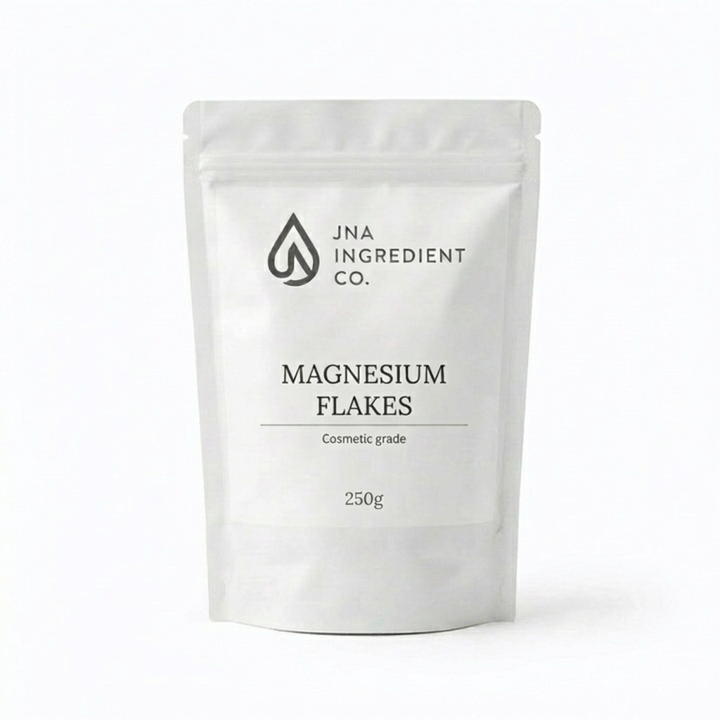
JNA Ingredient Co Magnesium Chloride Flakes, 250 g white resealable pouch
Magnesium Chloride Flakes - Dead Sea250 g Sale price$6.95
Australianowned & operated
Trusted byformulators
Quality ingredientsfor real results
Wholesale & bulk supply enquiriesTell us your ingredient, quantity and timeframe

Our Magnesium Chloride Flakes - Dead Sea

Create magnesium body sprays, mineral soaks and your own magnesium body-care formulations with JNA’s Dead Sea Magnesium Chloride Flakes. Sourced from the Dead Sea in Israel, these white, water-soluble flakes give you control over the mineral concentration, water content and format of your finished product.

Our grade has a specified minimum magnesium chloride content of 46.5%, with defined limits for calcium, sodium and potassium chlorides. These specifications give you meaningful composition data for selecting your raw material and calculating the mineral contribution to your formula.

Dissolve the flakes to prepare a magnesium solution, commonly called magnesium oil, or use them in dry bath salts and foot-soak blends. Beyond soaks, magnesium chloride can be incorporated into suitably designed body sprays, roll-ons, gels, lotions and creams. For these formulas, select salt-tolerant thickeners or emulsifiers and establish the concentration through product testing.

From a simple mineral spray to a more developed body-care range, the flake format lets you build your formula from the raw ingredient. Packs from 250 g to 10 kg support development batches and regular production.

Why choose JNA’s Magnesium Chloride?

  • Dead Sea Mineral OriginSourced from the Dead Sea in Israel for magnesium solutions, mineral soaks and suitably formulated body-care products.
  • Minimum 46.5% MgCl₂A specified magnesium chloride content gives you a clear starting point for choosing your ingredient and planning mineral concentrations.
  • Defined Mineral CompositionLimits for calcium, sodium and potassium chlorides provide useful detail about the grade you are buying.
  • More Ways to FormulateDevelop mineral sprays, roll-ons and salt-tolerant body-care formulas, or use the flakes in dry bath and foot-soak blends.

KEY SPECIFICATIONS

Know what you’re formulating with.

≥46.5%

Magnesium chloride content

Minimum MgCl₂ specification for the supplied hexahydrate flakes. Not elemental magnesium or a batch result.

INCI
Magnesium Chloride
Otherwise known as
Magnesium chloride flakes; magnesium chloride hexahydrate
Grade
Magnesium chloride flakes
Appearance
White flakes
Source
Dead Sea, Israel
Recommended use range
Select the inclusion level for the intended product and final dilution. Assess skin feel, compatibility and stability in small batches before scaling up.
Assay specification
Magnesium chloride (MgCl₂): minimum 46.5%
Solubility
Water soluble
  • Dead Sea Origin

    Magnesium chloride flakes sourced from the Dead Sea.

  • Minimum 46.5% MgCl₂

    Magnesium chloride content specified at a minimum of 46.5% by weight.

  • Hexahydrate Flakes

    Magnesium chloride hexahydrate containing water of crystallisation.

  • Water Soluble

    Dissolves in water for incorporation into aqueous formulations.

QUALITY · SOURCING · SAFE HANDLING

Selected for specification.

Ingredient name is the beginning. Specification is the difference.

We select our ingredients for the quality behind the name: the right grade, defined purity or composition, clear origin and consistent specifications.

Our focus is dependable ingredients, supported by clear technical information, that you can formulate with confidence and rely on for repeat production.

Need more information about this ingredient
Formulation & Processing

Processing

Weigh the flakes and water separately. Add flakes gradually to water with stirring until dissolved; monitor the temperature and allow the solution to cool before adding heat-sensitive ingredients or assessing the final properties.

For dry soak blends, use dry equipment and moisture-resistant packaging. Assess flow and caking in the complete blend under expected storage conditions.

Sensory profile: assess the intended use dilution. Concentrated solutions can feel slick or tacky and may leave a mineral residue as water evaporates.

Magnesium body sprays and roll-ons: dissolve the flakes into the water phase and develop the final mineral concentration and skin feel.

Magnesium gels: use a thickening system that tolerates the intended electrolyte concentration and check viscosity after storage.

Body lotions and creams: incorporate dissolved magnesium chloride into an emulsion specifically designed to tolerate salts; assess emulsion stability and sensory performance.

Bath salts and foot soaks: use flakes alone or in compatible dry blends, with clear dosing instructions for the final water dilution.

Compatibility

Magnesium chloride adds a substantial electrolyte load. Check the salt tolerance of thickeners, emulsifiers and surfactants before combining them; a formula that works in plain water may thin, separate or become cloudy after salt addition.

Fragrance and essential oils do not become water-soluble simply by mixing them with flakes. Use a suitable dispersing system and assess the finished bath dilution as well as the packaged product.

pH guidance

Measure pH in the complete aqueous formula at a defined concentration and temperature. A raw-material solution result is not a recommended finished-product pH. Recheck clarity and stability after any adjustment.

Troubleshooting

If a solution clouds or forms sediment, investigate the water quality, grade and other ingredients before assuming that more mixing will resolve it. Assess stability after cooling and storage.

When a gel thins after salt addition, review the polymer’s electrolyte tolerance rather than adding more thickener without testing.

Grade & analytical controls

INCI: Magnesium Chloride. Chemical form: magnesium chloride hexahydrate, MgCl₂·6H₂O. CAS: 7791-18-6.

Guaranteed composition limits: calcium chloride ≤2.2%; sodium chloride ≤0.9%; potassium chloride ≤0.6%.

Readily water-soluble. The MgCl₂ specification is distinct from elemental magnesium content.

The supplied specification limits calcium chloride to 2.2%, sodium chloride to 0.9% and potassium chloride to 0.6%. These are specification limits, not batch-specific results.

Water forms part of the hexahydrate crystal structure. The magnesium chloride percentage therefore describes MgCl₂ content and should not be interpreted as elemental magnesium content or as the purity of an anhydrous salt.

Storage & shelf life

Store tightly sealed in a cool, dry, well-ventilated place, away from direct sunlight, heat and moisture. Close the pack promptly after use.

Refer to the supplied batch label for expiry or retest information. Repacking does not restart the original shelf life.

Handling & product safety

Use clean, dry utensils. Magnesium chloride attracts moisture from the air; dampness and caking can develop if packaging is left open.

Protect packaging from damage and select moisture-resistant containers for repacked flakes or dry blends. Assess the packed product under its intended storage conditions.

Refer to the current SDS for safe handling, protective equipment, first aid and disposal guidance.

Assess the finished formulation for safety, stability and preservation before sale or use. Do not assume that a water-based product is adequately preserved simply because it contains magnesium chloride.

Documentation
Shipping & supply

Shipping charges and delivery options are confirmed at checkout. For supply quantities beyond the listed packs, contact JNA with your requirements.

View shipping information ↗
Need more information about this ingredient

FORMULATION QUESTIONS

Frequently asked questions

Dead Sea Magnesium Chloride

Does 46.5% magnesium chloride mean 46.5% elemental magnesium?

No. The minimum 46.5% figure refers to magnesium chloride (MgCl₂), which contains both magnesium and chloride. The supplied flakes are magnesium chloride hexahydrate, with water in their crystal structure. Flake inclusion, MgCl₂ content and elemental magnesium content are different measurements.

How do I calculate the amount of flakes for a water-based batch?

For a chosen flake inclusion, calculate: finished batch weight × flake percentage ÷ 100. A 1,000 g batch containing 30% flakes uses 300 g flakes, with the remaining 700 g supplied by water and any other ingredients.

That is not a 30% MgCl₂ solution. At the minimum 46.5% MgCl₂ specification, 30% flakes contributes 13.95% MgCl₂ by finished batch weight. If targeting a particular MgCl₂ strength, calculate from the applicable assay instead of treating flakes as 100% MgCl₂. These figures illustrate the calculation, not recommended use levels.

Can I replace Epsom salt with magnesium chloride at the same percentage?

Do not assume a direct substitution. Epsom salt is magnesium sulphate, whereas these flakes are magnesium chloride. Their composition, hydrated forms and contribution to the finished blend differ. Recheck the formulation, dissolution, storage behaviour and sensory properties.

Why does my gel become thinner after adding magnesium chloride?

Magnesium chloride introduces dissolved ions that can change how a thickener works. Check the polymer supplier’s electrolyte guidance and run small trials at the intended salt concentration. Adding extra thickener alone may not restore stability.

Can I add fragrance or essential oils directly to the flakes?

Coating flakes with fragrance does not ensure even dispersion in bath water. Choose a suitable dispersing system and test the finished dilution for oil separation and surface pooling. Assess both skin exposure and packaging compatibility.

Does a magnesium solution need a preservative?

Its preservation needs must be assessed in the complete formula. Salt concentration alone is not proof of adequate protection. Consider water quality, water activity where relevant, packaging and intended use, and validate the preservation approach.

Ingredient shortlist

Your shortlist is empty. Bookmark ingredients to keep them here while you shop.