Skip to content

Cart

Propanediol (1,3)

INCI: Propanediol · CAS: 504-63-2

≥99%High Purity
Fermentation-derived from renewable corn for lightweight hydration and versatile solvent performance.
Renewable corn-derived
COSMOS compliant
USP conforming
Sale price$8.95
Available in:

Available to order

Sold by weight (g or kg) for formulation accuracy.

Calculate quantity needed +
Recommended use levels

1-5%

Excludes processing loss and retained samples. The calculation does not establish a suitable or effective use level.

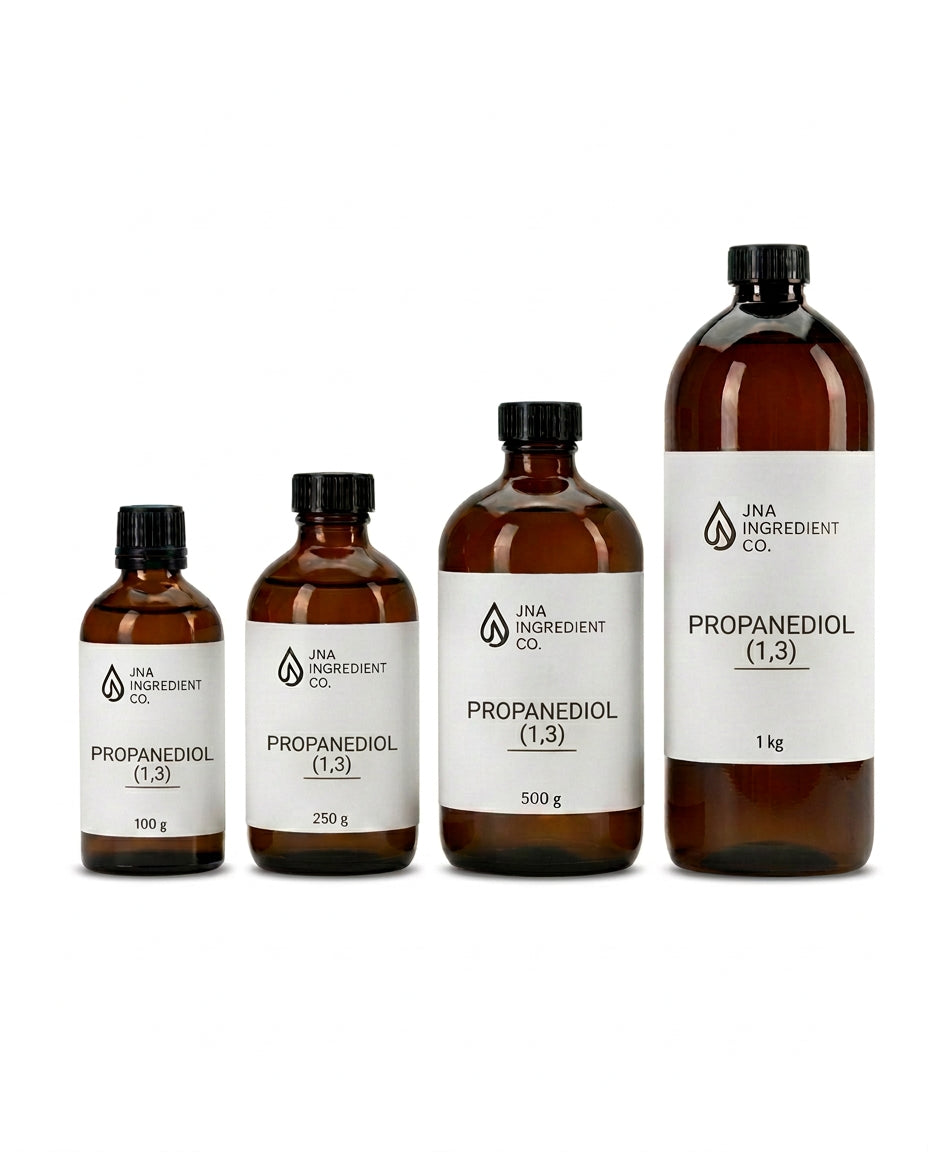
An amber glass bottle with a black cap and a white label reading 'JNA INGREDIENT CO.  containing Premium Propanediol 1,3 for skin-conditioning and formulation enhancement
Propanediol (1,3)100 g Sale price$8.95
Australianowned & operated
Trusted byformulators
Quality ingredientsfor real results
Wholesale & bulk supply enquiriesTell us your ingredient, quantity and timeframe

Our Propanediol (1,3)

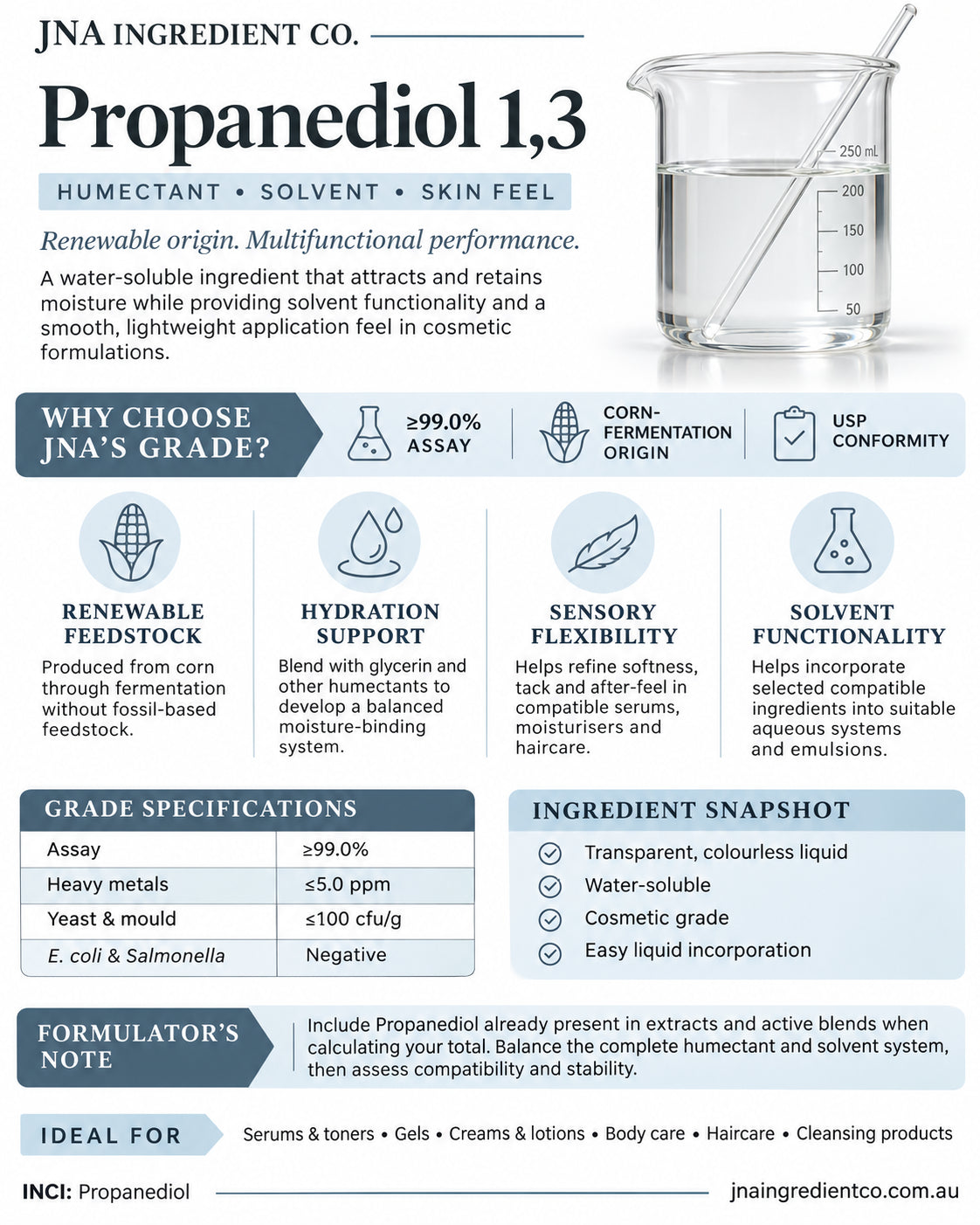
JNA’s Propanediol 1,3 combines renewable corn origin, a minimum 99.0% assay specification and versatile humectant and solvent performance. Produced through fermentation without fossil-based feedstock, our cosmetic grade gives you a clearly documented plant-derived ingredient for lightweight serums, toners, moisturisers and haircare.

Looking for Propanediol 1,3? This is 1,3-propanediol, a different ingredient from propylene glycol (1,2-propanediol). If you’re substituting one for the other, test the change in your formulation.

Our grade is supported by a written declaration of compliance with COSMOS technical requirements, alongside documented USP conformity. Its renewable feedstock and defined purity give you specific criteria for selecting Propanediol when both formulation performance and ingredient sourcing matter.

Use it to attract and retain moisture while developing a smooth, lightweight application feel. Blend it with glycerin and other humectants to refine the hydration system, balancing softness, tack and after-feel around your finished product.

Its solvent functionality also helps incorporate selected compatible ingredients, bringing more than moisture binding to the water phase. The liquid format blends readily into suitable aqueous systems and emulsions, giving you flexibility across facial skincare, body care and cleansing products.

When extracts or active blends already contain Propanediol, include their contribution when calculating the total. This helps you control the complete humectant and solvent balance as you move from initial trials to repeat production.

Why choose JNA’s Propanediol (1,3)?

  • Renewable Corn OriginProduced through fermentation from renewable corn, with no fossil-based feedstock used in production. Its defined origin supports ingredient selection when renewable sourcing is part of your formulation brief.
  • High-Purity Cosmetic GradeOur grade has a minimum 99% assay specification, with documentation stating conformity with USP standards. These give you clear quality benchmarks for development and repeat purchasing.
  • Lightweight HydrationHelps retain moisture while contributing to a smooth, light feel in compatible serums, toners and emulsions. Combine it with other humectants to refine hydration and the finished product’s sensory balance.
  • Versatile Solvent PerformanceCombines humectancy with solvent functionality for compatible ingredients, helping you manage incorporation and moisture binding with one liquid while tailoring the solvent system to your formulation.

KEY SPECIFICATIONS

Know what you’re formulating with.

≥99%

Assay specification

INCI
Propanediol
Otherwise known as
1,3-Propanediol
CAS number
504-63-2
Grade
Cosmetic grade
Appearance
Clear, colourless liquid
Source
Fermentation-derived from renewable corn
Recommended use range
1-5%
Assay specification
≥99.0%
Solubility
Water soluble
  • COSMOS Compliant

    Supported by a technical conformity declaration for this grade.

  • No Fossil-Based Feedstock

    No fossil-based feedstock is used in production.

  • USP Conforming

    Conforms with USP standards

  • Renewable Corn Feedstock

    Produced from corn, a renewable plant-based feedstock.

QUALITY · SOURCING · SAFE HANDLING

Selected for specification.

Ingredient name is the beginning. Specification is the difference.

We select our ingredients for the quality behind the name: the right grade, defined purity or composition, clear origin and consistent specifications.

Our focus is dependable ingredients, supported by clear technical information, that you can formulate with confidence and rely on for repeat production.

Need more information about this ingredient
Formulation & Processing

Processing

Incorporation: Add to the water phase and mix until uniform. Suitable for cold-process formulations or incorporation into the heated water phase.

Compatibility

Formulation balance: When combining with glycerin or other humectants, assess their total concentration and the finished formula’s tack, viscosity and stability.

Troubleshooting

Starting level: Begin at 3%, then adjust within 1-5% to balance hydration, solvent requirements and finished skin feel.

Grade & analytical controls

COSMOS compliance is supported by a written technical conformity declaration for this grade. The feedstock is renewable corn, with no fossil-based feedstock used during production.

Controlled to defined heavy-metal specifications, with microbiological limits covering total plate count, yeast and mould, E. coli and Salmonella.

Produced through fermentation from renewable corn, with no fossil-based feedstock used throughout production. The supplied grade is declared compliant with COSMOS technical requirements. RSPO certification concerns palm-oil sourcing and is not applicable to the declared corn feedstock.

Storage & shelf life

Store tightly closed in a cool, dry place away from direct sunlight and heat.

24 months under the recommended storage conditions. Refer to the batch label for the applicable expiry date.

Handling & product safety

Use clean, dry equipment when dispensing and avoid contamination. Clean spills promptly, as the liquid may create a slippery surface.

Refer to the current Safety Data Sheet for handling, storage and safety information before use.

Assess the finished product for safety, stability, preservation and suitability for its intended use. Raw-material information does not establish the performance or safety of the complete formulation.

Documentation
Shipping & supply

Shipping charges and delivery options are confirmed at checkout. For supply quantities beyond the listed packs, contact JNA with your requirements.

View shipping information ↗
Need more information about this ingredient

FORMULATOR FAQ

Propanediol Frequently Asked Questions

Working with Propanediol

How is Propanediol 1,3 different from propylene glycol?

Both are humectants and solvents, but they are different molecules: propanediol is 1,3-propanediol, while propylene glycol is 1,2-propanediol. Their structure affects solvent behaviour and sensory performance, so replacing one with the other calls for formulation testing. Our grade is fermentation-derived from renewable corn.

Why combine propanediol with glycerin?

Combining them gives formulators another way to balance hydration and skin feel. Replacing part of the glycerin with propanediol may reduce perceived stickiness while maintaining a useful humectant system. The best ratio depends on the total humectant level and the texture you want to achieve.

Can propanediol dissolve ingredients that will not dissolve in water?

Propanediol can act as a co-solvent for some ingredients with limited water solubility. Its effectiveness depends on the ingredient and concentration; a clear premix does not guarantee the ingredient will remain dissolved after dilution. Check the finished formula for crystallisation or precipitation during stability testing.

Does propanediol replace a preservative?

Propanediol can support the effectiveness of certain preservative systems, but it should not be treated as a complete preservative at typical humectant levels. The benefit depends on the formula and preservative combination, so the finished product still needs an appropriate preservation system and efficacy testing.

How should I choose between propanediol and pentylene glycol?

Both offer humectant and solvent functionality. Choose around the job you need them to perform: hydration, dissolving a particular ingredient, adjusting skin feel or supporting preservation. They are not automatically interchangeable at the same percentage; compare them in your actual formula before deciding.

Does more propanediol always mean better hydration and less tack?

No. Propanediol contributes moisturisation, but it is itself a somewhat viscous liquid and does not guarantee a non-sticky finish. Increasing it changes the overall solvent and humectant balance. Start at 3% and assess hydration, after-feel and viscosity before increasing the level.

Ingredient shortlist

Your shortlist is empty. Bookmark ingredients to keep them here while you shop.