Skip to content

Cart

Your cart is empty

Glyceryl Stearate Citrate

INCI: Glyceryl Stearate Citrate

PEG-FreeO/W Emulsifier
Modern PEG-free emulsifier
98% natural origin
PEG-free
No added additives
Sale price$8.95
Available in:

Available to order

Sold by weight (g or Kg) for formulation accuracy.

Calculate quantity needed +
Recommended use levels

2–6% of total formulation weight

Excludes processing loss and retained samples. The calculation does not establish a suitable or effective use level.

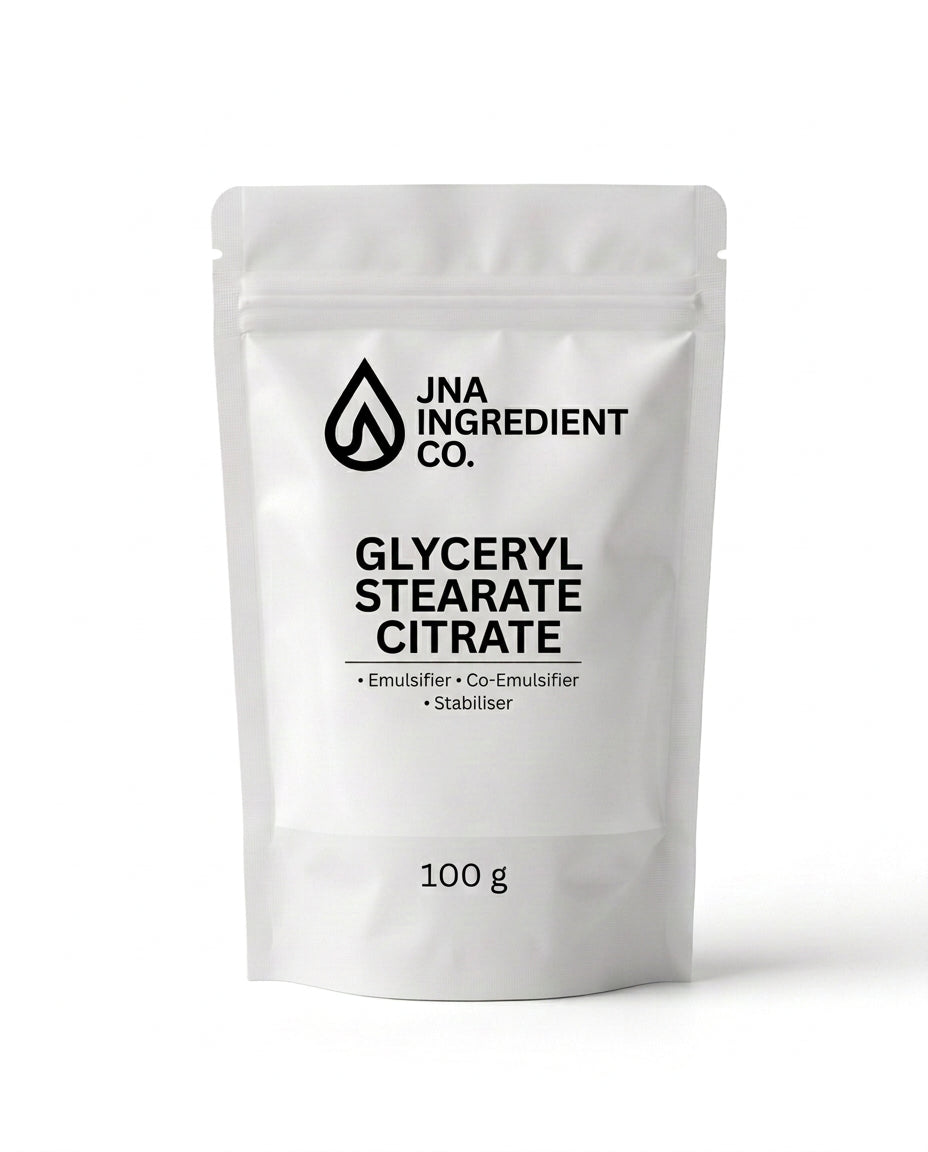
Glyceryl Stearate Citrate emulsifier for natural skincare and cosmetic formulations depicted in a white stand-up pouch sold by JNA Ingredient Co.  100 g, on a clean white background.
Glyceryl Stearate Citrate100 g Sale price$8.95
Australianowned & operated
Trusted byformulators
Quality ingredientsfor real results
Wholesale & bulk supply enquiriesTell us your ingredient, quantity and timeframe

Our Glyceryl Stearate Citrate

JNA’s Glyceryl Stearate Citrate helps you create creamy, beautifully spreading moisturisers with a soft, comfortable finish. Our PEG-free oil-in-water emulsifier combines a single-INCI composition with a declared ISO 16128 natural-origin index of 0.98, bringing formulation flexibility to facial creams, body lotions and hand care.

Its appeal extends beyond bringing oil and water together. Our grade is described as producing soft, non-greasy, non-tacky emulsions with good spreadability - qualities that contribute to a moisturiser’s feel from the first touch through to the finish left on skin. Use it to develop fluid lotions, softly cushioned creams or richer moisturisers around your chosen emollient blend.

Supplied without added emulsifiers, carriers, preservatives or stabilisers, it lets you select each supporting ingredient with purpose. Adjust cetyl, stearyl or cetearyl alcohol to build body and refine consistency, while shaping glide and richness through your choice of oils. This gives you the freedom to develop a distinctive texture across different products in your range.

The recommended use range is 2–6%, with application information supporting oil phases up to 25% in tested formulations. This provides scope for both lighter emulsions and more substantial creams, with the final balance developed around your oils, actives and desired skin feel.

Made from palm-derived glycerin and fatty acids, our grade is supported by a supplier declaration of RSPO Mass Balance certification. It combines clearly identified feedstocks with confirmed PEG-free composition and documented formulation parameters. JNA’s Glyceryl Stearate Citrate is a versatile foundation for moisturisers where creamy texture, smooth application and a refined after-feel are central to the product experience.

Why choose JNA’s Glyceryl Stearate Citrate?

  • Shape Your Signature TexturePair our Glyceryl Stearate Citrate with cetyl or cetearyl alcohol to develop the body, richness and spreading feel you want in creams and lotions.
  • PEG-Free EmulsificationBuild oil-in-water moisturisers with a PEG-free emulsifier, giving you another option when selecting ingredients around your formulation brief.
  • Freedom Beyond a Fixed Wax BlendSelect your emulsifier and supporting structurants separately, with greater control over their proportions as you refine texture and consistency.
  • Defined Emulsifier SpecificationsOur grade has controlled acid value, saponification value and free-glycerol limits, giving you a specified material to work with as you refine and reproduce your formulations.

KEY SPECIFICATIONS

Know what you’re formulating with.

PEG-Free

O/W Emulsifier

INCI
Glyceryl Stearate Citrate
Grade
Cosmetic grade
Appearance
White to off-white waxy solid
Source
Palm-derived glycerin and fatty acids
Recommended use range
2–6% of total formulation weight
Solubility
Oil dispersible
  • 98% Natural Origin

    Declared ISO 16128 natural-origin index: 0.98.

  • Non-GMO

    Declared free from genetically modified organisms

  • Vegan Suitable

    No animal-derived materials used in manufacturing

  • No Added Additives

    No added preservatives, stabilisers or other additives.

QUALITY · SOURCING · SAFE HANDLING

Selected for specification.

Ingredient name is the beginning. Specification is the difference.

We select our ingredients for the quality behind the name: the right grade, defined purity or composition, clear origin and consistent specifications.

Our focus is dependable ingredients, supported by clear technical information, that you can formulate with confidence and rely on for repeat production.

Need more information about this ingredient
Formulation & Processing

Processing

Add to the oil phase and heat to 70–80°C, ensuring the emulsifier and supporting waxy ingredients are fully melted before emulsification. Combine with the heated water phase using suitable homogenisation, then continue controlled stirring during cooling.

The TDS gives a laboratory homogenisation starting point of 3,000–5,000 rpm for 3–5 minutes. Adjust mixing to the equipment, batch size and formulation; rotational speed alone is not transferable between different mixer geometries.

Compatibility

Use cetyl, stearyl or cetearyl alcohol at a combined 0.5–2% as a development starting point to improve body, consistency and stability. Assess the emulsifier level alongside the oil-phase composition and supporting structurants.

Application information reports support for oil phases up to 25% in tested oil-in-water formulations. This is a development guide rather than a guaranteed capacity for every oil blend.

The grade is described as having moderate tolerance for common cosmetic electrolytes. High-salt systems require preliminary compatibility and stability trials.

pH guidance

Suggested finished-product pH: 5.0–7.0. Measure after cooling and monitor during stability testing.

Troubleshooting

If separation develops, review complete melting, phase temperatures, emulsifier balance and homogenisation. If the texture is too waxy or heavy, reassess the fatty-alcohol and oil-phase levels before simply reducing the emulsifier.

Grade & analytical controls

INCI: Glyceryl Stearate Citrate.

Acid value: 75-95 mg KOH/g.

Saponification value: 140-160 mg KOH/g.

Free glycerol: ≤3.0%.

Controlled to defined heavy-metal specifications, with microbiological limits covering total plate count, yeast and mould, E. coli and Salmonella.

Made using palm-derived glycerin and fatty acids. The supplied grade has a declared ISO 16128 natural-origin index of 0.98 and is supported by a supplier statement of RSPO Mass Balance certification. The glycerin and fatty acids are obtained from renewable palm feedstock.

Storage & shelf life

Store in a cool, dry place away from direct light and heat. Keep the container tightly closed when not in use.

24 months when stored under the recommended conditions. Refer to the batch-specific documentation for the applicable expiry or retest date.

Handling & product safety

Use clean, dry equipment when dispensing to minimise contamination. Reseal the container promptly after use.

Refer to the current Safety Data Sheet for handling, storage and safety information before use.

Assess the finished product for safety, stability, preservation and suitability for its intended use. Raw-material information does not establish the performance or safety of the complete formulation.

Documentation
Shipping & supply

Shipping charges and delivery options are confirmed at checkout. For supply quantities beyond the listed packs, contact JNA with your requirements.

View shipping information ↗
Need more information about this ingredient

FORMULATION SUPPORT

Glyceryl Stearate Citrate - FAQ

Working With Glyceryl Stearate Citrate

How is Glyceryl Stearate Citrate different from Glyceryl Stearate?

They are distinct ingredients with different emulsifying behaviour. Glyceryl Stearate Citrate can serve as a primary oil-in-water emulsifier, while ordinary Glyceryl Stearate is commonly used for co-emulsification and consistency. Neither should be substituted weight-for-weight without reviewing the complete emulsifying system.

Why combine it with cetyl or cetearyl alcohol?

Fatty alcohols help build body and structure around the emulsion. For our grade, the recommended combined cetyl, stearyl or cetearyl alcohol level is 0.5–2% as a development starting point. Their proportions influence consistency, spreading and after-feel, allowing you to refine texture separately from the emulsifier level. The right balance depends on your oils and intended product format.

Will increasing the emulsifier make my cream thicker?

Not necessarily. Viscosity also depends on the oil phase, fatty alcohols, other structurants and processing. Increasing emulsifier alone may change application feel without creating the texture you want. Assess the complete system rather than using emulsifier concentration as your only thickening control.

Can I substitute it directly for emulsifying wax?

A commercial emulsifying wax may contain several ingredients that provide emulsification and structure together. Glyceryl Stearate Citrate lets you select supporting ingredients separately, but replacing a blend requires reformulation rather than a simple weight-for-weight swap.

Why can an emulsion separate despite containing enough emulsifier?

Emulsifier level is only one factor. Incomplete melting, unsuitable phase temperatures, insufficient homogenisation, or incompatibility within the formula can undermine stability. Review processing and the oil-to-emulsifier balance before automatically adding more emulsifier.

Why does a cream’s texture change after cooling?

The emulsion continues developing structure as fatty alcohols and other waxy ingredients cool and organise. A cream that appears thin immediately after manufacture may gain body as it settles. Compare trial batches after the same resting period before adjusting emulsifier or thickener levels, and monitor texture during stability testing.

Ingredient shortlist

Your shortlist is empty. Bookmark ingredients to keep them here while you shop.