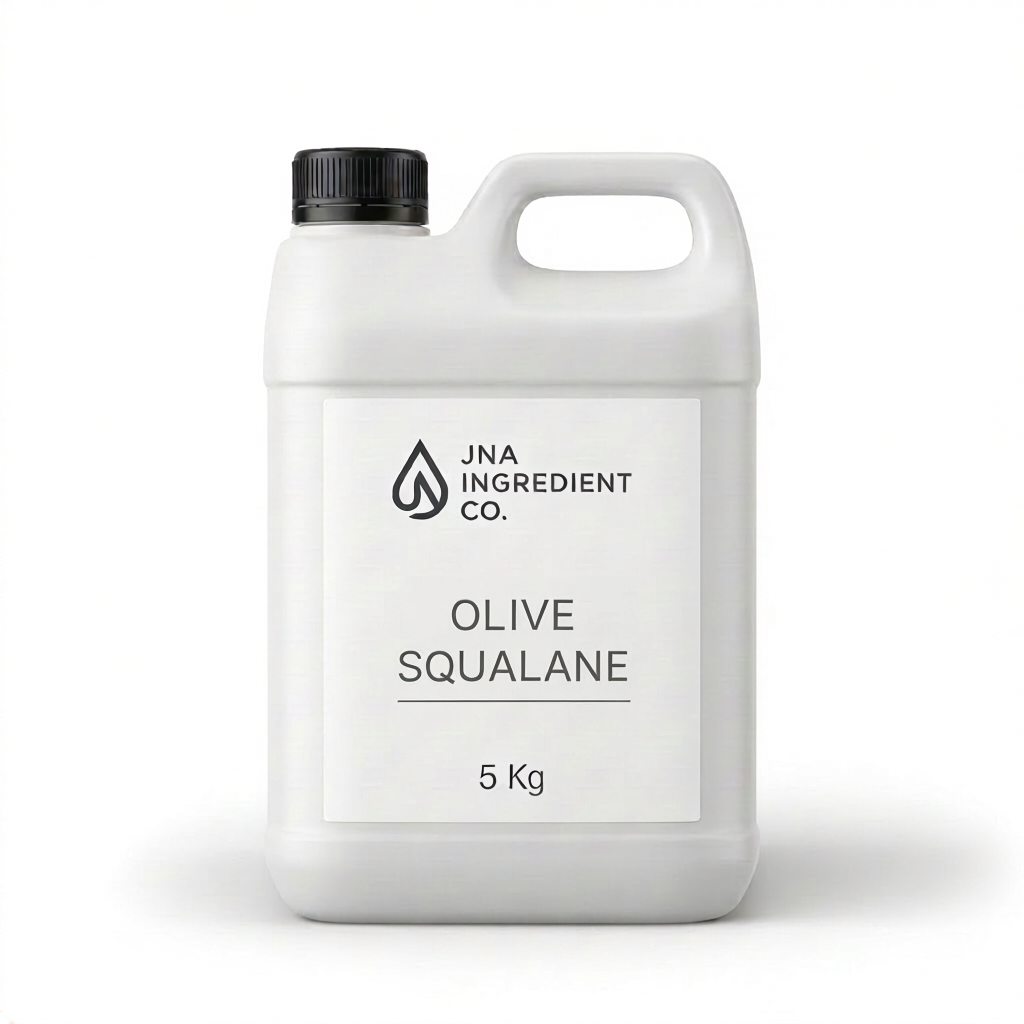


Product packaging may vary from the images shown based on pack size and packaging availability. Product specifications and declared net contents remain unchanged.
Olive Squalane
Sold by volume (mL or L). Due to its lightweight density (0.810–0.820 at 25°C), volume and weight will differ. Bulk 5 kg and above are sold by net weight.
Need a larger quantity? Explore bulk and trade supply options for production volumes.
VIEW BULK & TRADE OPTIONS →*Eligible Australian orders up to 10 kg. Bulk freight excluded.

Choose options


Selected for specification, not just ingredient name.
Specification Matters
Cosmetic grade
Documented quality
Formulator ready
FORMULATION OVERVIEW
Olive Squalane
.
JNA’s Olive Squalane is a high-purity, 100% olive-derived emollient selected for formulators seeking lightweight slip, softness and an elegant, non-heavy skin feel. Derived entirely from olive oil (Olea europaea) and purified using molecular distillation, it provides a plant-derived source of Squalane with a defined assay specification of ≥99.0%.
Its light, highly spreadable character makes Olive Squalane particularly useful for improving emollience, glide and after-feel without the heavier sensory profile associated with many conventional oils. It can be incorporated into facial oils, emulsions, balms and other oil-containing systems where formulators want softness and lubrication while maintaining an elegant finish.
Unlike conventional triglyceride-rich vegetable oils, Squalane is a saturated hydrocarbon emollient. This gives it a distinctly different formulation and sensory profile and makes it useful both as a standalone emollient and as part of more complex oil-phase systems.
JNA’s grade is explicitly plant-derived and not shark-derived, with a controlled ≥99.0% assay specification and manufacturer-confirmed non-GMO and BSE/TSE-free status. The current COA also specifies acid value ≤0.1 mg KOH/g, peroxide value ≤3.0 mmol/kg and conformity with the applicable USP standard.
KEY SPECIFICATIONS
FORMULATION NOTES
Processing Notes
Olive Squalane is an oil-phase emollient suitable for incorporation into anhydrous products and the oil phase of emulsions.
It can be blended with other compatible oil-phase ingredients to adjust spreadability, richness, slip and overall sensory character.
Compatibility Notes
Suitable for oil-based, anhydrous and emulsified cosmetic systems and can be combined with other compatible emollients and oil-phase ingredients.
Its lightweight sensory character makes it particularly useful for modifying heavier oil phases where improved spread, slip and reduced perceived heaviness are desired.
pH Notes
As an oil-phase hydrocarbon emollient, Squalane does not function as an aqueous pH-adjusting ingredient. In emulsions, finished-product pH should be established according to the requirements of the complete formulation.
Formulation Examples
Lightweight Facial Oil
Use Olive Squalane as part of the emollient system to improve spreadability, slip and create a lighter overall sensory profile.
Facial Serum Emulsion
Incorporate into the oil phase to provide lightweight emollience while balancing richer oils and structuring ingredients.
Cream or Lotion
Use within a mixed emollient system to contribute softness and glide without relying solely on conventional triglyceride oils.
Balm
Combine with waxes, butters and other liquid emollients to modify spreadability and reduce an excessively heavy or draggy feel.
Hair Serum or Treatment
Use within an appropriate oil-phase system where smoothness, slip and a lightweight emollient character are desired.
Troubleshooting
Finished product feels too heavy:
Consider replacing part of a heavier oil/emollient system with Squalane rather than simply reducing the entire oil phase.
Facial oil lacks glide:
Squalane can be used to modify the emollient blend and improve spread across the skin.
Balm has excessive drag:
Review the balance between waxes, solid lipids and liquid emollients. Squalane can contribute fluidity and slip but cannot correct an unsuitable structural system by itself.
Emulsion becomes unstable after changing the oil phase:
Changing the emollient blend can alter the requirements of the emulsification system. Reassess the complete oil phase and emulsifier rather than assuming Squalane can be substituted indefinitely without reformulation
SENSORY PROFILE
Formulation Impact
Provides lightweight emollience while helping improve spreadability, slip and the overall elegance of the oil phase.
Olive Squalane can be used to balance richer botanical oils, butters and waxes, helping reduce perceived heaviness and drag while retaining softness and conditioning. This makes it useful not only as an emollient in its own right, but as a sensory-modification tool within a broader emollient system.
Its low specific gravity of 0.810–0.820 at 25°C also distinguishes it physically from many conventional vegetable oils, although the final sensory character will always depend on the complete formulation.
QUALITY & SOURCING
JNA’s Olive Squalane is a high-purity, 100% olive-derived emollient sourced exclusively from olive oil (Olea europaea) and purified using a proprietary molecular distillation process. The material is entirely plant-derived and explicitly not sourced from sharks or other animal sources, providing formulators with a clearly defined botanical origin alongside a controlled ≥99.0% Squalane assay specification.
Origin
100% Olive Derived
COMPARISON & ALTERNATIVES
Choose CCT where a light, highly versatile triglyceride emollient and carrier is desired. Choose Olive Squalane where the formulation calls for the distinctive slip and sensory profile of Squalane together with an olive-derived sourcing story.
Jojoba is technically a liquid wax ester and provides a different emollient and sensory profile. Choose it where the formulation benefits from Jojoba’s characteristic wax-ester composition; choose Squalane where lightweight hydrocarbon emollience and high spreadability are priorities.
Camellia is a conventional botanical triglyceride oil with a richer fatty-acid profile. Choose it where botanical-oil character is central to the formulation; use Squalane where a lighter, more neutral emollient contribution is preferred.
STORAGE & HANDLING
Storage Conditions
Store in a cool, dry place in a tightly sealed container. Protect from strong light, direct heat and ignition sources. Keep separate from strong oxidising agents.
Handling Notes
Use clean, dry equipment when dispensing and keep the container tightly closed when not in use. Minimise unnecessary exposure to heat, light, air and contamination during handling.
Shelf Life / Retest Guidance
24 months when stored under recommended conditions. Refer to the product label and batch-specific COA for the applicable retest or expiry date.
PRODUCT SAFETY
Olive Squalane is supplied as a cosmetic raw material and should be handled using normal good industrial and formulation practices.
Warnings & Precautions
For formulation use. Avoid eye contact during handling. Keep away from ignition sources, excessive heat and strong oxidising agents.
DOCUMENTATION
Safety Data Sheet available. Batch-specific Certificate of Analysis documentation is maintained for the supplied material.
Formulator's Quick Guide
Why Formulators Choose This Ingredient
100% Olive Derived
Sourced entirely from olive oil (Olea europaea), providing a clearly defined plant-derived source with no shark or other animal-derived Squalane.
High-Purity Specifications
Supplied to a controlled ≥99.0% Squalane assay specification, with additional quality parameters covering acid value, peroxide value, residual solvents and impurities.
Molecularly Distilled
Purified using molecular distillation to produce a highly refined, consistent Squalane suitable for sophisticated cosmetic formulation.
Lightweight Sensory Performance
Provides excellent slip, easy spreadability and lightweight emollience, helping formulators soften and condition while avoiding the heavier sensory character of richer botanical oils.
Technical Documents
Safety Data Sheet available. Batch-specific Certificate of Analysis documentation is maintained for the supplied material.
Working With Olive Squalane
Olive Squalane - FAQ
Working With Olive Squalane
Ask a Question →What makes JNA’s Olive Squalane different from standard Squalane?
JNA’s Squalane has a defined 100% olive-oil origin and is purified using molecular distillation. It is supplied to a ≥99.0% Squalane assay specification, with controlled quality parameters including acid value, peroxide value, residual solvents and insoluble impurities.
Is Olive Squalane the same as olive oil?
No. Although JNA’s Squalane originates from olive oil, the finished ingredient is chemically different. Olive oil is predominantly composed of triglycerides, while Squalane is a saturated hydrocarbon. This gives Squalane a different stability, spreadability and sensory profile from conventional olive oil.
How does Olive Squalane compare with Caprylic/Capric Triglyceride?
Both are lightweight emollients that can improve spreadability and reduce the heaviness of an oil phase, but they are different ingredient types with distinct sensory profiles. Caprylic/Capric Triglyceride is a triglyceride emollient, while Squalane is a saturated hydrocarbon. Olive Squalane is particularly useful where formulators want silky slip, lightweight conditioning and a clearly defined olive-derived emollient.
Can Olive Squalane be used on its own in a facial oil?
Yes. Squalane can form the primary emollient in an anhydrous facial oil or be blended with other compatible emollients and botanical oils. Blending allows formulators to tailor richness, glide, spreadability and residual skin feel according to the intended product.
Can Olive Squalane help make a heavy formulation feel lighter?
Yes. Its high spreadability and lightweight emollient character make Squalane useful for modifying richer oil phases. Replacing part of a heavier botanical oil or butter system with Squalane can help improve glide and reduce perceived heaviness, although the final result depends on the complete emollient and structuring system.
Why does molecular distillation matter for Olive Squalane?
Molecular distillation is used during purification of JNA’s olive-derived Squalane to produce a highly refined finished material. JNA’s grade is supplied to a ≥99.0% Squalane assay specification, with additional limits for impurities, acid value, peroxide value and residual solvents.
Create Lighter, More Elegant Emollient Systems
Molecularly distilled for purity and consistency, it provides lightweight emollience, excellent slip and smooth spreadability, making it an ideal choice for facial oils, emulsions, balms and carefully balanced emollient systems.
Often paired with this ingredient
Explore a curated edit of key ingredients.
Learn more
Formulate with Confidence
Practical ingredient education and formulation guidance to help you choose, use and combine cosmetic ingredients with clarity.
Read All ArticlesJoin the JNA Community
Get practical formulation tips, launches & ingredient updates.
Create Lighter, More Elegant Emollient Systems
Molecularly distilled for purity and consistency, it provides lightweight emollience, excellent slip and smooth spreadability, making it an ideal choice for facial oils, emulsions, balms and carefully balanced emollient systems.