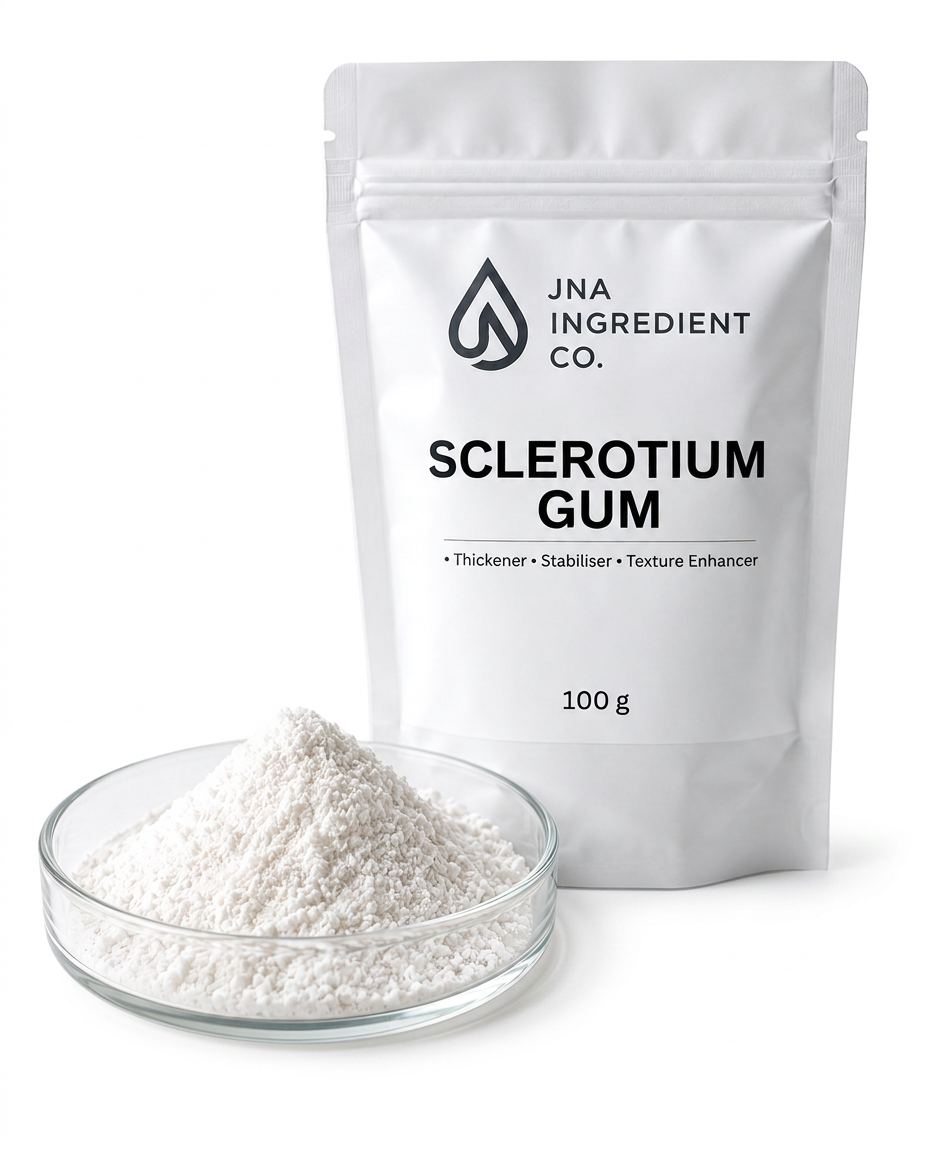
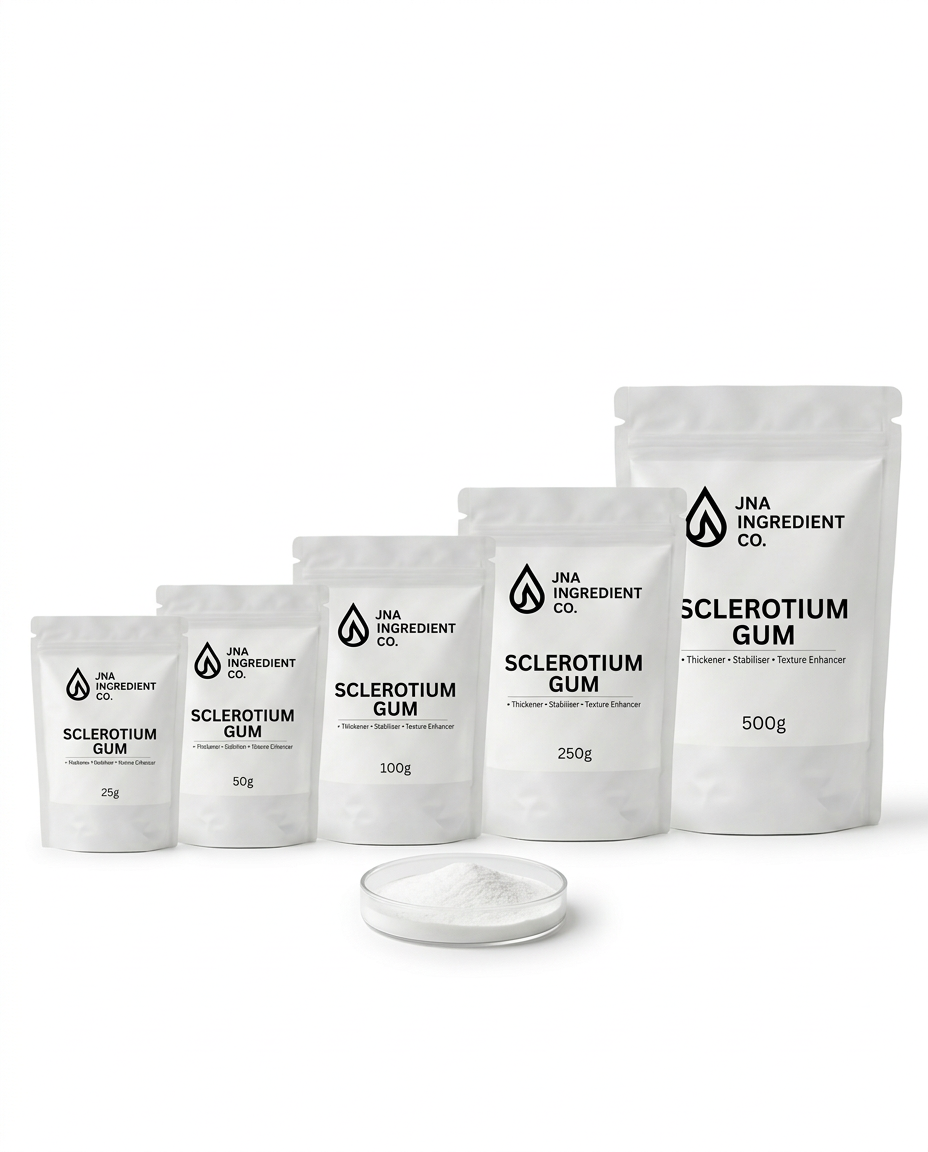
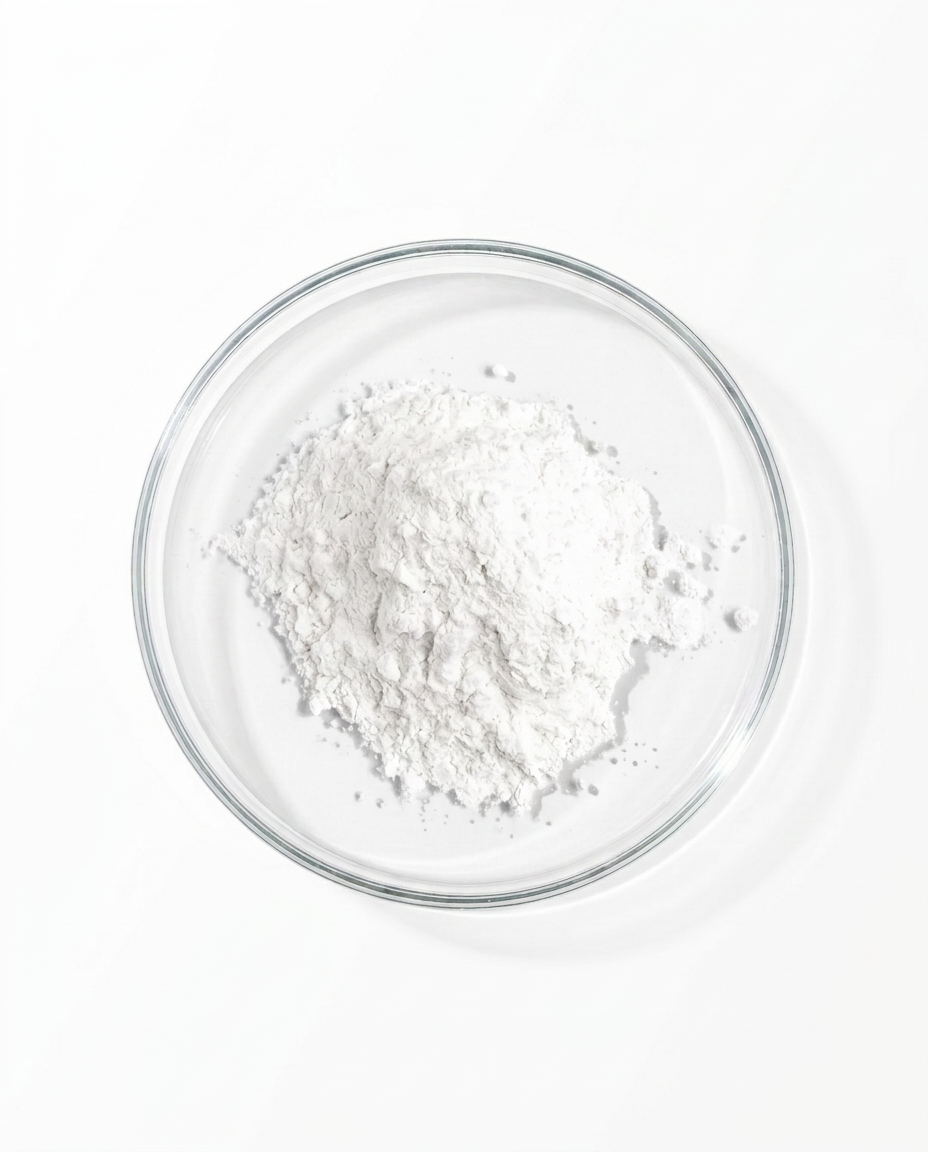
Product packaging may vary from the images shown based on pack size and packaging availability. Product specifications and declared net contents remain unchanged.
Sclerotium Gum
Need a larger quantity? Explore bulk and trade supply options for production volumes.
VIEW BULK & TRADE OPTIONS*Eligible Australian orders up to 10 kg. Bulk freight excluded.


Choose options
Selected for specification, not just ingredient name.

Specification Matters

Cosmetic grade

Documented quality

Formulator ready
FORMULATION OVERVIEW
Sclerotium Gum
JNA’s Sclerotium Gum is a cosmetic-grade, fermentation-derived polysaccharide supplied to a ≥99.0% assay specification for professional cosmetic formulation. A versatile rheology modifier, it builds viscosity and smooth gel structure while also supporting stabilisation and suspension in water-based and emulsified systems.
Its formulation value extends beyond simple thickening. Sclerotium Gum can help stabilise oil-in-water emulsions, suspend insoluble particles and improve spreadability, while contributing the smooth, silky and non-sticky sensory profile identified for this grade.
Water soluble and stable across a broad pH range, it gives formulators flexibility across serums, gels, creams, lotions, masks, sunscreens, shampoos, conditioners and makeup formulations. This makes it particularly useful where viscosity, stability and finished-product aesthetics need to be considered together rather than treating thickening as an isolated function.
Why Formulators Choose Sclerotium Gum
Multi-Functional Rheology Control
Provides thickening, gelling and suspending functionality, allowing formulators to manage viscosity, structure and particle suspension with one rheology modifier.
Broad pH Formulation Flexibility
Stable across a broad pH 3–12 range, making it useful across cosmetic formulations with differing finished-product pH requirements.
Smooth, Elegant Texture
Helps create smooth gel textures, improve spreadability and contribute a silky, non-sticky skin feel - particularly valuable where sensory elegance matters alongside viscosity.
Supports Emulsion & Suspension Stability
Helps stabilise oil-in-water emulsions and suspend insoluble particles, providing useful structural support beyond viscosity building alone.
Processing Notes
Compatibility Notes
pH Notes
Sclerotium Gum is stable across a broad pH range of approximately 3–12. The supplied material has a specified pH of 5.5–8.0 when measured as a 0.2% aqueous solution. It is not used primarily as a pH adjuster; finished-product pH should be selected according to the requirements of the complete formulation.
Formulation Examples
Troubleshooting
Formulation Impact
Quality Testing
Heavy Metals <5.0 mg/kg · Total Plate Count ≤1,000 CFU/g · Yeast & Moulds ≤100 CFU/g · E. coli Negative · Salmonella Negative
Supported Claims

A widely used polysaccharide thickener and stabiliser suitable for many aqueous cosmetic systems. Consider Xanthan Gum where robust viscosity building and suspension support are priorities and a different finished texture is acceptable.

A cellulose-derived non-ionic thickener useful for building viscosity in aqueous systems. Consider HEC where a cellulose-based rheology modifier and a different flow and sensory profile are preferred.

A synthetic polymeric rheology modifier capable of producing high-viscosity, structured gels. Consider Carbomer 940 where strong gel formation and precise viscosity control are required and the formulation is suitable for the processing and neutralisation requirements of a carbomer system.
Storage Conditions
Handling Notes
Shelf Life / Retest Guidance
Shelf life is 24 months when stored under the recommended conditions. Refer to the expiry date shown on the product label and applicable batch documentation.
Warnings & Precautions
Formulator's Quick Guide
Why Formulators Choose This Ingredient

Multi-Functional Rheology Control
Provides thickening, gelling and suspending functionality, helping formulators manage viscosity and structure with one rheology modifier

Broad pH Flexibility
Performs across a broad pH range, making it useful across formulation systems with very different finished-product pH requirements.

Smooth Sensory Profile
Helps create smooth textures with good spreadability and a silky, non-sticky feel, making it particularly attractive for elegant skincare formulations.

Stability & Suspension Support
Provides structural support for oil-in-water emulsions and suspended insoluble materials, extending its usefulness beyond viscosity building alone.
Technical Documents
Sclerotium Gum
FORMULATOR FAQ - SCLEROTIUM GUM
Working With Sclerotium Gum
Ask a QuestionWhat is the difference between Sclerotium Gum and Xanthan Gum?
Does Sclerotium Gum need to be neutralised?
How should Sclerotium Gum be added to a formulation?
Can Sclerotium Gum help suspend particles?
Can Sclerotium Gum be used in emulsions?
Is Sclerotium Gum suitable across different formulation pH levels?
Often paired with this ingredient
Explore a curated edit of key ingredients.