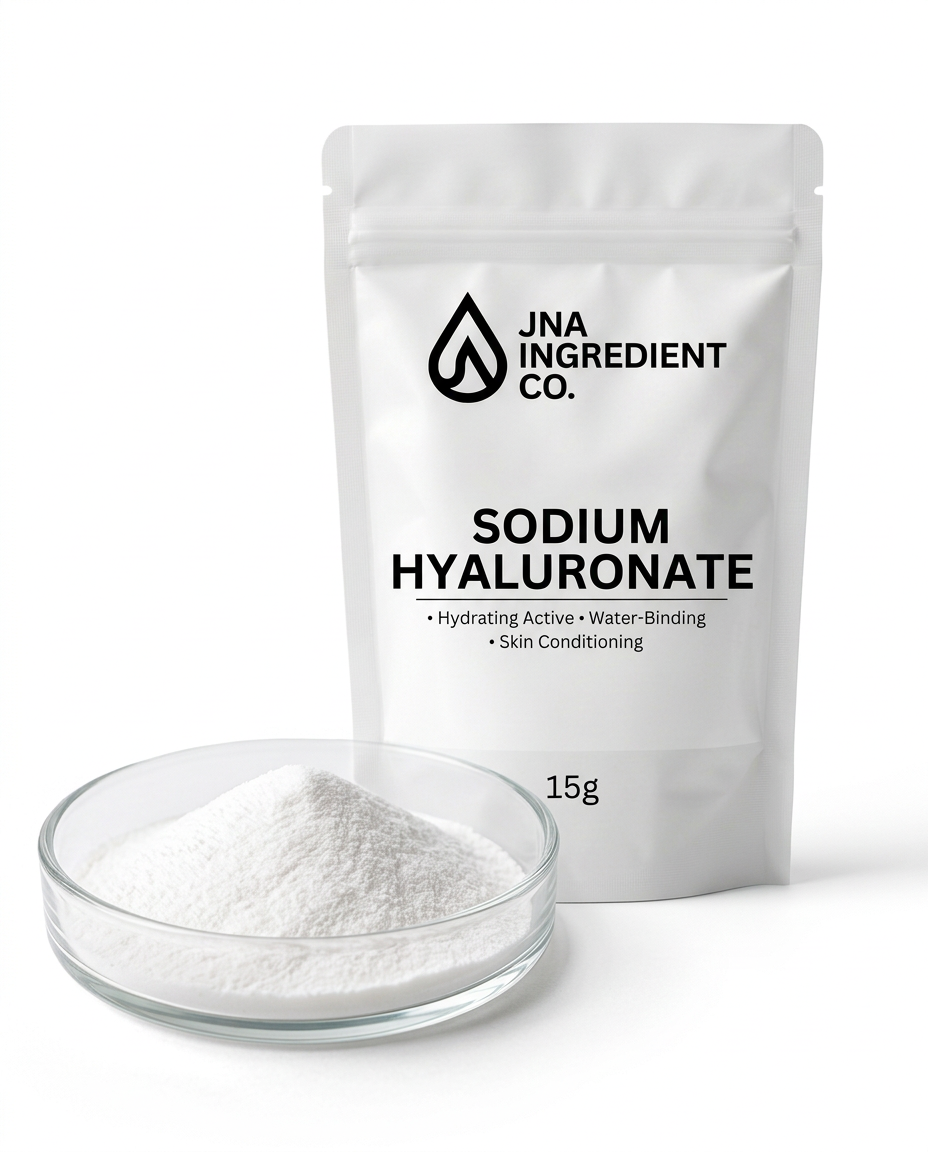


Product packaging may vary from the images shown based on pack size and packaging availability. Product specifications and declared net contents remain unchanged.
Sodium Hyaluronate (Hyaluronic Acid) Powder - LMW
Sold by weight (g or Kg) for formulation accuracy.
Need a larger quantity? Explore bulk and trade supply options for production volumes.
VIEW BULK & TRADE OPTIONS →*Eligible Australian orders up to 10 kg. Bulk freight excluded.

Choose options
Selected for specification, not just ingredient name.
Specification Matters
Cosmetic grade
Documented quality
Formulator ready
FORMULATION OVERVIEW
Sodium Hyaluronate (Hyaluronic Acid) Powder - LMW
JNA’s Sodium Hyaluronate LMW is a high-purity, cosmetic-grade humectant with a defined low molecular weight range of 50–100 kDa, selected for sophisticated hydration-focused skincare formulations. With an assay specification of ≥99%, it gives formulators a clearly characterised Sodium Hyaluronate grade for building targeted moisture support into serums, toners, gels, creams and other water-based systems.
Highly water soluble, JNA’s Sodium Hyaluronate LMW provides water-binding, moisture-retention and film-forming functionality, helping support hydrated, smooth and conditioned-feeling skin. Its low molecular weight profile makes it particularly useful within layered hydration systems alongside complementary humectants and skin-conditioning ingredients.
Once hydrated in water, Sodium Hyaluronate contributes characteristic viscosity and film formation, allowing it to provide both functional hydration and a meaningful influence on finished-product texture and skin feel. It can be incorporated into lightweight aqueous products as well as emulsions, masks and eye-care formulations.
JNA’s defined 50–100 kDa molecular weight specification, together with controlled assay, glucuronic acid, heavy-metal and microbiological parameters, provides formulators with a consistent LMW grade for repeat formulation and product development.
KEY SPECIFICATIONS
FORMULATION NOTES
Processing Notes
Sodium Hyaluronate should be incorporated into the aqueous phase and allowed to hydrate completely before final viscosity and texture are assessed.
Compatibility Notes
Suitable for water-based and water-containing cosmetic systems, including serums, toners, gels, masks and emulsions.
It can be incorporated into layered hydration systems alongside complementary humectants and water-soluble skincare ingredients. Compatibility should be evaluated within the complete formulation, particularly where significant electrolyte loads, multiple polymers or complex active systems are present.
pH Notes
The raw material has a documented aqueous-solution pH of 6.0–7.5. Set final formulation pH according to the requirements of the complete system.
Formulation Examples
Hydrating Serum
Combine Sodium Hyaluronate LMW with complementary humectants such as Glycerin, Sodium PCA or D-Panthenol to build a layered hydration system.
Lightweight Gel
Incorporate into an aqueous gel where both moisture-binding functionality and a conditioned skin feel are desired.
Hydrating Toner or Essence
Use at an appropriate low level to introduce Sodium Hyaluronate functionality while maintaining a lightweight fluid format.
Cream or Lotion
Incorporate into the aqueous system of an emulsion to complement the formula’s broader humectant and emollient system.
Troubleshooting
Powder forms clumps: Ensure adequate dispersion and avoid adding a concentrated mass of powder into insufficiently agitated water.
Texture continues changing after manufacture: Sodium Hyaluronate requires complete hydration. Do not make final rheology adjustments before hydration is complete.
Formula becomes more viscous than expected: Consider the total polymer system and Sodium Hyaluronate level rather than evaluating it solely as a humectant.
Unexpected behaviour in a complex system: Evaluate electrolytes, other polymers and the complete active system and conduct compatibility testing before scale-up.
SENSORY PROFILE
Formulation Impact
Sodium Hyaluronate functions as more than a simple water-binding ingredient. Once hydrated, it can influence viscosity, film formation, flow and finished-product sensory character.
The final sensory effect depends on concentration and the surrounding humectant, polymer, emollient and rheology systems
QUALITY & SOURCING
JNA’s Sodium Hyaluronate LMW is supplied as a cosmetic-grade, ≥99.0% Sodium Hyaluronate with a defined 50–100 kDa molecular weight specification and ≥45.0% glucuronic acid specification.
The defined molecular-weight range gives formulators a clearly characterised LMW grade rather than an unspecified Sodium Hyaluronate powder.
Quality Testing
Controlled heavy-metal and microbiological specifications include: Heavy metals ≤5.0 ppm · As ≤1.0 ppm · Pb ≤1.0 ppm · Cd ≤1.0 ppm · Hg ≤1.0 ppm · Total Plate Count ≤1,000 CFU/g · Yeast & Mould ≤100 CFU/g · E. coli Negative · Salmonella Negative.
Supported Claims
JNA’s Sodium Hyaluronate is selected to a defined 50–100 kDa molecular weight specification, with controlled assay, glucuronic acid, heavy-metal and microbiological parameters supporting consistency for formulation and repeat production.
COMPARISON & ALTERNATIVES
Choose for efficient, economical humectancy and broad formulation versatility. Glycerin is useful as a foundational humectant but does not provide the same polymeric film-forming behaviour as Sodium Hyaluronate.
Choose for a lightweight, highly water-soluble humectant associated with the skin’s natural moisturising factor.
Choose where humectancy, conditioning and skin-comfort support are desired within the same formulation.
STORAGE & HANDLING
Storage Conditions
Store in a sealed, cool and dry place, protected from strong light and heat. Avoid moisture exposure.
Handling Notes
Keep the container tightly sealed after opening and use clean, dry equipment when weighing or dispensing. Avoid unnecessary dust generation and moisture uptake during handling.
Shelf Life / Retest Guidance
24 months when stored under recommended conditions.Refer to the product label and applicable batch documentation for batch-specific retest or expiry information.
PRODUCT SAFETY
Sodium Hyaluronate is supplied as a raw material for cosmetic formulation. Appropriate good manufacturing and occupational hygiene practices should be followed when handling and incorporating the powder.
Warnings & Precautions
For formulation use only. Not intended for direct application in concentrated raw-material form. Avoid eye contact and unnecessary inhalation of powder. Minimise dust generation during weighing and dispensing. Keep out of reach of children.
DOCUMENTATION
Formulator's Quick Guide
Why Formulators Choose This Ingredient
Defined LMW Profile
A defined 50–100 kDa molecular weight range gives formulators a clearly characterised low molecular weight Sodium Hyaluronate grade.
Concentrated Hydration
Provides concentrated water-binding and moisture-retention functionality at relatively low formulation levels.
Film-Forming Support
Forms a lightweight moisture-supporting film within the finished formulation, contributing to hydrated and smooth-feeling skin.
Layered Hydration Versatility
Pairs naturally with complementary humectants and skin-conditioning ingredients, allowing formulators to build multi-component hydration systems rather than relying on a single humectant.
Technical Documents
FORMULATION SUPPORT
Sodium Hyaluronate - FAQ
Working With Sodium Hyaluronate LMW
Ask a Question →What does 50–100 kDa mean for this Sodium Hyaluronate?
It identifies the product’s defined molecular weight range. Sodium Hyaluronate is available commercially across substantially different molecular-weight ranges, so specifying 50–100 kDa tells formulators which grade they are working with and supports more consistent formulation development.
Is Sodium Hyaluronate the same as Hyaluronic Acid?
They are closely related but are not chemically identical names. Sodium Hyaluronate is the sodium salt of Hyaluronic Acid and is commonly supplied as a water-soluble cosmetic raw material.
Does low molecular weight mean it penetrates deeper into the skin?
Molecular weight influences the behaviour of Sodium Hyaluronate, but claims about specific depths of skin penetration should not be inferred from molecular weight alone. JNA identifies this material by its 50–100 kDa specification so formulators know precisely which molecular-weight grade they are using.
Why can Sodium Hyaluronate change the texture of my formulation?
Once hydrated, Sodium Hyaluronate behaves as a water-binding polymer and can contribute viscosity and film formation. Its effect on texture depends on concentration and the surrounding polymer, humectant and rheology systems.
Can I combine Sodium Hyaluronate with other humectants?
Yes. Sodium Hyaluronate can form part of a layered hydration system alongside ingredients such as Glycerin, Sodium PCA and D-Panthenol, allowing formulators to combine different water-binding and sensory characteristics.
Why should I allow Sodium Hyaluronate to hydrate before adjusting viscosity?
The polymer’s behaviour changes as hydration develops. Assessing viscosity too early can lead to unnecessary thickener adjustments and an unexpectedly viscous finished product once full hydration occurs.
Build More Considered Hydration Systems
With a ≥99% assay specification, high water solubility and compatibility with a wide range of water-containing product formats, it provides a versatile foundation for serums, toners, gels, creams, masks and layered hydration systems.
- 5 stars: 1 (100%)
- 4 stars: 0 (0%)
- 3 stars: 0 (0%)
- 2 stars: 0 (0%)
- 1 star: 0 (0%)
very happy with this product and quality
Often paired with this ingredient
Explore a curated edit of key ingredients.
Learn more
Formulate with Confidence
Practical ingredient education and formulation guidance to help you choose, use and combine cosmetic ingredients with clarity.
Read All Articles
Ingredient Knowledge
Ingredient Spotlight: Glycerin – Why It Remains a Formulation Essential
Ingredient Knowledge
Ingredient Spotlight: Squalane – Why It's One of Skincare's Most Loved Oils
Ingredient Knowledge
What Does Beta-Glucan Do in Skincare?
Ingredient Knowledge
Understanding Cosmetic Actives in Formulation
Ingredient Knowledge
Why Formulators Use Ectoin
Ingredient Knowledge
Niacinamide for Barrier Support and Skin Balance
Beginner Formulation
What Does Pentylene Glycol Do in Skincare?
Beginner Formulation
How to Formulate a Hydrating Face Serum
Beginner Formulation
Why Glycerin Still Matters
Article
Sodium Hyaluronate VS Hyaluronic Acid
Article
What Does Panthenol Do in Skincare
Join the JNA Community
Get practical formulation tips, launches & ingredient updates.
Build More Considered Hydration Systems
With a ≥99% assay specification, high water solubility and compatibility with a wide range of water-containing product formats, it provides a versatile foundation for serums, toners, gels, creams, masks and layered hydration systems.