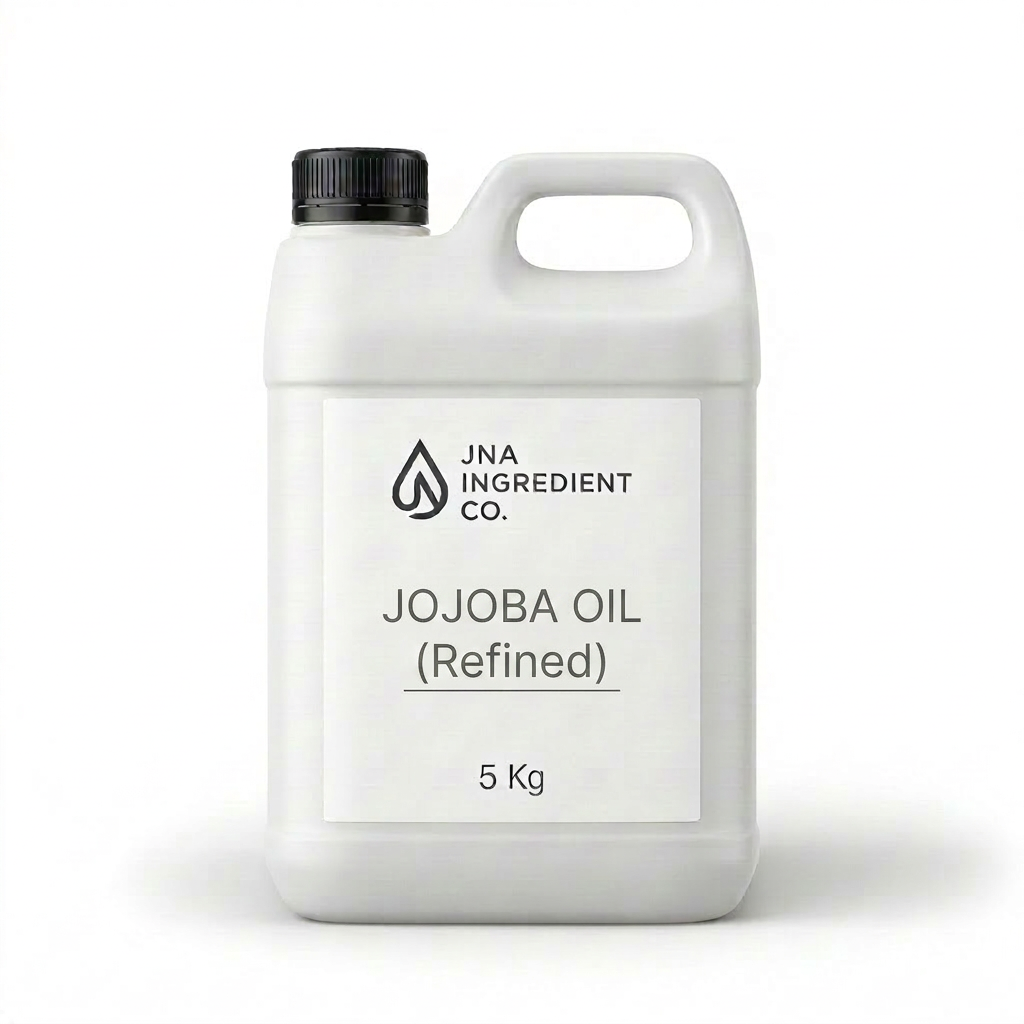
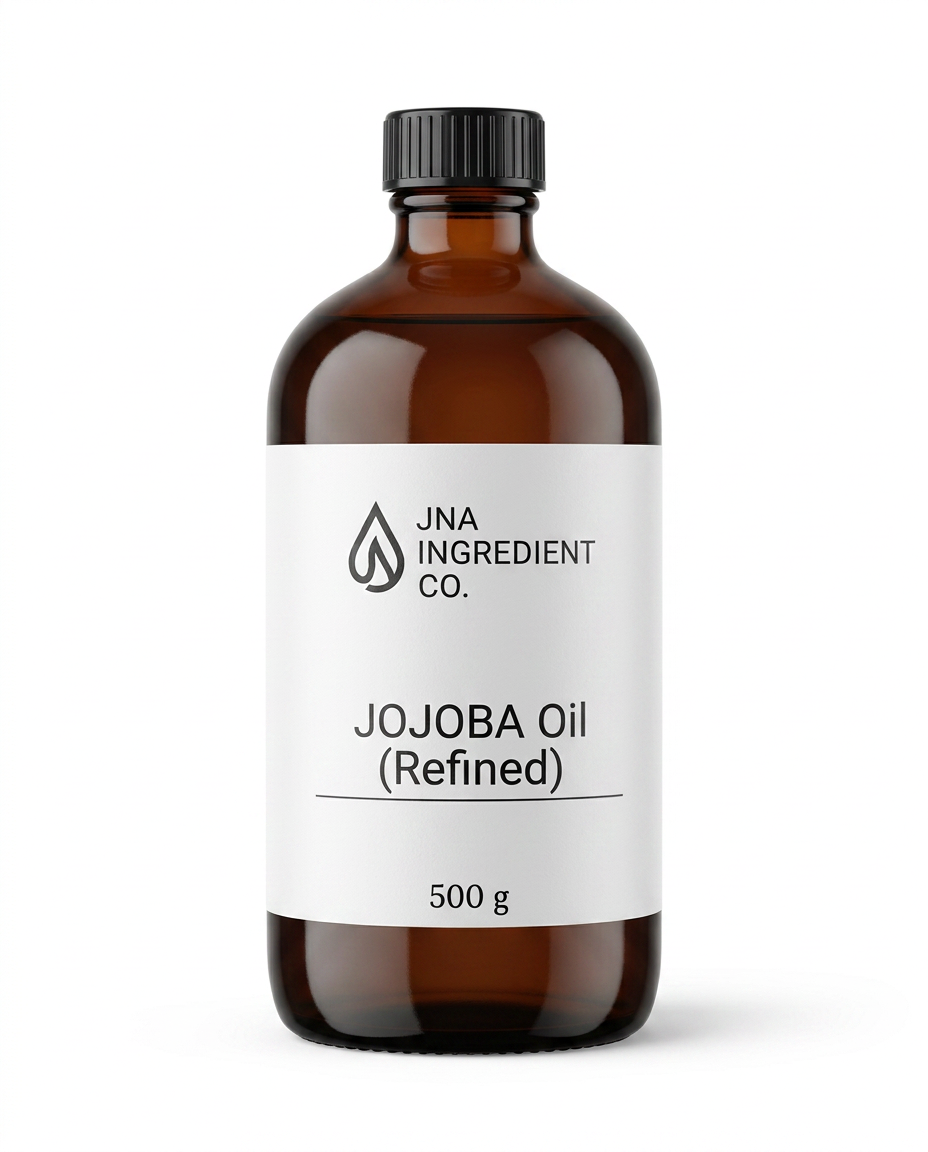

Product packaging may vary from the images shown based on pack size and packaging availability. Product specifications and declared net contents remain unchanged.
Jojoba Oil (Refined)
Pack sizes up to 1 L are sold by volume; bulk packs are sold by weight.
Need a larger quantity? Explore bulk and trade supply options for production volumes.
VIEW BULK & TRADE OPTIONS →*Eligible Australian orders up to 10 kg. Bulk freight excluded.

Choose options


Selected for specification, not just ingredient name.
Specification Matters
Cosmetic grade
Documented quality
Formulator ready
FORMULATION OVERVIEW
Jojoba Oil (Refined)
Jojoba Oil is a versatile botanical emollient valued for its smooth spreadability, conditioning properties and elegant skin feel.
Structurally a liquid wax ester rather than a conventional triglyceride oil, it is particularly suited to facial oils, serums, creams, lotions, balms, body care and haircare formulations.
JNA supplies cosmetic-grade Jojoba Oil selected for consistent quality and predictable formulation performance.
KEY SPECIFICATIONS
FORMULATION NOTES
Processing Notes
Add to the oil phase and mix until uniform. Suitable for cold-process formulations and the oil phase of heated emulsions. Can also be used as a primary emollient in anhydrous formulations.
Compatibility Notes
Compatible with most cosmetic oils, emollients, esters, waxes and oil-soluble ingredients. Suitable for anhydrous formulations and the oil phase of emulsions.
Blends well with lighter and richer emollients to adjust spreadability, richness and after-feel.
pH Notes
Not pH dependent in anhydrous systems; in emulsions, follow the pH requirements of the overall formulation.
Formulation Examples
Facial oils: 10–100%
Creams & lotions: 2–10%
Balms: 5–30%
Body oils: 10–100%
Hair oils & treatments: 2–100%
Troubleshooting
Formula feels too rich or oily: Reduce the use level or blend with a lighter, faster-spreading emollient such as CCT or Squalane.
Formula needs more cushion: Increase the Jojoba Oil level or combine with a richer botanical oil or butter.
Unexpected odour or appearance develops during storage: Review storage conditions, contamination risk and the stability of the overall oil phase.
SENSORY PROFILE
Formulation Impact
Provides smooth emolliency and good spreadability with a soft, conditioned after-feel. Its wax-ester character makes Jojoba Oil particularly useful for refining the sensory profile of facial oils, serums, creams, lotions, balms and haircare formulations.
QUALITY & SOURCING
Cosmetic-grade Jojoba Oil supplied to defined specifications for assay, acid value, peroxide value, tocopherol content, heavy metals and microbiological quality.
Quality Testing
Heavy metals ≤5.0 ppm; microbiological quality tested to specification.
COMPARISON & ALTERNATIVES
Choose for a lighter, silkier premium emollient with excellent spreadability and a low-grease finish.
Choose for a lightweight, cost-effective emollient with fast spread and a neutral sensory profile.
Choose for a more traditional botanical carrier oil with a richer, more cushioned emollient feel.
STORAGE & HANDLING
Storage Conditions
Store in a cool, dry place away from light and heat. Keep the container tightly closed when not in use.
Handling Notes
Use clean, dry equipment when dispensing and minimise unnecessary exposure to heat, light and contamination. Clean spills promptly, as the oil may create a slippery surface.
Shelf Life / Retest Guidance
2 years when properly stored.
PRODUCT SAFETY
For cosmetic formulation use. Follow appropriate good manufacturing and hygiene practices when handling and formulating.
Warnings & Precautions
Avoid contact with eyes. Clean spills promptly, as the oil may create a slippery surface. Keep the container closed when not in use.
Use clean, dry equipment and avoid contamination during dispensing and repacking.
DOCUMENTATION
Safety Data Sheet available. Batch-specific Certificate of Analysis documentation is maintained for the supplied material.
Formulator's Quick Guide
Why Formulators Choose This Ingredient
Liquid Wax Ester Advantage
Jojoba is predominantly composed of liquid wax esters rather than triglycerides, giving formulators a genuinely different emollient tool from conventional botanical oils.
Exceptional Oxidative Stability
Its wax-ester composition gives Jojoba excellent resistance to oxidation compared with many triglyceride-rich botanical oils, making it especially valuable in formulations where oil-phase stability matters.
Elevates Emollient Blends
Jojoba does not need to dominate the oil phase to make a meaningful difference. Blend it with Squalane, botanical oils, esters, butters and other compatible emollients to improve glide, balance richness and create a smoother, more refined sensory profile tailored to the finished produc
Skin + Hair Conditioning Versatility
Delivers smooth slip, softness and conditioning across both skin and hair, making one ingredient useful across facial skincare, body care, lip care and conditioning hair formulations.
Technical Documents
Safety Data Sheet available. Batch-specific Certificate of Analysis documentation is maintained for the supplied material.
FORMULATION SUPPORT
Jojoba Oil FAQ
Working With Jojoba Oil
Ask a Question →Is Jojoba Oil actually an oil?
Despite its common name, Jojoba Oil is technically a liquid wax, composed predominantly of wax esters rather than the triglycerides found in most conventional botanical oils. This difference contributes to its distinctive formulation and sensory characteristics.
How does Jojoba Oil differ from conventional botanical oils?
Most botanical oils are primarily triglycerides composed of glycerol and fatty acids. Jojoba instead contains predominantly long-chain wax esters, giving formulators a different emollient profile. It can therefore be useful when building an oil phase with varied sensory and functional characteristics rather than simply combining several similar triglyceride oils.
Why is Jojoba Oil more oxidatively stable than many botanical oils?
Jojoba is composed predominantly of wax esters rather than triglycerides, giving it a different oxidative profile from many conventional botanical oils. This makes Jojoba particularly useful when formulators want a plant-derived emollient with strong inherent oxidative stability, especially within oil-rich and anhydrous formulations.
Does Jojoba Oil need an antioxidant such as Tocopherol?
Jojoba has good inherent oxidative stability, but that does not automatically protect every other oil in the formulation. If a blend contains more oxidation-sensitive botanical oils, an antioxidant may still be appropriate for the overall oil phase. Assess the complete lipid blend rather than assuming Jojoba removes the need for oxidative protection.
Can Jojoba Oil replace another botanical oil 1:1?
Sometimes from a percentage perspective, but not necessarily from a formulation-performance perspective. Replacing a triglyceride oil with Jojoba changes the composition of the emollient phase and can alter spreadability, richness, slip and after-feel. In emulsions, a substantial change to the oil phase should also be followed by stability testing rather than assuming the original system will behave identically.
Can Jojoba Oil be blended with Squalane or other emollients?
Yes - and this is often more useful than treating the ingredients as alternatives. Jojoba Oil and Squalane provide different emollient profiles and can be blended with each other or with botanical oils, esters and other compatible oil-phase ingredients to tailor richness, slip, spreadability and after-feel.
Often paired with this ingredient
Explore a curated edit of key ingredients.
Learn more
Formulate with Confidence
Practical ingredient education and formulation guidance to help you choose, use and combine cosmetic ingredients with clarity.
Read All ArticlesJoin the JNA Community
Get practical formulation tips, launches & ingredient updates.