Skip to content

Cart

Your cart is empty

Caprylic/Capric Triglycerides (MCT Oil)

INCI: Caprylic/Capric Triglycerides · CAS: 73398-61-5

100%Natural Origin
Coconut-derived, palm-free CCT with a defined 60:40 C8:C10 ratio for smooth spreading and a light, non-greasy feel.
Coconut-derived
Palm-free
100% natural origin
Sale price$11.95
Available in:

Available to order

All pack sizes are sold by volume and filled by weight to achieve the labelled volume. CCT has a density of 0.930–0.940 g/mL at 25°C. Fill weights vary with batch density and temperature.

Calculate quantity needed +
Recommended use levels

General guidance: 2–20% in leave-on emulsions; 2–10% in rinse-off emulsions. Anhydrous products may use higher proportions.

Excludes processing loss and retained samples. The calculation does not establish a suitable or effective use level.

JNA Ingredient Co Caprylic/Capric Triglycerides (MCT Oil), 500 mL amber bottle
Caprylic/Capric Triglycerides (MCT Oil)100 mL Sale price$11.95
Australianowned & operated
Trusted byformulators
Quality ingredientsfor real results
Wholesale & bulk supply enquiriesTell us your ingredient, quantity and timeframe

Our Caprylic/Capric Triglycerides (MCT Oil)

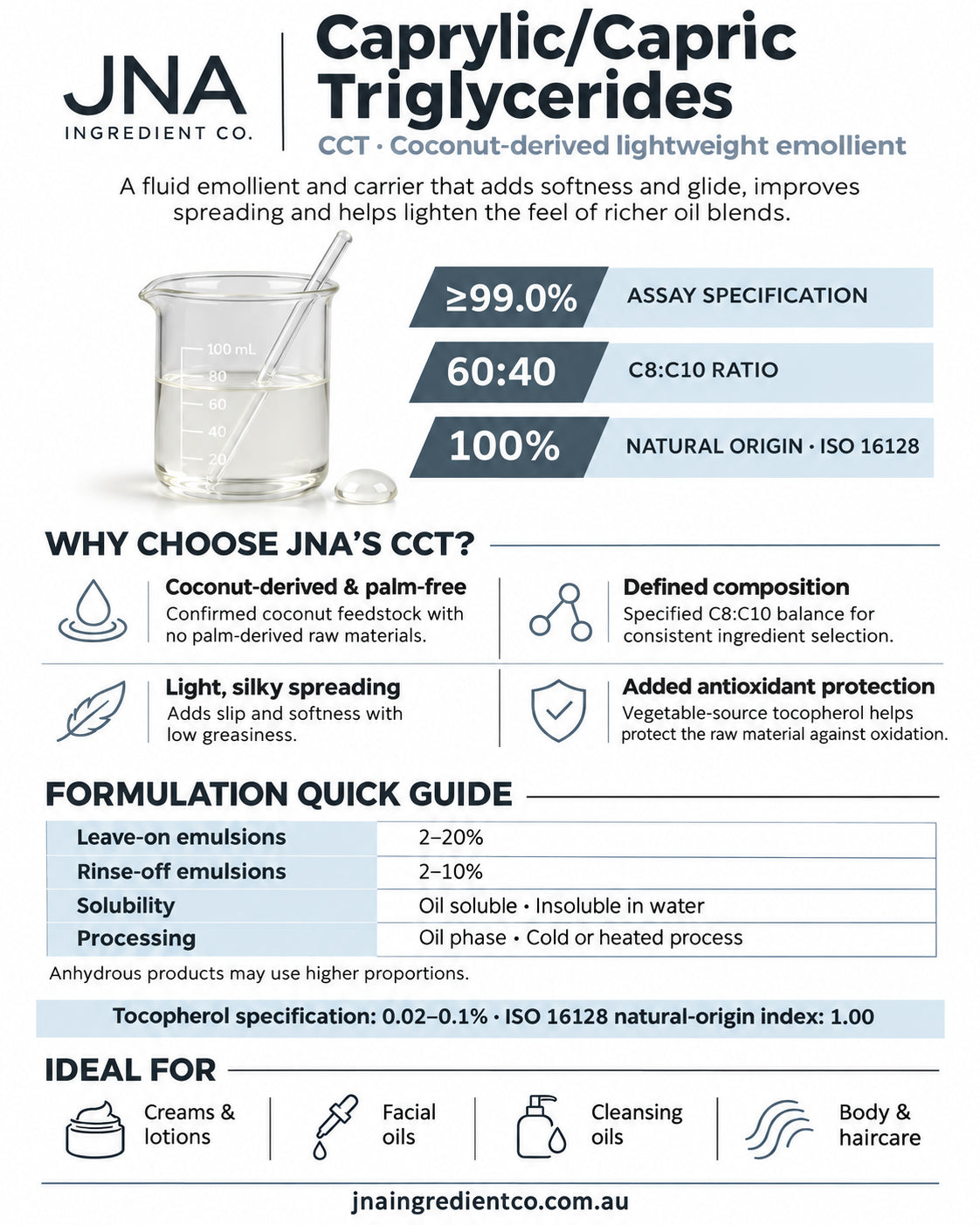
JNA’s Caprylic/Capric Triglycerides (CCT) is a coconut-derived, palm-free emollient for smooth creams, lighter-feeling lotions and facial oils that spread effortlessly. Almost odourless, it adds softness and glide while helping refine the heavy or greasy feel of richer botanical oil blends.

Our grade combines a minimum 99% assay specification, a defined 60:40 C8:C10 ratio and an ISO 16128 natural-origin index of 1.00 (100%). These give you clear composition and sourcing details when selecting an emollient for development and repeat production.

Produced through fractionation, re-esterification and refining of coconut oil, our CCT has a clear, light pale-yellow appearance. Added natural vegetable-source tocopherol provides antioxidant protection for the raw material, complementing its controlled acid and peroxide values.

Use it as an emollient base or carrier for compatible oil-soluble ingredients across facial oils, emulsions, cleansing oils, body care and haircare, tailoring richness and spreadability to your finished product.

Why choose JNA’s Caprylic/Capric Triglycerides?

  • Defined 60:40 CompositionMinimum 99% assay with a specified C8:C10 ratio, giving you a clearly characterised emollient for repeat formulation.
  • Smooth, Lightweight SpreadingAdds glide and softness while helping balance the heavy or greasy feel of richer botanical oil blends.
  • Added Antioxidant ProtectionNatural vegetable-source tocopherol helps protect the raw material against oxidation during storage.
  • Coconut-Derived & Palm-FreeConfirmed coconut feedstock with an ISO 16128 natural-origin index of 1.00, supporting formulations where origin matters.

KEY SPECIFICATIONS

Know what you’re formulating with.

≥99%

Assay Specification

INCI
Caprylic/Capric Triglycerides
Otherwise known as
MCT Oil
CAS number
73398-61-5
Grade
Cosmetic Grade
Appearance
Colourless to slightly yellowish clear liquid
Source
Coconut-derived, palm-free
Recommended use range
General guidance: 2–20% in leave-on emulsions; 2–10% in rinse-off emulsions. Anhydrous products may use higher proportions.
Assay specification
≥99.0%
Solubility
Oil soluble
  • No Animal Testing

    Declared Not tested on Animals

  • 100% Palm Free

    No palm oil, palm kernel oil or palm-derived raw materials

  • Natural Origin

    Product is 100% · ISO 16128

  • Coconut Derived

    Made using coconut-derived triglycerides.

QUALITY · SOURCING · SAFE HANDLING

Selected for specification.

Ingredient name is the beginning. Specification is the difference.

We select our ingredients for the quality behind the name: the right grade, defined purity or composition, clear origin and consistent specifications.

Our focus is dependable ingredients, supported by clear technical information, that you can formulate with confidence and rely on for repeat production.

Need more information about this ingredient
Formulation & Processing

Processing

Add to the oil phase and mix until uniform. Suitable for cold-process formulations and the oil phase of heated emulsions. Can also be used as the primary emollient or carrier in anhydrous formulations.

Compatibility

Blend with compatible botanical oils, esters and other oil-phase ingredients to adjust spreadability and richness. Check each active’s solubility in CCT; oil-soluble does not guarantee it will dissolve at your intended concentration.

pH guidance

pH is not applicable to the neat oil. For emulsions, select the finished-product pH for the emulsifier, preservative and active ingredients.

Troubleshooting

For a lighter-feeling blend, trial replacing part of a richer oil with CCT. For more cushion or body, adjust the richer emollients or structuring ingredients. Compare at the same total oil-phase level.

Grade & analytical controls

C8:C10 ratio: 60:40. ISO 16128 natural-origin index: 1.00 (100%).

Natural vegetable-source tocopherol is added as an antioxidant to help protect the raw material against oxidation. The documented tocopherol specification is 0.02-0.1%.

Controlled to defined heavy-metal specifications; microbiological quality tested to specification.

Coconut-derived and palm-free. Produced through coconut oil fractionation, re-esterification and distillation, followed by decolourisation and deodorisation. Manufacturer-confirmed ISO 16128 natural-origin index: 1.00 (100%). The triglyceride feedstock is coconut-derived, providing a renewable botanical source.

Storage & shelf life

Store in a cool, dry place away from direct sunlight and heat. Keep the container tightly closed when not in use.

24 months under the recommended storage conditions. Refer to the batch documentation for the applicable expiry or retest date.

Handling & product safety

Use clean, dry equipment when dispensing and avoid contamination. Clean spills promptly, as the liquid may create a slippery surface.

Refer to the current Safety Data Sheet for handling, storage and safety information before use.

Avoid contact with eyes. Clean spills promptly, as the liquid may create a slippery surface.

Assess the finished product for safety, stability, preservation and suitability for its intended use.

Documentation
Shipping & supply

Shipping charges and delivery options are confirmed at checkout. For supply quantities beyond the listed packs, contact JNA with your requirements.

View shipping information ↗
Need more information about this ingredient

FORMULATOR FAQ

Caprylic/Capric Triglycerides Frequently Asked Questions

Working with CCT

How does CCT differ from conventional botanical oils?

CCT is composed predominantly of triglycerides of saturated caprylic and capric fatty acids. Botanical oils such as sunflower or sweet almond contain a broader fatty-acid profile. This gives formulators different options for controlling spreading, richness and oxidative behaviour; they can be blended rather than treated as direct substitutes.

How does CCT compare with Olive Squalane?

Both contribute emollience, but CCT is a triglyceride ester while squalane is a saturated hydrocarbon. Their different chemistry gives each a distinct application feel and solvent behaviour. Compare them within the intended oil blend rather than assuming equal percentages will feel identical.

Why can replacing part of an oil phase with CCT change more than greasiness?

Changing the emollient blend can alter spreading, cushion, viscosity and the residual film after application. In an emulsion, it also changes the oil phase the emulsifier must accommodate. Compare substitutions at a constant total oil level to understand CCT’s contribution.

What makes CCT useful as a carrier for oil-soluble ingredients?

Its fluid character makes it useful for distributing compatible lipophilic ingredients through an oil phase. However, carrying or dispersing an ingredient is different from dissolving it. Confirm the required concentration remains dissolved after cooling and storage—not just immediately after mixing.

Why doesn’t CCT alone produce a water-rinsable cleansing oil?

CCT provides emollience and an oil medium, but not the emulsifying function needed to disperse that oil into rinse water. Rinse behaviour depends on the chosen emulsifier, its concentration and the complete oil blend.

What does the tocopherol content mean when developing a formula?

Our grade contains added natural vegetable-source tocopherol as an antioxidant, within a documented specification of 0.02-0.1%. Account for this existing content when considering further antioxidant additions. It does not establish oxidative protection for the complete oil blend or replace a microbial preservative system.

Ingredient shortlist

Your shortlist is empty. Bookmark ingredients to keep them here while you shop.