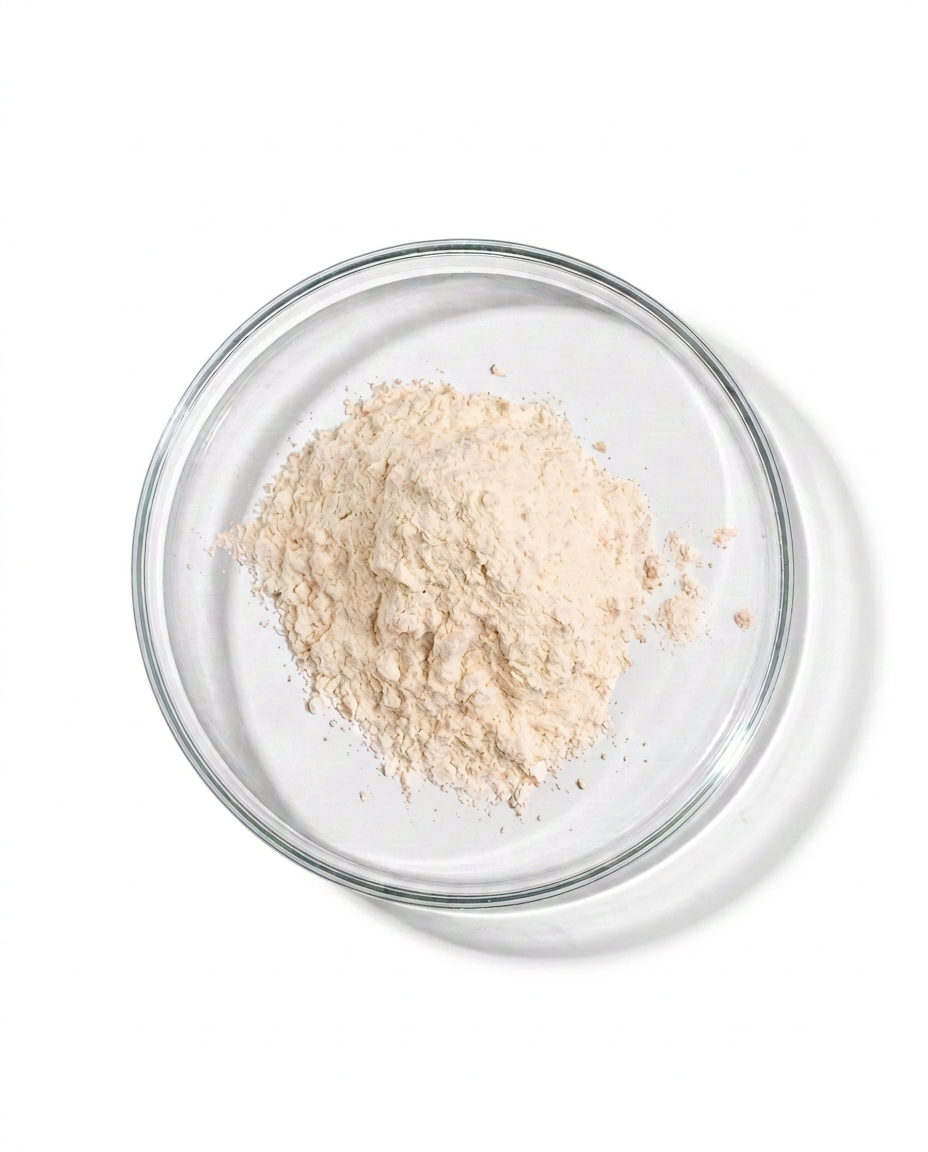
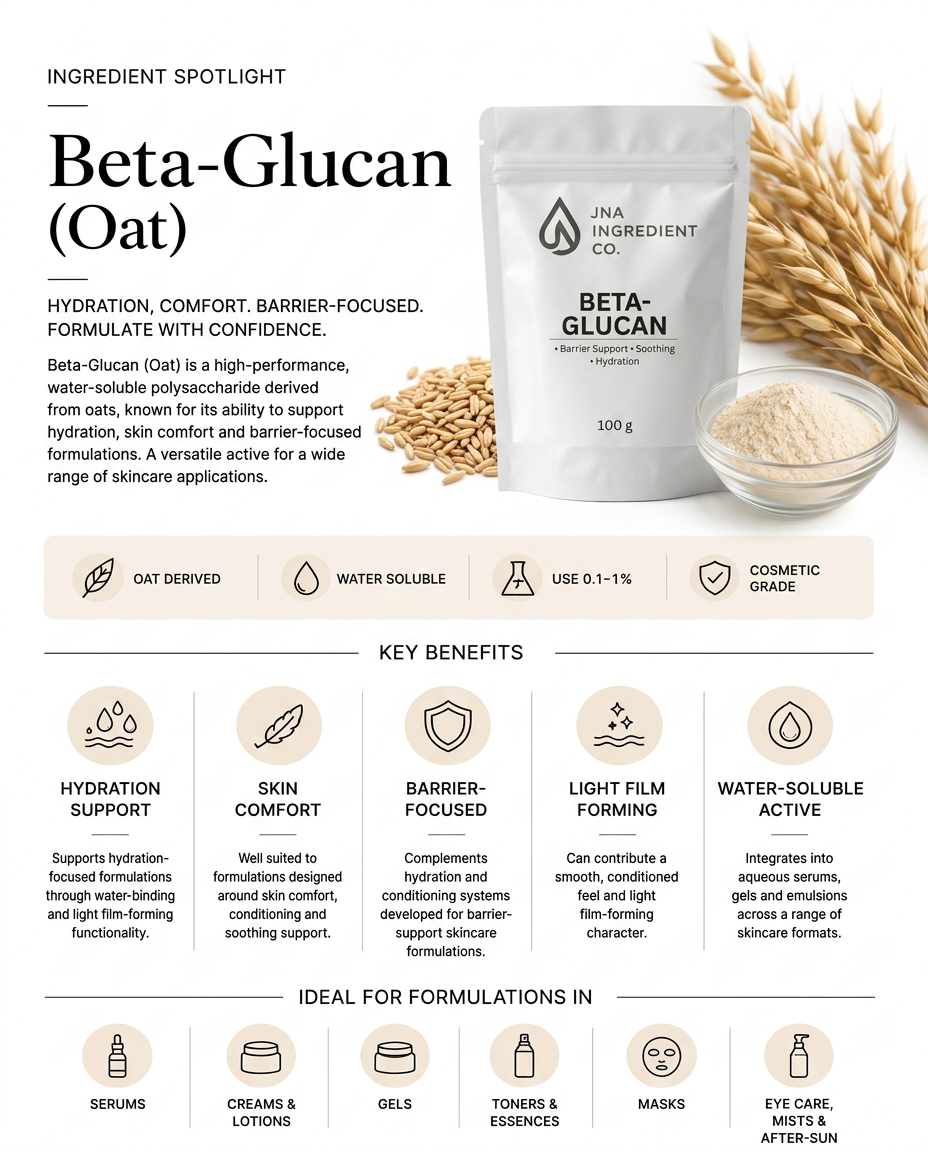


Product packaging may vary from the images shown based on pack size and packaging availability. Product specifications and declared net contents remain unchanged.
Oat Beta-Glucan Powder
Sold by weight (g or Kg) for formulation accuracy.
Need a larger quantity? Explore bulk and trade supply options for production volumes.
VIEW BULK & TRADE OPTIONS →*Eligible Australian orders up to 10 kg. Bulk freight excluded.

Choose options


Selected for specification, not just ingredient name.
Specification Matters
Cosmetic grade
Documented quality
Formulator ready
FORMULATION OVERVIEW
Oat Beta-Glucan Powder
Beta-Glucan (Oat) is a high-performance, water-soluble cosmetic active for formulators looking to build more effective hydration, soothing and skin-barrier support into skincare. Naturally derived from oat grain, it is especially valuable in formulations for dry, sensitive or uncomfortable-feeling skin, bringing skin-conditioning and comfort benefits to serums, creams, toners, masks and other water-based formulations.
With a beta-glucan specification of ≥70% w/w and an overall assay specification of ≥99.0%, JNA’s cosmetic-grade Oat Beta-Glucan gives formulators a concentrated and versatile way to add meaningful performance without complicating the formulation. Beyond moisturising and barrier support, supplier technical data also identifies soothing, antioxidant-support and hair-conditioning functionality, making it relevant across both advanced skincare and haircare formulations.
Why formulators choose it
- Concentrated oat-derived cosmetic active
- Supports hydration and skin-barrier focused formulations
- Helps build soothing and skin-comfort functionality
- Water soluble for straightforward use in aqueous systems
- Suitable for sensitive-skin focused formulation concepts
- Antioxidant-support functionality
- Useful across skincare and haircare formulations
- Defined 1500–3500 Da molecular-weight range
KEY SPECIFICATIONS
FORMULATION NOTES
Processing Notes
Disperse gradually into the aqueous phase with mixing to minimise clumping and allow sufficient time for complete hydration. Avoid adding the powder rapidly in one concentrated mass.
For more complex systems, adjust the dispersion method, order of addition and hydration time according to the complete formulation and batch process.
Compatibility Notes
Suitable for use in many water-based cosmetic systems and may be formulated alongside complementary humectants and water-soluble cosmetic actives.
Evaluate compatibility, viscosity, preservation and stability within the complete formulation, particularly when combining multiple polymers or other ingredients that may influence rheology.
pH Notes
Select the final formulation pH according to the requirements of the complete ingredient and preservative system. Confirm compatibility and stability in the finished formulation.
Formulation Examples
- Hydrating serum: 0.2–0.5%
- Soothing gel: 0.2–0.5%
- Barrier-support cream: 0.2–0.5%
- Facial mist or toner: 0.1–0.3%
Troubleshooting
Clumping during dispersion
Add the powder gradually with adequate mixing rather than introducing it in one concentrated mass. Allow sufficient time for complete hydration before assessing the formulation.
Unexpected viscosity or texture change
Review the Beta-Glucan use level and the complete rheology system. Other polymers, gums and thickeners in the formulation may contribute to changes in viscosity or texture.
Incomplete hydration
Allow additional hydration time and review the dispersion method and order of addition. Ensure the powder has been distributed evenly throughout the aqueous system.
Finished formula feels too tacky or heavy
Review the Beta-Glucan concentration and total humectant or polymer load. Adjusting the wider formulation may improve the finished sensory profile.
SENSORY PROFILE
Formulation Impact
Oat Beta-Glucan can contribute a smooth, conditioned feel and light film-forming character to water-based formulations. Sensory impact is concentration and formulation dependent, with higher polymer or humectant loads potentially increasing tack or altering the finished texture.
QUALITY & SOURCING
Cosmetic-grade Oat Beta-Glucan Powder supplied for use in skincare and personal care formulations.
Defined Beta-Glucan Content
Specified at ≥70% w/w Beta-Glucan, with the current manufacturer batch testing at 75.2% w/w.
Recognised Analytical Method
Beta-Glucan content is tested using AOAC Official Method 995.16.
Defined Molecular Weight
Specified molecular-weight range of 1500–3500 Da.
No Added Fillers or Excipients
The remaining fraction is naturally derived from the oat raw material and consists of other oat dietary fibre, plant protein, trace starch and moisture. The supplier confirms no artificial additives, fillers or excipients are added.
Quality Testing
Heavy metals: ≤5.0 ppm; arsenic, lead, mercury and cadmium: ≤1.0 ppm each. Total plate count: ≤10,000 cfu/g; yeast and mould: ≤100 cfu/g; E. coli: negative; Salmonella: negative.
Supported Claims
Supplier technical documentation identifies the material as cosmetic-grade Oat Beta-Glucan extracted from oat grain, with a Beta-Glucan specification of ≥70% w/w. Beta-Glucan content is tested using AOAC Official Method 995.16. The supplier confirms that the remaining fraction is naturally derived from the oat raw material and consists of other oat dietary fibre, plant protein, trace starch and moisture, with no artificial additives, fillers or excipients. Supplier compliance documentation additionally supports Non-GMO, cruelty-free/no animal testing and BSE/TSE-free
COMPARISON & ALTERNATIVES
Choose for water-binding hydration with the defined characteristics of a 50–100 kDa Sodium Hyaluronate grade.
Choose as a premium low-use active for hydration, barrier support and skin-comfort formulations.
Choose for versatile humectant, conditioning and skin-comfort support across a broad range of cosmetic formulations.
STORAGE & HANDLING
Storage Conditions
Store Oat Beta-Glucan Powder in a cool, dry place away from direct light and heat. Keep the container tightly sealed when not in use and protect the powder from moisture during storage.
Handling Notes
Use clean, dry equipment when weighing and dispensing. Minimise exposure to moisture and keep the container tightly sealed after use.
As the ingredient is supplied as a powder, avoid generating unnecessary airborne dust during handling. Wear appropriate eye protection and follow good industrial handling practices as outlined in the Safety Data Sheet.
Shelf Life / Retest Guidance
Shelf life: 24 months when stored under recommended conditions.
PRODUCT SAFETY
Not classified as hazardous for transport according to the supplier safety documentation. Follow good industrial hygiene practices during weighing and handling. Wear appropriate eye protection and refer to the current Safety Data Sheet for complete safety and handling information.
Warnings & Precautions
Avoid generating unnecessary airborne dust during weighing and dispensing. Avoid contact with eyes. In case of eye contact, rinse thoroughly with water or a standard eye-wash solution. Seek medical advice if irritation occurs and persists.
DOCUMENTATION
Safety Data Sheet available. Batch-specific Certificate of Analysis documentation is maintained for the supplied material.
Formulator's Quick Guide
Why Formulators Choose This Ingredient
Hydration & Barrier Support
Supports formulations developed around hydration, skin conditioning and barrier-focused skincare.
Soothing Skin Comfort
Well suited to formulations targeting dry, sensitive or uncomfortable-feeling skin.
Concentrated Active Grade
Defined ≥70% w/w Beta-Glucan content with an overall assay specification of ≥99.0%.
Water-Soluble Active
Integrates into aqueous serums, gels and emulsions, allowing Beta-Glucan functionality to be incorporated across a range of skincare formats.
Technical Documents
Safety Data Sheet available. Batch-specific Certificate of Analysis documentation is maintained for the supplied material.
FORMULATOR FAQ
Oat Beta-Glucan FAQ
Practical formulation questions about Oat Beta-Glucan
Ask a Question →Why is Beta-Glucan content ≥75% when the overall assay is ≥99%?
These specifications measure different aspects of the ingredient. The ≥75% w/w specification refers specifically to Beta-Glucan content, while the ≥99% overall assay relates to the supplied material as a whole. Supplier technical documentation identifies the remaining composition as naturally occurring oat-source dietary fibre, plant protein, trace starch and moisture, with no artificial additives or fillers.
Can Oat Beta-Glucan be combined with Ectoin, Panthenol or Hyaluronic Acid?
Yes. Oat Beta-Glucan can be used as part of a multi-active hydration and skin-comfort system alongside ingredients such as Ectoin, D-Panthenol or Sodium Hyaluronate. Rather than treating them as interchangeable actives, consider the role each contributes and incorporate each according to its own solubility and processing requirements. The complete formulation should then be assessed for stability, preservation, viscosity and sensory performance.
Why can Beta-Glucan make a serum feel more tacky or change its texture?
Beta-Glucan is a polysaccharide, so its contribution to texture and skin feel can become more noticeable as its level increases or when it is combined with other polymers and humectants. If a formulation becomes heavier or tackier than intended, assess the total polymer and humectant system rather than adjusting Beta-Glucan in isolation.
Is Oat Beta-Glucan a replacement for Hyaluronic Acid?
Not necessarily. Both can be used in hydration-focused skincare, but they do not need to be treated as substitutes. Oat Beta-Glucan brings moisturising, soothing, skin-conditioning and barrier-support functionality, while Sodium Hyaluronate can be selected according to its particular molecular-weight grade and desired formulation role. They can also be used together when a more layered hydration system is desired.
Can Oat Beta-Glucan be used in shampoo and conditioner formulations?
Yes. Oat Beta-Glucan is not limited to facial skincare. Supplier technical documentation identifies hair conditioning as a function and lists shampoos and conditioners among its applications. Because it is water soluble and insoluble in oils, it should be incorporated through the appropriate aqueous portion of the haircare formulation and evaluated within the complete surfactant or conditioning system.
What does the 1500–3500 Da molecular-weight specification mean for formulators?
The manufacturer specifies a molecular-weight range of 1500–3500 Da for this Oat Beta-Glucan grade. Molecular weight is one of the technical characteristics formulators can use when comparing Beta-Glucan raw materials, alongside Beta-Glucan content, solubility, analytical method and overall composition. JNA provides the specified molecular-weight range so formulators can make a more informed raw-material selection.
Often paired with this ingredient
Explore a curated edit of key ingredients.
Learn more
Formulate with Confidence
Practical ingredient education and formulation guidance to help you choose, use and combine cosmetic ingredients with clarity.
Read All Articles
Ingredient Knowledge
What Does Beta-Glucan Do in Skincare?
Ingredient Knowledge
Ingredient Spotlight: Glycerin – Why It Remains a Formulation Essential
Ingredient Knowledge
Ingredient Spotlight: Squalane – Why It's One of Skincare's Most Loved Oils
Ingredient Knowledge
Understanding Cosmetic Actives in Formulation
Ingredient Knowledge
Why Formulators Use Ectoin
Beginner Formulation
How to Formulate a Hydrating Face Serum
Beginner Formulation
Why Glycerin Still Matters
Article
Sodium Hyaluronate VS Hyaluronic Acid
Article
What Does Panthenol Do in Skincare
Join the JNA Community
Get practical formulation tips, launches & ingredient updates.