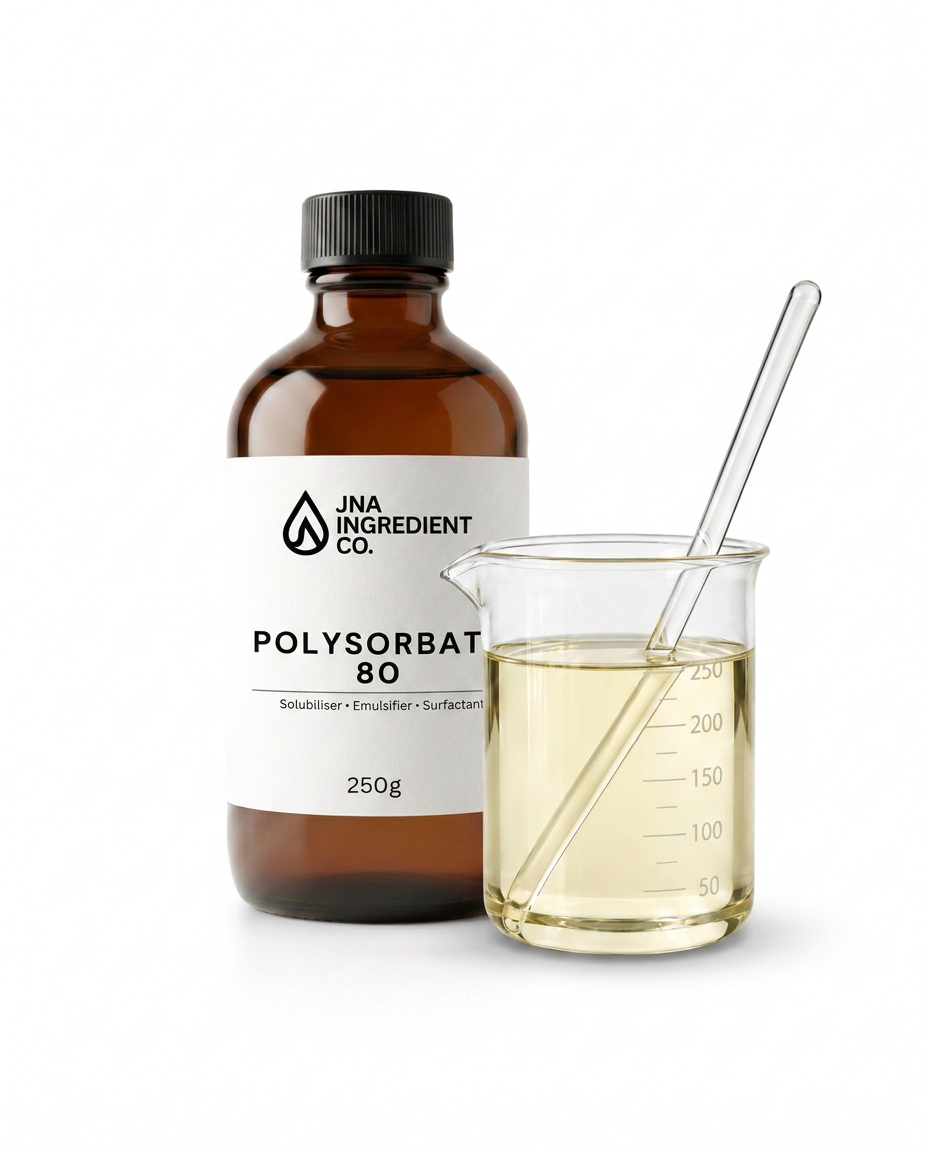
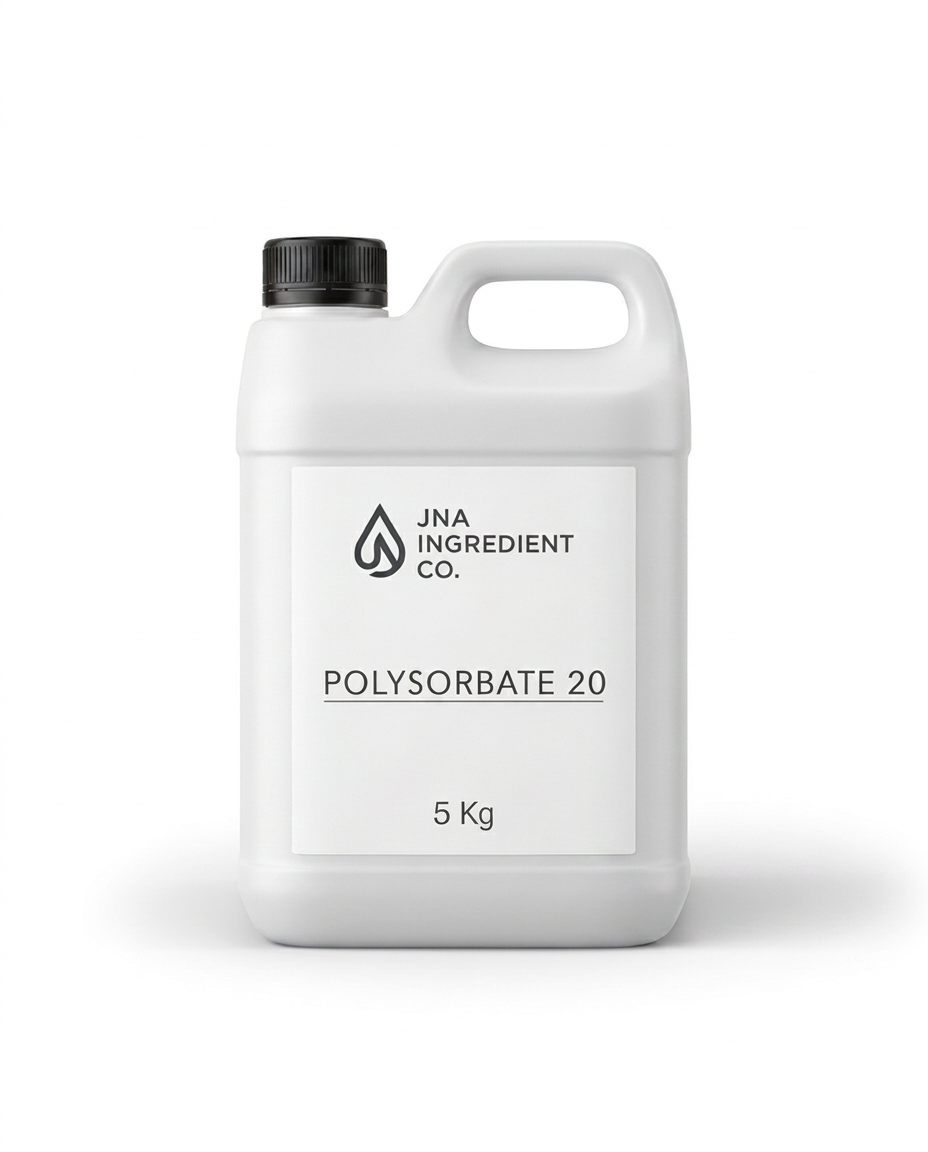


Product packaging may vary from the images shown based on pack size and packaging availability. Product specifications and declared net contents remain unchanged.
Polysorbate 20
Sold by weight (g or Kg) for formulation accuracy. Reference only: 250 g ≈ 250 mL (at 20°C).
Need a larger quantity? Explore bulk and trade supply options for production volumes.
VIEW BULK & TRADE OPTIONS →*Eligible Australian orders up to 10 kg. Bulk freight excluded.

Choose options


Selected for specification, not just ingredient name.
Specification Matters
Cosmetic grade
Documented quality
Formulator ready
FORMULATION OVERVIEW
Polysorbate 20
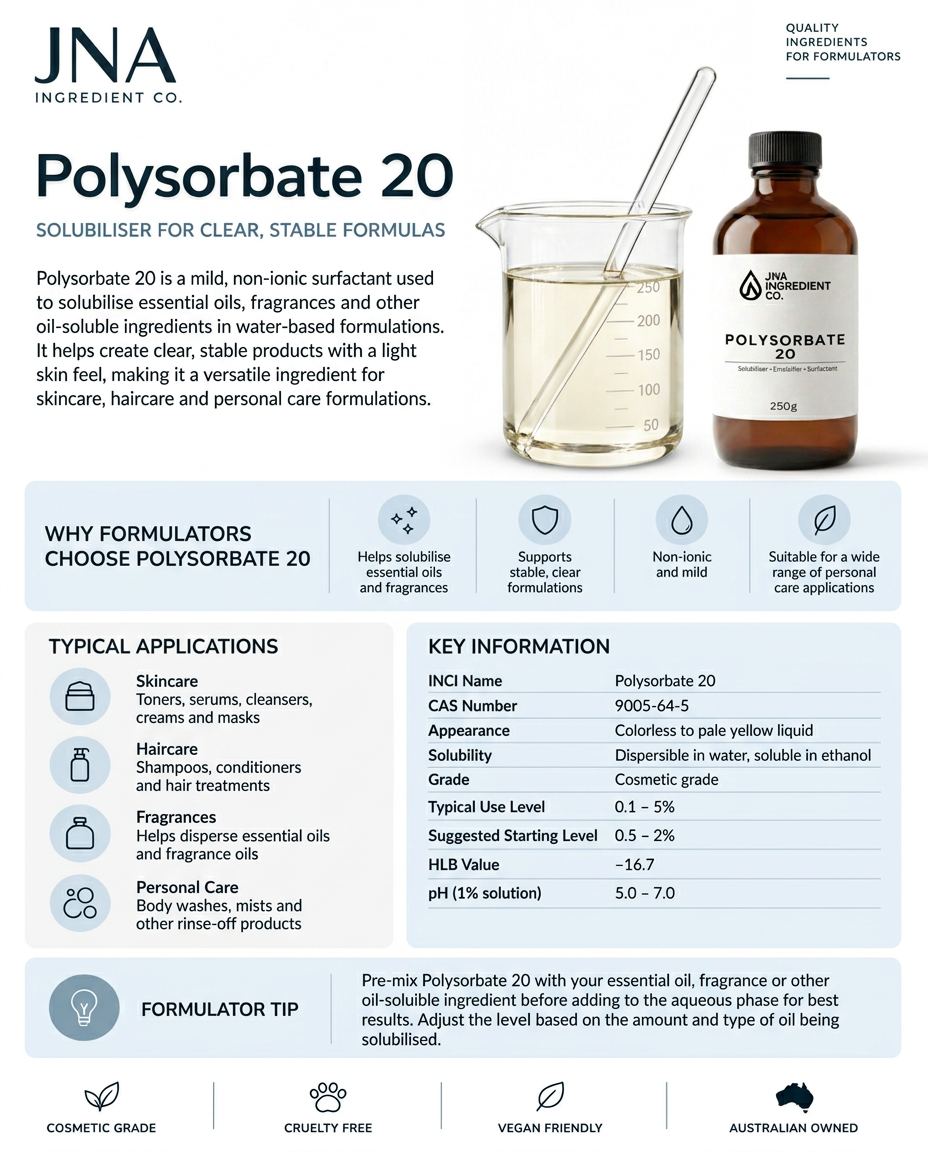
Polysorbate 20 is a versatile non-ionic solubiliser used to incorporate small amounts of fragrance, essential oils and other oil-soluble ingredients into water-based cosmetic formulations. It is particularly useful when developing toners, facial mists, serums, shampoos and bath products where an otherwise water-insoluble ingredient needs to be effectively dispersed or solubilised into the aqueous system.
Its value to formulators goes beyond simple fragrance solubilisation. Polysorbate 20 also provides emulsifying and dispersing functionality, making it a useful formulation aid across a broad range of skincare, haircare and personal-care systems. Its water solubility and non-ionic character make it particularly versatile when working with water-dominant formulations and mixed ingredient systems.
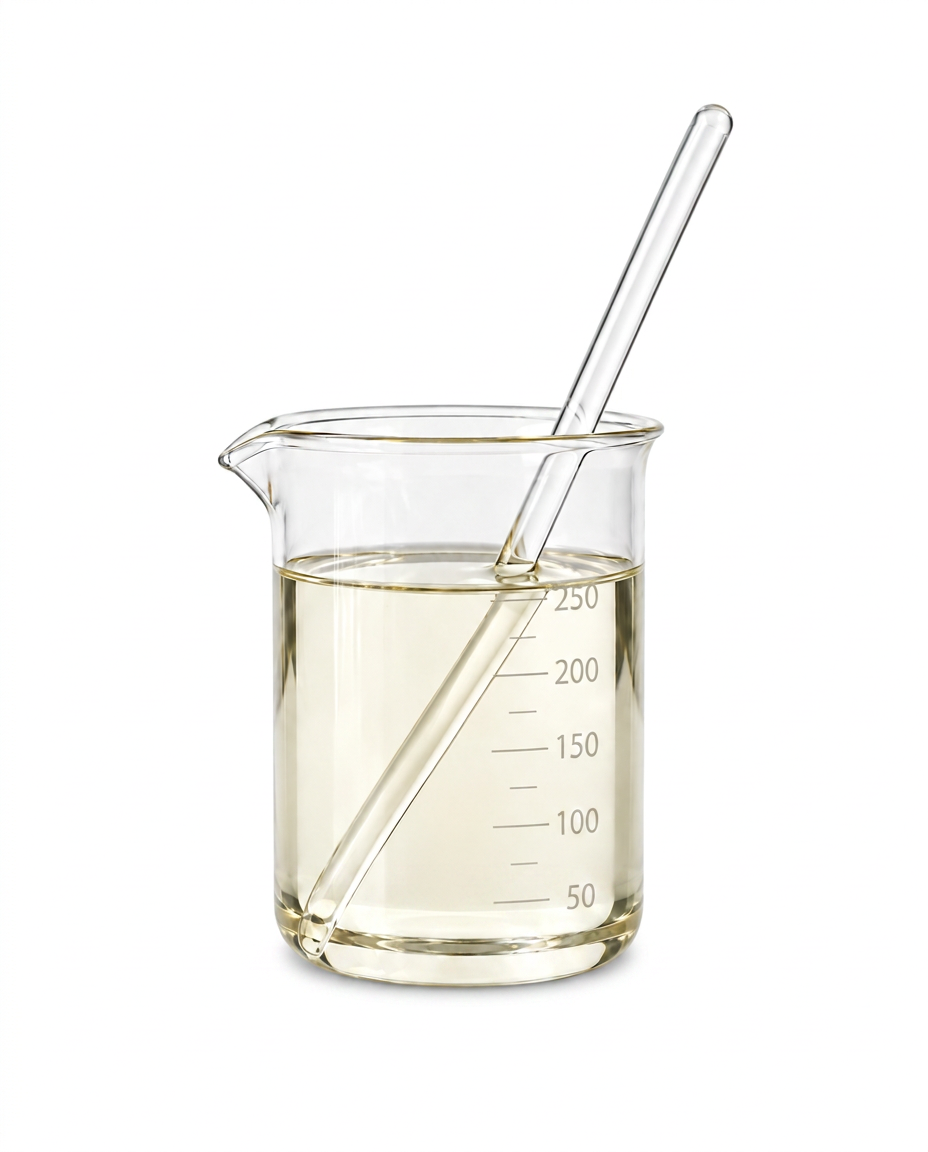
JNA's cosmetic-grade Polysorbate 20 is supplied as a clear, colourless to slightly yellow liquid and is manufactured to a defined specification with documented USP monograph conformity. For formulators, it provides a practical and adaptable way to manage small oil-soluble components in aqueous products while giving greater control over dispersion, appearance and formulation stability.
Why Formulators Choose It
- Effective fragrance & oil solubilisation – Helps incorporate fragrance, essential oils and suitable lipophilic ingredients into water-based cosmetic systems.
- Useful beyond simple solubilising – Provides additional emulsifying and dispersing functionality across a variety of formulation types.
- Ideal for water-dominant products – Particularly useful in toners, mists, serums, shampoos, bath products and other predominantly aqueous formulations.
- Flexible formulation tool – The amount required can be adjusted around the oil-soluble material and the clarity, appearance and performance required from the finished product.
- Non-ionic functionality – Offers formulators a versatile non-ionic option for use within more complex cosmetic ingredient systems.
KEY SPECIFICATIONS
FORMULATION NOTES
Processing Notes
Add to the water phase or pre-mix with the fragrance, essential oil or other suitable oil-soluble component before incorporating into the aqueous phase. The required ratio will vary depending on the material being solubilised and the desired clarity of the finished formulation. Mix thoroughly and assess clarity and stability before finalising the formulation.
Compatibility Notes
Non-ionic and broadly compatible with many commonly used cosmetic ingredients and aqueous formulation systems. Particularly useful for incorporating small amounts of fragrance, essential oils and suitable lipophilic ingredients into water-dominant formulations. Compatibility and clarity should be confirmed in the finished formulation, particularly when working with complex fragrance or essential-oil blends.
pH Notes
The supplier does not specify a recommended finished-formulation pH range for this grade. Set and adjust final pH according to the requirements of the complete formulation, particularly the preservative system, surfactants and any pH-sensitive actives.
Formulation Examples
Use in facial mists, toners and aqueous serums where small amounts of fragrance, essential oils or other suitable oil-soluble ingredients need to be incorporated into a predominantly water-based system. Also useful in shampoos, cleansers and bath products where fragrance or lipophilic components require additional solubilising or dispersing support.
Troubleshooting
Premix looks uniform but the finished product turns cloudy
Evaluate the complete formulation before increasing Polysorbate 20. Other ingredients can change the behaviour of the solubilised system, so determine whether the haze appears only after a particular ingredient, pH adjustment or processing step.
Oil droplets appear on the surface after standing
The system may not contain enough solubiliser for the particular oil load, even if it appeared uniform immediately after manufacture. Increase Polysorbate 20 incrementally, remix and reassess after standing.
One fragrance works but another stays cloudy
Do not automatically reuse the same Polysorbate 20-to-fragrance ratio. Fragrance and essential-oil compositions vary considerably, so each new material should be bench tested and its solubiliser requirement optimised independently.
Formula is clear initially but develops haze during stability testing
Treat initial clarity as a starting point rather than proof of stability. Reassess the solubiliser ratio and complete formulation under the intended storage conditions if haze, droplets or separation develop over time.
Finished product feels heavier than expected
Check whether Polysorbate 20 has been increased beyond the level actually required to maintain the desired system. Optimising the oil load and solubiliser ratio can help avoid unnecessarily altering the sensory character of a lightweight aqueous product.
Excessive aeration or foam develops during processing
Reduce unnecessary high-speed agitation after the solubilised premix has been incorporated. Controlled mixing can help minimise air incorporation when working with this non-ionic surfactant.
SENSORY PROFILE
Formulation Impact
Can influence clarity, viscosity, foaming and sensory character depending on concentration and the material being solubilised. Optimising the Polysorbate 20-to-oil ratio helps achieve effective solubilisation without adding more surfactant than the system requires.
QUALITY & SOURCING
JNA's Polysorbate 20 is supplied as a high-purity cosmetic-grade material with an assay specification of ≥99.0%. The supplied grade is supported by defined physicochemical, purity and microbiological specifications, giving formulators documented quality parameters for raw-material selection and batch consistency.
High-Purity Cosmetic Grade
≥99.0% assay specification.
Why it matters: Provides a defined purity benchmark rather than relying on the ingredient name alone.
USP Monograph Conformity
Conforms with the corresponding USP monograph.
Why it matters: Provides a recognised quality benchmark against which the supplied material is specified.
Defined Quality Parameters
Key physicochemical properties are controlled within established specifications.
Why it matters: Helps provide greater confidence in raw-material consistency when moving between formulation batches.
Controlled Process Residuals
Residual ethylene oxide ≤1 μg/g and 1,4-dioxane ≤10 ppm.
Why it matters: Demonstrates defined manufacturing controls for process-related residuals that aren't apparent from the INCI name alone.
Low Trace Contaminant Limits
Low specified limits are established for trace contaminants.
Why it matters: Adds another documented layer of raw-material quality control beyond assay alone.
Microbiological Quality
Defined microbiological acceptance criteria form part of the material specification.
Why it matters: Provides formulators with documented microbiological quality criteria when assessing incoming raw materials.
Quality Testing
Low heavy-metal limits and tightly controlled microbiological specifications support consistent, high-quality cosmetic formulation.
Supported Claims
JNA's manufacturing documentation confirms that Polysorbate 20 conforms with the corresponding USP monograph, with residual ethylene oxide limited to ≤1 μg/g and 1,4-dioxane to ≤10 ppm. The manufacturer also confirms the material is non-GMO, cruelty-free with no animal testing, BSE/TSE-free with no animal-derived raw materials, and free from known cosmetic or food allergens. The material is manufactured within ISO- and GMP-compliant production facilities.
COMPARISON & ALTERNATIVES
Consider when working with heavier oils or more substantial lipophilic components, or where broader emulsifying support is required alongside solubilisation.
Consider when stronger solubilising support is required for fragrance, essential oils or other lipophilic materials, particularly where achieving clarity is the primary formulation objective.
Consider when a PEG-free solubilising and emulsifying option is preferred, particularly where additional emulsification functionality or a different formulation approach is desired.
STORAGE & HANDLING
Storage Conditions
Store tightly closed in a cool, dry place away from direct sunlight, excessive heat and moisture. Keep in the original or other suitable compatible container when not in use.
Handling Notes
Use clean, dry equipment when dispensing and minimise unnecessary exposure of the bulk material during use. Reseal promptly after dispensing to help maintain raw-material quality. Avoid introducing water or other formulation ingredients into the original container.
Shelf Life / Retest Guidance
Store under the recommended conditions and refer to the product label for the applicable retest date. Raw-material suitability should be reassessed if the material has been stored outside the recommended conditions or shows an unexpected change in appearance, odour or physical condition.
PRODUCT SAFETY
Polysorbate 20 is supplied as a cosmetic-grade raw material for use in formulated cosmetic and personal-care products. Use in accordance with appropriate formulation practice and review the current SDS before handling.
Warnings & Precautions
For formulation use only. Avoid direct contact with eyes and prolonged contact with undiluted material. Use appropriate personal protective equipment when handling bulk raw material. Clean spills promptly as surfaces may become slippery. Keep out of reach of children.
DOCUMENTATION
Batch-specific Certificate of Analysis documentation is maintained for the supplied material.
Formulator's Quick Guide
Why Formulators Choose This Ingredient
Reliable Solubilisation
Helps formulators incorporate small amounts of fragrance, essential oils and suitable lipophilic ingredients into water-dominant cosmetic systems.
Multi-Functional Performance
Provides solubilising, emulsifying and dispersing functionality, making it useful across more than one formulation challenge.
Formulation Versatility
Useful across mists, toners, serums, cleansers, shampoos and bath formulations where small oil-soluble components need to be managed within the finished system.
Greater Control Over Clarity
Provides a practical way to optimise clear or translucent aqueous products by adjusting the solubiliser system around the specific oil load.
Technical Documents
Batch-specific Certificate of Analysis documentation is maintained for the supplied material.
FORMULATOR FAQ
Practical Questions About Formulating with Polysorbate 20
Polysorbate 20 FAQ
Ask a Question →How much Polysorbate 20 do I need for a fragrance or essential oil?
There is no universal Polysorbate 20-to-oil ratio that works for every material. Fragrances and essential oils vary considerably in composition and solubilisation requirements. Start with a small bench trial, adjust the ratio incrementally and assess the complete formulation for clarity and stability rather than relying on a fixed ratio.
Why is my formula still cloudy even though I have used Polysorbate 20?
Cloudiness does not necessarily mean Polysorbate 20 is unsuitable. The required level depends on the specific oil-soluble material, its concentration and the rest of the formulation. If increasing Polysorbate 20 does not improve clarity, assess the oil load and complete ingredient system rather than continuing to increase the solubiliser indefinitely.
Can Polysorbate 20 make an essential oil completely water soluble?
No. Polysorbate 20 does not make the essential oil itself water soluble. Instead, it can help solubilise suitable essential oils within an aqueous system by incorporating them through the solubiliser system. The amount required depends on the particular essential oil, its concentration and the complete formulation.
Should I choose Polysorbate 20 or Polysorbate 80?
Polysorbate 20 is commonly selected for fragrance, essential oils and relatively small lipophilic components in water-dominant products. Polysorbate 80 has a different fatty-acid structure and is often considered where more substantial oil-phase materials or different emulsification requirements are involved. They should not automatically be substituted at the same level; select according to the oil phase and required finished-product performance.
Will using more Polysorbate 20 always make my product clearer?
No. Increasing the level can improve solubilisation in some systems, but there is a point where additional Polysorbate 20 may provide little improvement while changing sensory feel, viscosity or foam behaviour. The objective is to optimise the complete solubiliser system rather than simply use the highest possible level.
Do I still need to stability test a formula that looks clear?
Yes. Immediate clarity does not confirm long-term physical stability. A solubilised system can develop haze, droplets or separation during storage or under different temperature conditions. Assess the finished formulation using an appropriate stability-testing program, particularly when fragrance or essential oils are present.
Often paired with this ingredient
Explore a curated edit of key ingredients.
Learn more
Formulate with Confidence
Practical ingredient education and formulation guidance to help you choose, use and combine cosmetic ingredients with clarity.
Read All ArticlesJoin the JNA Community
Get practical formulation tips, launches & ingredient updates.