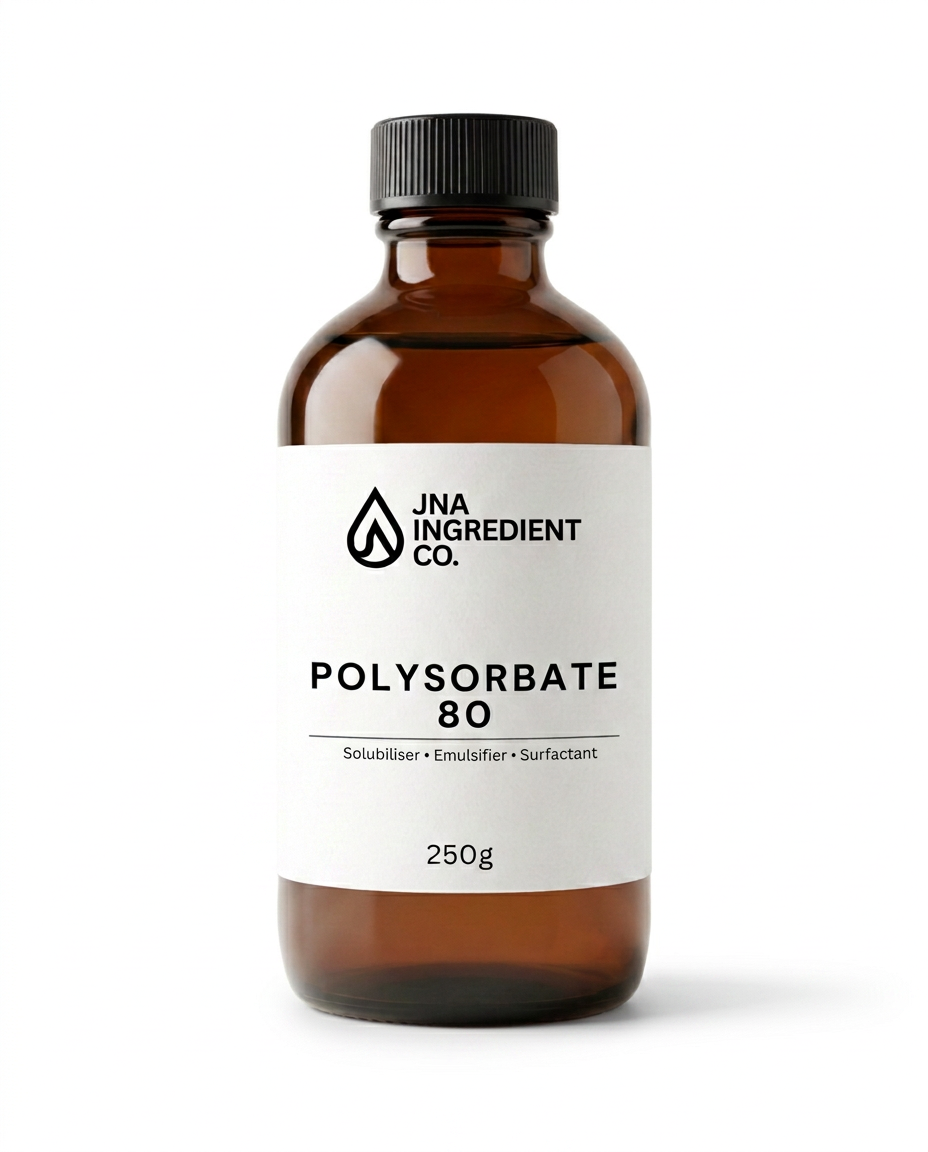
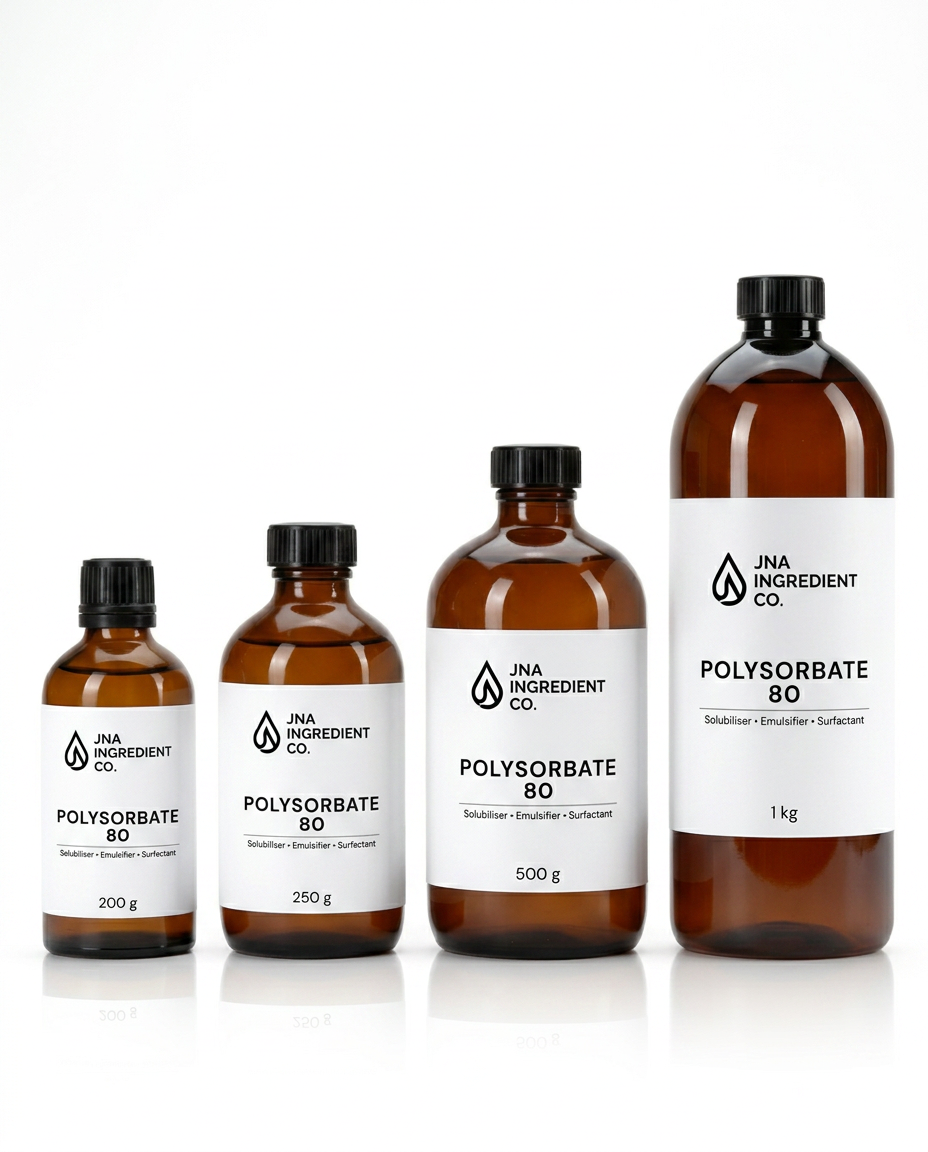


Product packaging may vary from the images shown based on pack size and packaging availability. Product specifications and declared net contents remain unchanged.
Polysorbate 80
Sold by weight (g or Kg) for formulation accuracy. Reference only: 250 g ≈ 245–250 mL (at 20°C).
Need a larger quantity? Explore bulk and trade supply options for production volumes.
VIEW BULK & TRADE OPTIONS →*Eligible Australian orders up to 10 kg. Bulk freight excluded.

Choose options


Selected for specification, not just ingredient name.
Specification Matters
Cosmetic grade
Documented quality
Formulator ready
FORMULATION OVERVIEW
Polysorbate 80
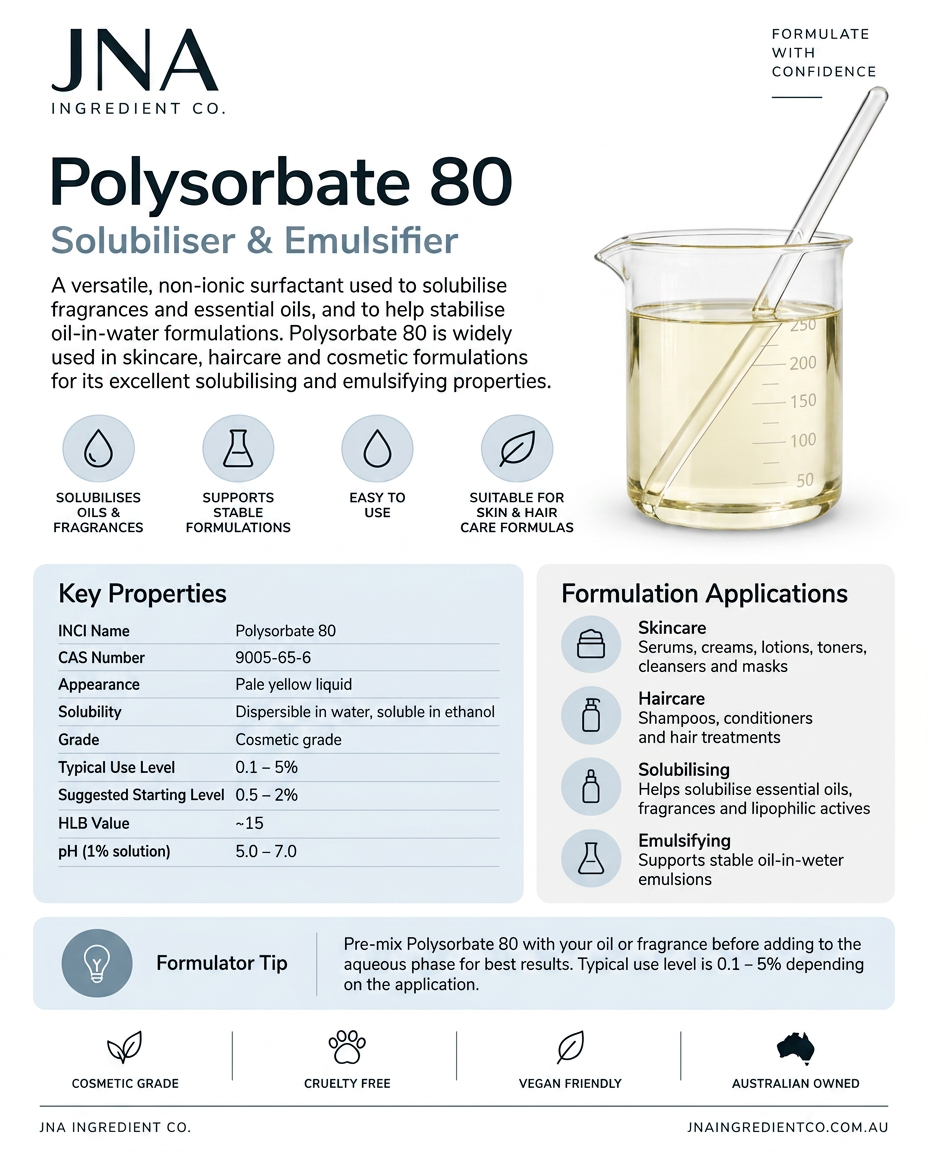
Polysorbate 80 is a versatile non-ionic emulsifier and solubiliser used to help incorporate and distribute oil-soluble ingredients within water-containing cosmetic formulations. Its oil-in-water emulsifying functionality makes it particularly useful across emulsions, cleansers, shampoos and other personal-care systems where oils, emollients, fragrance or other suitable lipophilic materials need to be effectively incorporated into the finished formulation.
For formulators, Polysorbate 80 offers useful flexibility beyond straightforward solubilisation. It can provide emulsifying support in oil-in-water systems while also assisting with the solubilisation and dispersion of suitable lipophilic ingredients. This makes it a practical choice for formulations containing a more developed oil, surfactant or emulsion system where effective distribution of oil-phase materials is important.
JNA’s cosmetic-grade Polysorbate 80 is supplied as a pale yellow liquid with defined physicochemical specifications, including controls for acid value, hydroxyl value, pH and moisture. Manufacturing documentation states USP conformity, giving formulators documented material specifications alongside its emulsifying, solubilising and dispersing functionality.
Why Formulators Choose It
- Oil-in-water emulsifying functionality - supports the incorporation and distribution of oil-phase materials within water-containing formulations.
- Effective solubilising support - helps incorporate fragrance and other suitable lipophilic ingredients into predominantly aqueous systems.
- Multi-functional performance - provides emulsifying, solubilising and dispersing functionality from one versatile formulation ingredient.
- Useful in more developed systems - well suited to emulsions, cleansers, shampoos and formulations containing both aqueous and lipophilic components.
- Non-ionic versatility - offers flexible surface-active functionality across a broad range of cosmetic and personal-care formulation systems.
- Documented cosmetic grade - supplied against defined physicochemical specifications with manufacturing documentation stating USP conformity.
KEY SPECIFICATIONS
FORMULATION NOTES
Processing Notes
Polysorbate 80 can be incorporated into the water phase or pre-mixed with suitable oil-soluble ingredients before addition to the formulation. For solubilising applications, pre-mixing with the oil, fragrance or other compatible lipophilic material can support more uniform incorporation. Mix thoroughly until the system is homogeneous. Where heat is used, incorporate according to the requirements of the overall formulation.
Compatibility Notes
As a non-ionic emulsifier and solubiliser, Polysorbate 80 is suitable for use across a broad range of cosmetic formulation systems. It can be used alongside other surfactants, emulsifiers, humectants and common water- and oil-phase ingredients. Performance should be assessed in the complete formulation, particularly where electrolyte levels, surfactant concentration or substantial oil loads may influence clarity, viscosity or stability.
pH Notes
Polysorbate 80 is used across a broad range of cosmetic systems. The supplied material has a specified pH of 5.0–8.0. Finished-product pH should be selected according to the requirements of the complete formulation and its other ingredients rather than adjusted specifically for Polysorbate 80.
Formulation Examples
Suitable applications include oil-in-water emulsions, creams and lotions, facial and body cleansers, shampoos, bath products and aqueous systems requiring solubilisation or dispersion of suitable oils, fragrance or other lipophilic ingredients.
Troubleshooting
Oil droplets or separation develop after standing
The emulsifier or solubiliser system may not adequately support the oil phase. Reassess the oil load, Polysorbate 80 level and complete emulsifier system rather than increasing Polysorbate 80 automatically.
Formula remains cloudy after adding Polysorbate 80
Assess the specific lipophilic material and complete formulation. Increase Polysorbate 80 incrementally only where testing indicates additional solubilisation improves the system.
Formula is initially uniform but separates during stability testing
Initial appearance does not confirm long-term physical stability. Review the complete emulsifier system, oil phase, ingredient interactions and processing method before adjusting the Polysorbate 80 level.
Different fragrances give different results at the same ratio
Solubilisation requirements vary between fragrance and oil-soluble materials. Optimise each material individually rather than applying a fixed Polysorbate 80-to-oil ratio.
Finished product feels heavier than intended
Review the total surfactant and emulsifier load and optimise Polysorbate 80 to the lowest level that delivers the required performance.
Excessive aeration or foam develops during processing
Reduce unnecessary high-shear or prolonged mixing and use controlled agitation during incorporation.
SENSORY PROFILE
Formulation Impact
Can influence clarity, viscosity, foaming and sensory character depending on concentration, oil load and the material being incorporated. Optimising the Polysorbate 80-to-oil ratio can help achieve the required emulsifying or solubilising performance without unnecessarily increasing surfactant level.
QUALITY & SOURCING
USP-Conforming Cosmetic Grade
JNA’s Polysorbate 80 is supplied as a cosmetic-grade material with manufacturing documentation stating conformity with the applicable USP standard, providing formulators with a recognised quality benchmark for raw-material selection.
Defined Quality Specification
Supplied against established physicochemical specifications including acid value, hydroxyl value, pH and moisture for consistent raw-material quality.
Documented Batch Verification
Batch-specific Certificate of Analysis documentation verifies the supplied material against its established quality specification.
Supported Claims
Supported by supplier technical documentation and batch-specific quality verification, with the supplied material conforming to the USP standard.
COMPARISON & ALTERNATIVES
Consider where the primary formulation objective is solubilising small amounts of fragrance, essential oils or other suitable lipophilic materials in predominantly aqueous products.
Alternative non-ionic solubiliser commonly considered for fragrance and oil-soluble materials in aqueous systems.
Polysorbate 80 can be evaluated alone or within a broader emulsifier or solubiliser system where additional control over dispersion, appearance or physical stability is required. Optimise combinations against the specific oil phase and complete finished formulation.
STORAGE & HANDLING
Storage Conditions
Store in a cool, dry place in the original tightly closed container, away from direct sunlight, excessive heat and sources of contamination. Maintain appropriate storage conditions to preserve material quality.
Handling Notes
Use clean, dry equipment when dispensing or transferring. Keep the container tightly closed when not in use and avoid introducing water or other contaminants into the raw material. Follow the applicable SDS and good industrial hygiene practices when handling.
Shelf Life / Retest Guidance
Refer to the retest date shown on the product label and applicable batch documentation. Material stored beyond the stated retest date should be reassessed for suitability before use.
PRODUCT SAFETY
Polysorbate 80 is intended for use as a cosmetic formulation ingredient. Handle in accordance with good industrial hygiene and formulation practices. Avoid unnecessary direct contact with the concentrated raw material and follow the applicable SDS when handling.
Warnings & Precautions
For formulation use only. Not intended for direct application to skin in undiluted raw-material form. Avoid contact with eyes and prolonged or repeated contact with the concentrated material. Keep out of reach of children.
DOCUMENTATION
Formulator's Quick Guide
Why Formulators Choose This Ingredient
Multi-Functional Performance
Provides solubilising, emulsifying and dispersing functionality, making it useful across more than one formulation challenge.
Oil-in-Water Emulsifying Support
Helps incorporate and distribute oil-phase materials within water-containing formulations, supporting creams, lotions and other emulsion systems.
Supports More Developed Oil Systems
Particularly useful in formulations containing oils, emollients and other lipophilic materials where effective distribution within the finished system is required.
Broad Formulation Versatility
Suitable across emulsions, cleansers, shampoos, bath products and other personal-care systems where emulsifying, solubilising or dispersing support is required.
Technical Documents
FORMULATOR FAQ
Practical Questions About Formulating with Polysorbate 80
Polysorbate 80 FAQ
Ask a Question →When should I choose Polysorbate 80 instead of Polysorbate 20?
The choice depends primarily on the material being incorporated and the formulation system. Polysorbate 20 is commonly selected for fragrance and lighter lipophilic materials in aqueous systems, while Polysorbate 80 can be particularly useful with heavier oils and in systems where additional emulsifying support is beneficial. Comparative bench testing is the best way to determine which performs better with a particular oil phase.
Can Polysorbate 80 be used as the only emulsifier in a formulation?
Polysorbate 80 provides oil-in-water emulsifying functionality, but whether it can function as the sole emulsifier depends on the oil phase, ingredient concentrations, desired viscosity and overall formulation system. More developed emulsions may require additional emulsifiers, co-emulsifiers or structuring ingredients. Finished-product stability testing is essential.
How do I determine the right Polysorbate 80-to-oil ratio?
There is no universal ratio because the amount required varies with the oil, fragrance or lipophilic material being incorporated and the characteristics required from the finished product. Begin with a small development batch, assess the system at different ratios and increase Polysorbate 80 incrementally where necessary. Evaluate clarity, separation, viscosity and sensory feel rather than relying on a fixed ratio for every formulation.
Why can a Polysorbate 80 formulation separate even when it initially looks uniform?
Initial uniformity does not confirm long-term physical stability. Separation can result from an unsuitable emulsifier balance, oil-phase composition, ingredient interactions or processing conditions. Assess the complete system during stability testing before simply increasing the Polysorbate 80 level.
Can Polysorbate 80 affect the foam or viscosity of a cleanser?
Yes. Because Polysorbate 80 is a surface-active ingredient, changing its concentration can influence the behaviour of a surfactant system, including foam character, clarity, viscosity and sensory feel. These effects depend on the complete surfactant blend, so viscosity and foam should be reassessed whenever the Polysorbate 80 level is adjusted.
Should Polysorbate 80 be pre-mixed with the oil or fragrance?
Pre-mixing Polysorbate 80 with the oil, fragrance or other compatible lipophilic material can help achieve more uniform incorporation before the mixture is introduced into the aqueous system. The best processing method depends on the formulation, so the pre-mix should be assessed for homogeneity and the finished product checked for clarity or dispersion, separation and stability.
Often paired with this ingredient
Explore a curated edit of key ingredients.
Learn more
Formulate with Confidence
Practical ingredient education and formulation guidance to help you choose, use and combine cosmetic ingredients with clarity.
Read All ArticlesJoin the JNA Community
Get practical formulation tips, launches & ingredient updates.