Skip to content

Cart

Your cart is empty

Polysorbate 80

INCI: Polysorbate 80 · CAS: 9005-65-6

USPConforming Grade
NON-IONIC EMULSIFIER & SOLUBILISER
USP conforming
Non-ionic solubiliser
Heavier-oil compatibility
Sale price$9.95
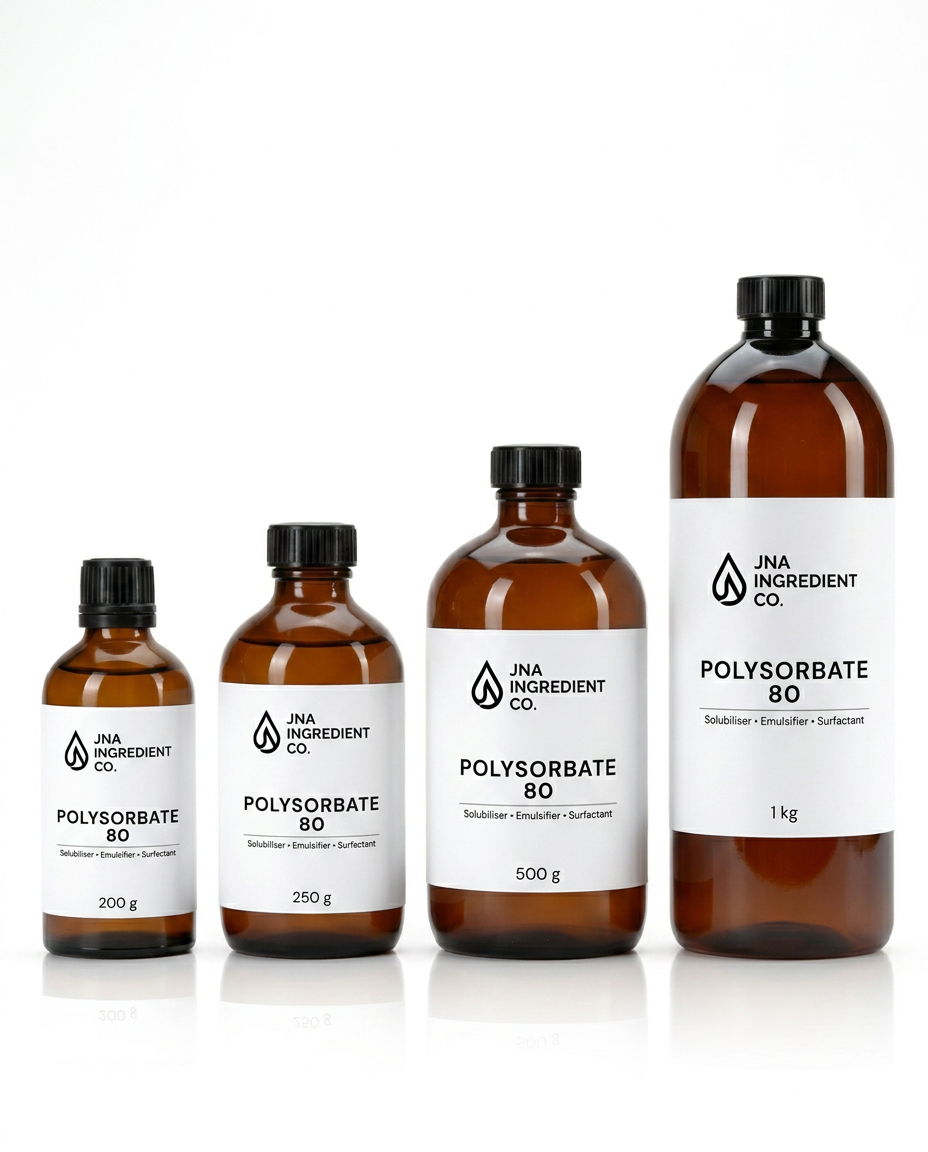
Available in:

Available to order

Sold by weight (g or Kg) for formulation accuracy. Reference only: 250 g ≈ 245–250 mL (at 20°C).

Calculate quantity needed +
Calculation guidance

Enter your selected trial percentage. Determine the level through formulation trials according to function, oil loading and the complete system; the calculator does not establish a recommended ratio.

Excludes processing loss and retained samples. The calculation does not establish a suitable or effective use level.

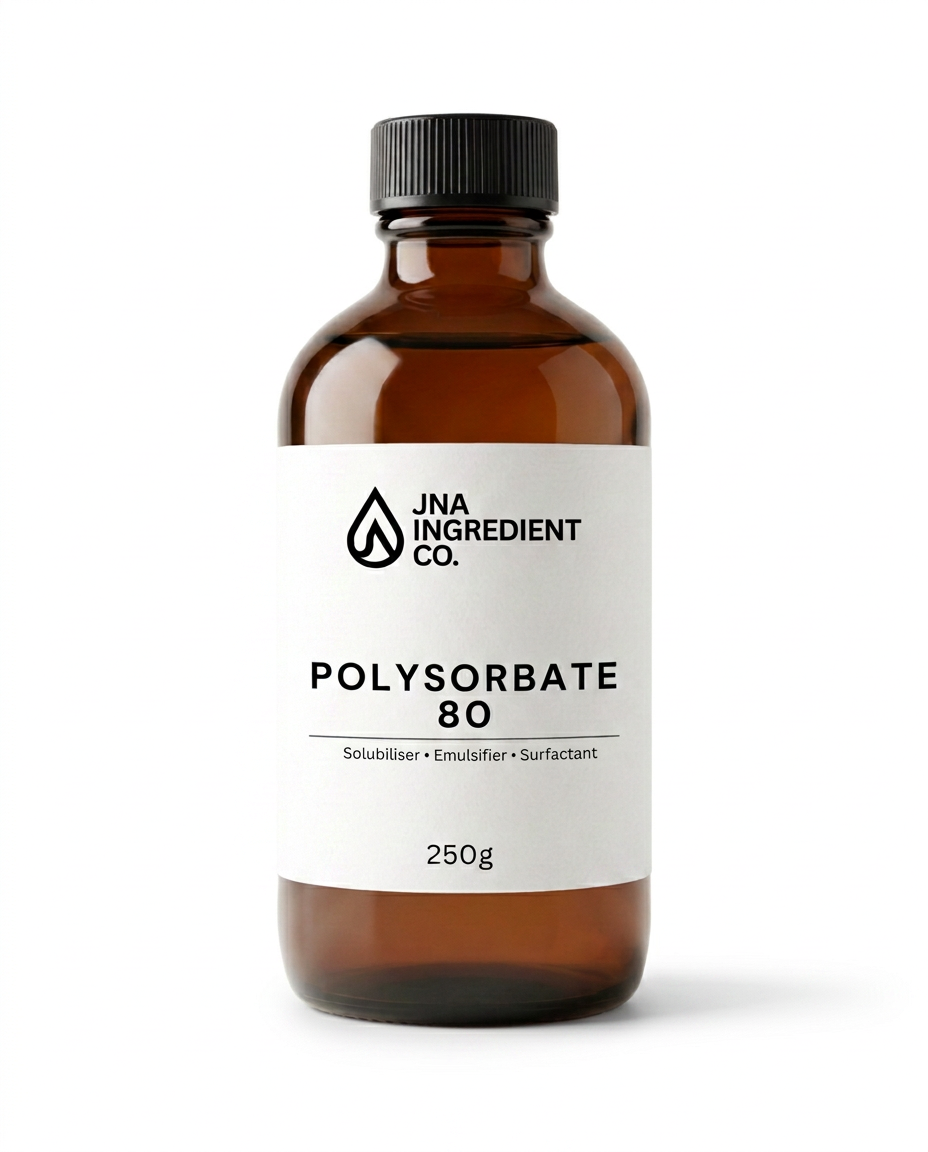
Cosmetic‑grade Polysorbate 80 photographed in editorial, ingredient‑focused composition for high‑performance emulsification in skincare
Polysorbate 80100 g Sale price$9.95
Australianowned & operated
Trusted byformulators
Quality ingredientsfor real results
Wholesale & bulk supply enquiriesTell us your ingredient, quantity and timeframe

Our Polysorbate 80

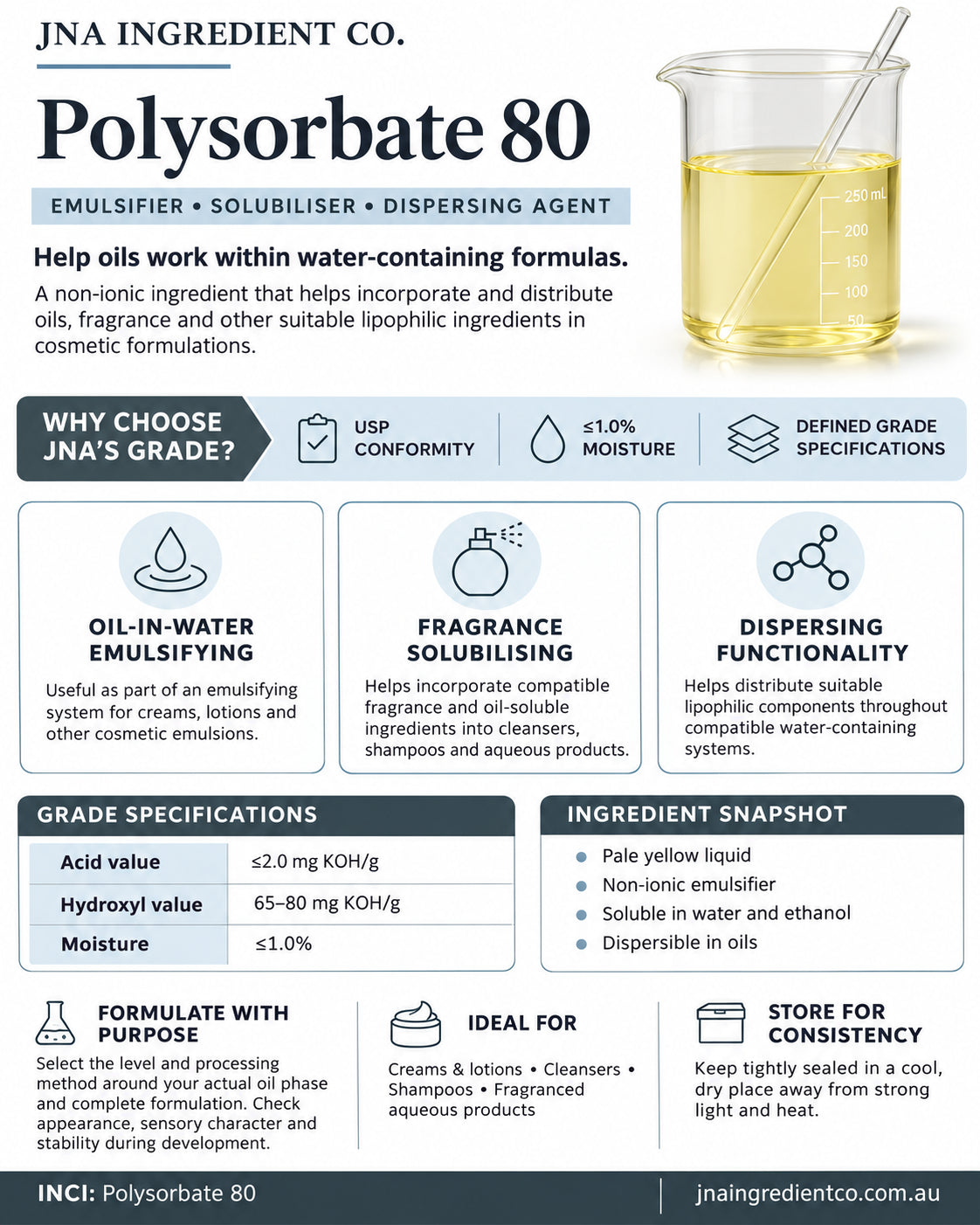
JNA’s Polysorbate 80 is a non-ionic emulsifier and solubiliser with documented USP conformity and defined physicochemical specifications. It helps incorporate and distribute oils, fragrance and other suitable oil-soluble ingredients within water-containing formulations, providing emulsifying, solubilising and dispersing functionality.

Its oil-in-water emulsifying properties make it useful in creams, lotions and other emulsion systems, while its solubilising functionality supports fragrance incorporation in cleansers, shampoos and aqueous products. This gives formulators a flexible ingredient for managing the interaction between water and lipophilic components.

JNA’s grade is supplied as a pale yellow liquid, with specifications covering acidity, hydroxyl value, pH and moisture. These documented parameters provide a technical basis for raw-material assessment and repeat purchasing, alongside conformity to a recognised quality standard.

Select the amount and processing approach around the actual oil phase and complete formulation. Whether used for solubilisation or as part of an emulsifying system, assess finished-product appearance, sensory character and stability during development.

Why choose JNA’s Polysorbate 80?

KEY SPECIFICATIONS

Know what you’re formulating with.

USP

Conforming Grade

INCI
Polysorbate 80
Otherwise known as
Polyoxyethylene (20) Sorbitan Monooleate; Tween 80
CAS number
9005-65-6
Grade
Cosmetic grade - USP conforming
Appearance
Pale yellow liquid
Source
Ethoxylated sorbitan monooleate
Recommended use range
Enter your selected trial percentage. Determine the level through formulation trials according to function, oil loading and the complete system; the calculator does not establish a recommended ratio.
Solubility
Water soluble
  • Vegan Suitable

    No animal-derived materials used in manufacturing

  • Non-GMO

    Declared free from genetically modified organisms

  • No Animal Testing

    Declared Not tested on Animals

  • Allergen Exclusions

    Made without specified allergenic materials

QUALITY · SOURCING · SAFE HANDLING

Selected for specification.

Ingredient name is the beginning. Specification is the difference.

We select our ingredients for the quality behind the name: the right grade, defined purity or composition, clear origin and consistent specifications.

Our focus is dependable ingredients, supported by clear technical information, that you can formulate with confidence and rely on for repeat production.

Need more information about this ingredient
Formulation & Processing

Processing

For fragrance or other suitable oil-soluble ingredients, trial a premix with Polysorbate 80 before incorporation into the aqueous system. When using it as part of an emulsifier blend, select the processing method around the complete emulsifier system, oil phase and ingredients requiring heating.

The required level depends on the material being incorporated, oil load and desired product structure. Solubilising fragrance in a cleanser and supporting emulsification in a lotion require different development approaches; a single percentage should not be applied to both.

Compatibility

Check appearance, separation, viscosity, foam and skin feel after all ingredients and pH adjustments have been incorporated. Initial uniformity does not establish long-term stability.

pH guidance

Set pH according to the preservative system, actives and overall formulation requirements. Confirm compatibility and stability at the intended finished-product pH.

Troubleshooting

Oil droplets or separation develop after standing
The emulsifier or solubiliser system may not adequately support the oil phase. Reassess the oil load, Polysorbate 80 level and complete emulsifier system rather than increasing Polysorbate 80 automatically.

Formula remains cloudy after adding Polysorbate 80
Assess the specific lipophilic material and complete formulation. Increase Polysorbate 80 incrementally only where testing indicates additional solubilisation improves the system.

Formula is initially uniform but separates during stability testing
Initial appearance does not confirm long-term physical stability. Review the complete emulsifier system, oil phase, ingredient interactions and processing method before adjusting the Polysorbate 80 level.

Different fragrances give different results at the same ratio
Solubilisation requirements vary between fragrance and oil-soluble materials. Optimise each material individually rather than applying a fixed Polysorbate 80-to-oil ratio.

Finished product feels heavier than intended
Review the total surfactant and emulsifier load and optimise Polysorbate 80 to the lowest level that delivers the required performance.

Excessive aeration or foam develops during processing
Reduce unnecessary high-shear or prolonged mixing and use controlled agitation during incorporation.

Grade & analytical controls

Acid value: ≤2.0 mg KOH/g. Hydroxyl value: 65-80 mg KOH/g. Moisture: ≤1.0%. Soluble in water and ethanol; dispersible in oils.

JNA’s Polysorbate 80 is supported by documented USP conformity and a defined physicochemical specification. Controls for acid value, hydroxyl value, pH and moisture provide measurable criteria for assessing the supplied grade beyond its appearance and ingredient name.

Acid value limits form part of its chemical quality controls, while hydroxyl value helps characterise the material. Moisture is limited to a maximum of 1.0%. Together, these parameters give formulators a documented basis for material selection and repeat purchasing.

The documented pH specification is 5.0-8.0. This is a raw-material test parameter and should not be presented as the recommended pH range for finished formulations.

Storage & shelf life

Store tightly closed in a cool, dry place, protected from direct sunlight and heat.

The documented shelf life is 24 months under the recommended storage conditions. Refer to the product label for the applicable expiry or retest date.

Handling & product safety

Use clean, dry equipment when dispensing, avoid introducing water or other ingredients into the original container, and reseal promptly after use.

Supplied as a concentrated raw material for incorporation into formulations. Use appropriate protective equipment when handling. Refer to the SDS for safe handling, storage and first-aid guidance.

Documentation
Shipping & supply

Shipping charges and delivery options are confirmed at checkout. For supply quantities beyond the listed packs, contact JNA with your requirements.

View shipping information ↗
Need more information about this ingredient

FORMULATOR FAQ

Practical Questions About Formulating with Polysorbate 80

Polysorbate 80 FAQ

When should I choose Polysorbate 80 instead of Polysorbate 20?

Choose around the actual oil-soluble ingredient and formulation. Polysorbate 20 is commonly used for fragrance and essential oils in aqueous products, while Polysorbate 80 is often considered for heavier oils and additional emulsifying support. Compare performance in small trials rather than assuming either will suit every oil.

Can Polysorbate 80 be the only emulsifier?

It provides oil-in-water emulsifying functionality, but suitability as a sole emulsifier depends on the oil blend, concentrations and intended product structure. Creams and lotions may require complementary emulsifiers and structuring ingredients. Confirm the complete system through stability testing.

How do I determine the right Polysorbate 80-to-oil ratio?

Keep the oil concentration constant while comparing several Polysorbate 80 levels in small trials. Assess incorporation, appearance, separation, viscosity and skin feel after standing. There is no universal ratio for every fragrance, oil or formulation.

Why does my formulation separate after initially looking uniform?

Mixing can temporarily distribute ingredients without producing a stable system. Review the emulsifier balance, oil phase, processing conditions and ingredient interactions. Increasing Polysorbate 80 alone may not resolve the underlying problem.

Can it affect a cleanser’s foam or viscosity?

Yes. Changing its concentration can alter foam, viscosity, clarity and skin feel within a surfactant blend. Reassess these properties whenever the Polysorbate 80 level or fragrance changes.

Should I pre-mix it with the oil or fragrance?

Pre-mixing can help distribute suitable lipophilic ingredients before addition to the aqueous phase. For emulsions, follow the processing requirements of the complete emulsifier system. Check the finished formulation after cooling and during storage.

Ingredient shortlist

Your shortlist is empty. Bookmark ingredients to keep them here while you shop.