Skip to content

Cart

Your cart is empty

Polysorbate 20

INCI: Polysorbate 20 · CAS: 9005-64-5

≥99.0%Assay specification
non-ionic solubiliser
USP conforming
Non-ionic solubiliser
Oil & fragrance incorporation
Sale price$7.95
Available in:

Available to order

Sold by weight (g or Kg) for formulation accuracy. Reference only: 250 g ≈ 250 mL (at 20°C).

Calculate quantity needed +
Calculation guidance

Enter your selected trial percentage. Required solubiliser-to-oil ratio depends on the oil-soluble material and loading; this calculator calculates quantity, not the required ratio.

Excludes processing loss and retained samples. The calculation does not establish a suitable or effective use level.

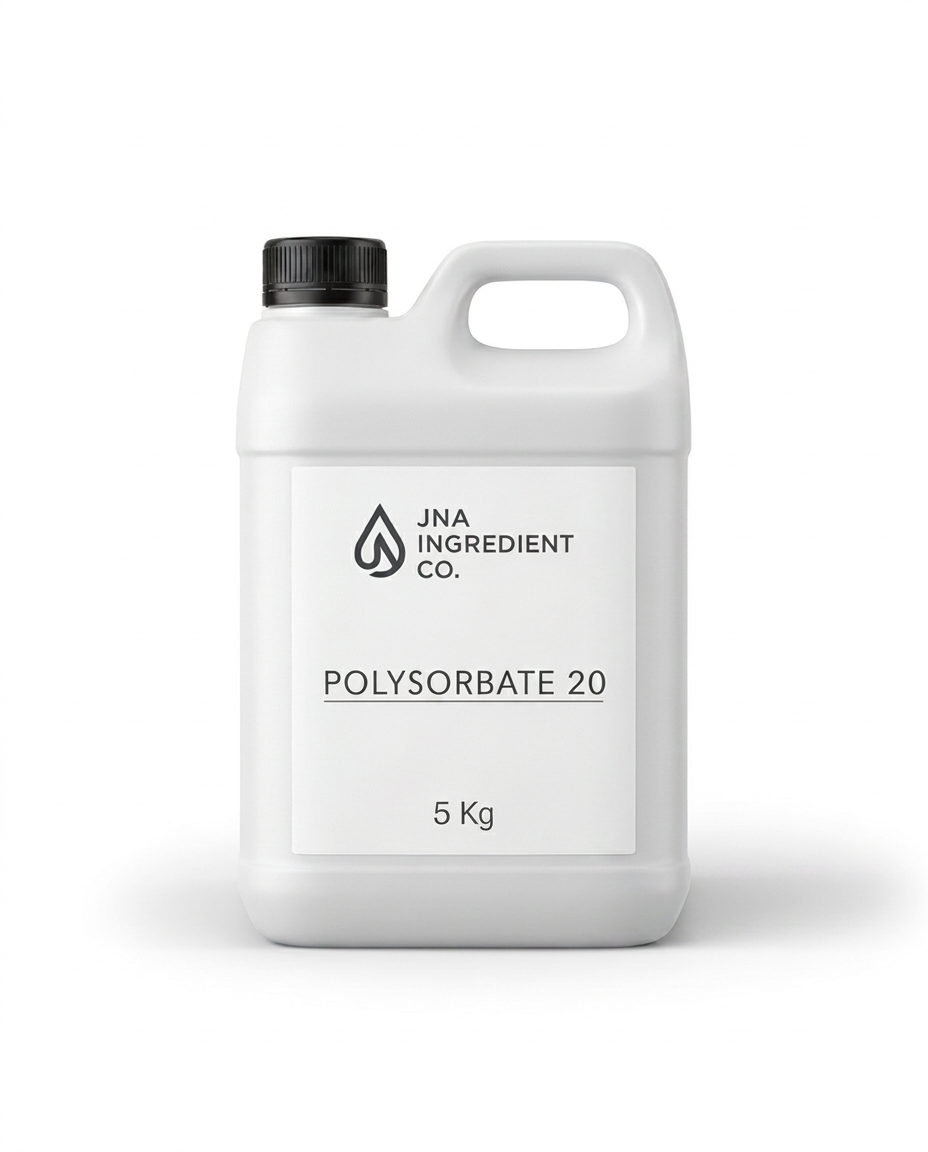
JNA Ingredient Co. Polysorbate 20 showcased in luxury minimalist bottle for emulsifying, dispersing, and stabilising cosmetic formulations
Polysorbate 20100 g Sale price$7.95
Australianowned & operated
Trusted byformulators
Quality ingredientsfor real results
Wholesale & bulk supply enquiriesTell us your ingredient, quantity and timeframe

Our Polysorbate 20

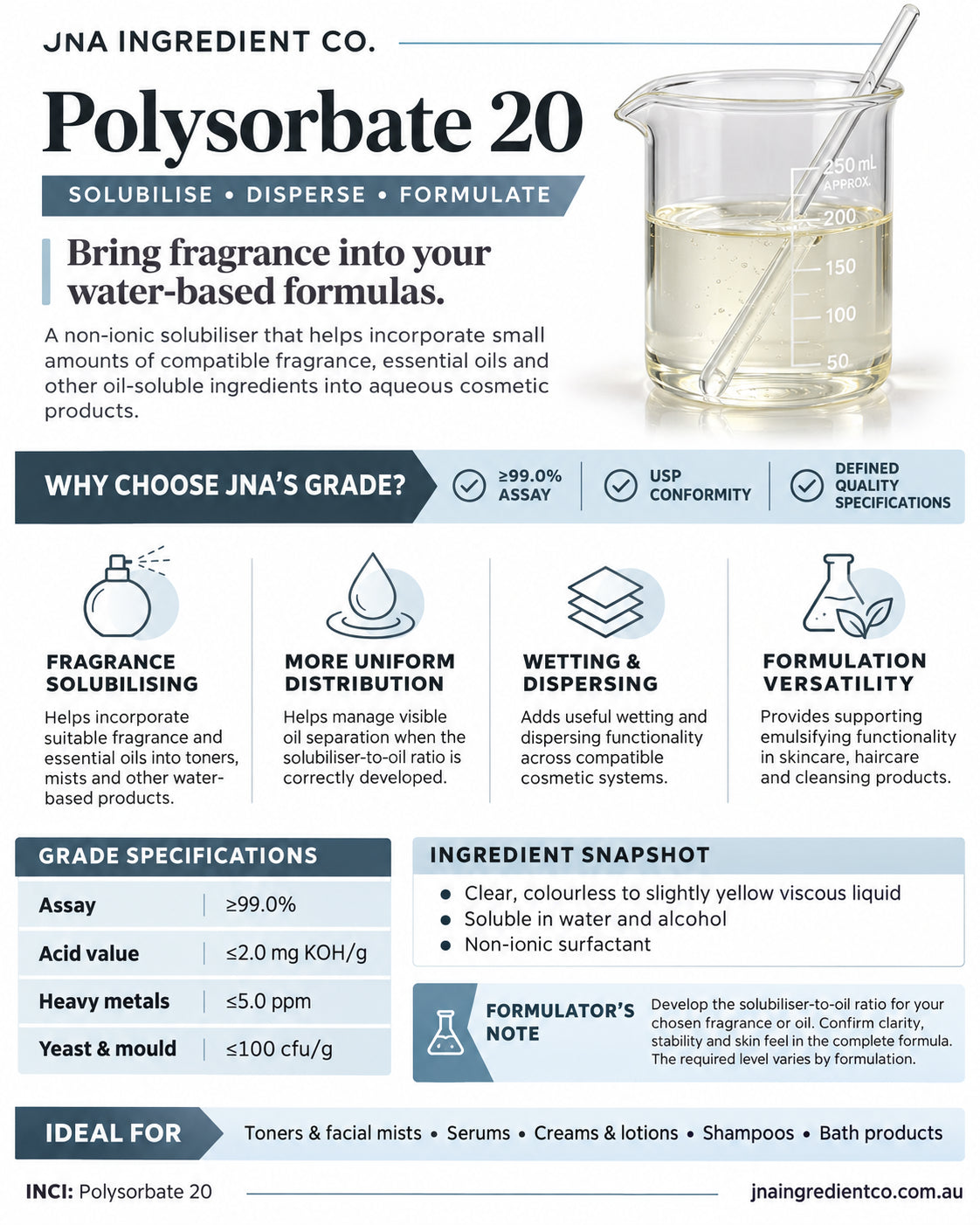
JNA’s Polysorbate 20 is a high-purity, non-ionic solubiliser with a minimum assay of 99.0% and documented conformity to the USP standard. It helps incorporate small amounts of fragrance, essential oils and other suitable oil-soluble ingredients into water-based products, making it a useful formulation tool for toners, facial mists, serums, shampoos and bath products.

By helping distribute these ingredients throughout the aqueous phase, Polysorbate 20 supports a more uniform formulation and helps manage visible oil separation. It also provides wetting, dispersing and supporting emulsifying functionality, extending its usefulness across skincare, haircare and cleansing systems.

JNA’s grade is supplied as a clear, colourless to slightly yellow, viscous liquid. Its specification includes controls for assay, acidity, oxidative stability, heavy metals and microbiological quality, giving formulators a defined technical basis for ingredient selection and repeat purchasing.

The amount required depends on the oil-soluble ingredient, its concentration and the desired finished appearance. Adjusting the solubiliser-to-oil ratio allows formulators to balance clarity, stability and skin feel during development.

Why choose JNA’s Polysorbate 20?

KEY SPECIFICATIONS

Know what you’re formulating with.

≥99.0%

Assay specification

INCI
Polysorbate 20
Otherwise known as
Polyoxyethylene (20) Sorbitan Monolaurate; Tween 20
CAS number
9005-64-5
Grade
Cosmetic grade - USP conforming
Appearance
Clear, colourless to slightly yellow, viscous liquid
Source
Vegetable-derived feedstock, processed through ethoxylation
Recommended use range
Enter your selected trial percentage. Required solubiliser-to-oil ratio depends on the oil-soluble material and loading; this calculator calculates quantity, not the required ratio.
Assay specification
≥99.0%
Solubility
Water soluble
  • Vegan Suitable

    No animal-derived materials used in manufacturing

  • Non-GMO

    Declared free from genetically modified organisms

  • No Animal Testing

    Declared Not tested on Animals

  • USP Conforming

    Conforms with USP standards

QUALITY · SOURCING · SAFE HANDLING

Selected for specification.

Ingredient name is the beginning. Specification is the difference.

We select our ingredients for the quality behind the name: the right grade, defined purity or composition, clear origin and consistent specifications.

Our focus is dependable ingredients, supported by clear technical information, that you can formulate with confidence and rely on for repeat production.

Need more information about this ingredient
Formulation & Processing

Processing

Pre-mix Polysorbate 20 with the fragrance, essential oil or other suitable oil-soluble ingredient, then gradually incorporate into the aqueous phase with thorough mixing. Assess the complete formulation, as a uniform premix does not necessarily produce a clear finished product.

Establish the level around the type and quantity of material being solubilised. Different fragrances and essential oils can require different solubiliser-to-oil ratios. Increase incrementally during small trials, checking appearance and skin feel rather than adding more indefinitely.

Observe for haze, surface droplets or separation after standing and during stability testing. Initial clarity is a useful development checkpoint, but does not establish long-term stability.

Compatibility

Its non-ionic character makes Polysorbate 20 useful across many aqueous and surfactant systems. Other ingredients and pH adjustments can affect clarity and stability.

pH guidance

Select the finished pH around the complete formulation, including the preservative system and any sensitive actives.

Troubleshooting

Premix looks uniform but the finished product turns cloudy
Evaluate the complete formulation before increasing Polysorbate 20. Other ingredients can change the behaviour of the solubilised system, so determine whether the haze appears only after a particular ingredient, pH adjustment or processing step.

Oil droplets appear on the surface after standing
The system may not contain enough solubiliser for the particular oil load, even if it appeared uniform immediately after manufacture. Increase Polysorbate 20 incrementally, remix and reassess after standing.

One fragrance works but another stays cloudy
Do not automatically reuse the same Polysorbate 20-to-fragrance ratio. Fragrance and essential-oil compositions vary considerably, so each new material should be bench tested and its solubiliser requirement optimised independently.

Formula is clear initially but develops haze during stability testing
Treat initial clarity as a starting point rather than proof of stability. Reassess the solubiliser ratio and complete formulation under the intended storage conditions if haze, droplets or separation develop over time.

Finished product feels heavier than expected
Check whether Polysorbate 20 has been increased beyond the level actually required to maintain the desired system. Optimising the oil load and solubiliser ratio can help avoid unnecessarily altering the sensory character of a lightweight aqueous product.

Excessive aeration or foam develops during processing
Reduce unnecessary high-speed agitation after the solubilised premix has been incorporated. Controlled mixing can help minimise air incorporation when working with this non-ionic surfactant.

Grade & analytical controls

Soluble in water and alcohol. Acid value: ≤2.0 mg KOH/g.

JNA’s Polysorbate 20 combines a minimum assay specification of 99.0% with documented USP conformity. Its quality specification extends beyond assay to include acidity, oxidative stability, heavy metals and microbiological acceptance criteria, providing a documented basis for raw-material assessment and repeat purchasing.

Peroxide value and tocopherol content are retained as routine oxidative stability control parameters. The trace tocopherol originates naturally from the vegetable feedstock and is not intentionally added as a separate antioxidant or stabiliser.

Heavy metals and microbiological quality are controlled to defined specifications.

Heavy metals and microbiological quality are controlled to defined specifications.

Vegetable-derived feedstock, processed through ethoxylation

Storage & shelf life

Store tightly closed in a cool, dry place, protected from direct sunlight and heat.

The documented shelf life is 24 months under the recommended storage conditions. Refer to the product label for the applicable expiry or retest date.

Handling & product safety

Use clean, dry dispensing equipment and reseal promptly after use. Avoid introducing water or other ingredients into the original container.

Supplied as a concentrated raw material for incorporation into formulations. Use appropriate protective equipment when handling. Refer to the SDS for safe handling, storage and first-aid guidance.

Documentation
Shipping & supply

Shipping charges and delivery options are confirmed at checkout. For supply quantities beyond the listed packs, contact JNA with your requirements.

View shipping information ↗
Need more information about this ingredient

FORMULATOR FAQ

Practical Questions About Formulating with Polysorbate 20

Polysorbate 20 FAQ

How much Polysorbate 20 do I need for fragrance or essential oils?

There is no universal ratio. The amount depends on the composition and concentration of the oil-soluble material and the complete formula. Run small trials, adjusting the solubiliser-to-oil ratio while checking clarity, skin feel and stability.

Why is my formulation still cloudy?

The solubiliser level, oil load or other ingredients may be affecting clarity. Compare the premix with the finished formulation to identify when haze develops. If additional Polysorbate 20 provides little improvement, reassess the oil load or consider another solubilising system.

Does Polysorbate 20 make essential oils water soluble?

It helps suitable essential oils remain incorporated within an aqueous system through solubilisation. It does not change the essential oil itself into a water-soluble ingredient. Performance depends on the particular oil, the ratio used and the complete formulation.

Should I choose Polysorbate 20 or Polysorbate 80?

Polysorbate 20 is commonly selected for fragrance and essential oils in water-based products. Polysorbate 80 is often considered for heavier oil components and different emulsification requirements. Trial the ingredient against your actual oil phase rather than assuming they are interchangeable.

Will adding more always improve clarity?

No. Additional Polysorbate 20 may eventually provide little improvement while increasing tack, weight or foaming. Aim for an effective level that balances appearance, stability and sensory performance.

Does a clear formulation still need stability testing?

Yes. Initial clarity does not establish long-term stability. Check for haze, surface droplets, separation and other changes over time under the intended storage conditions.

Ingredient shortlist

Your shortlist is empty. Bookmark ingredients to keep them here while you shop.